


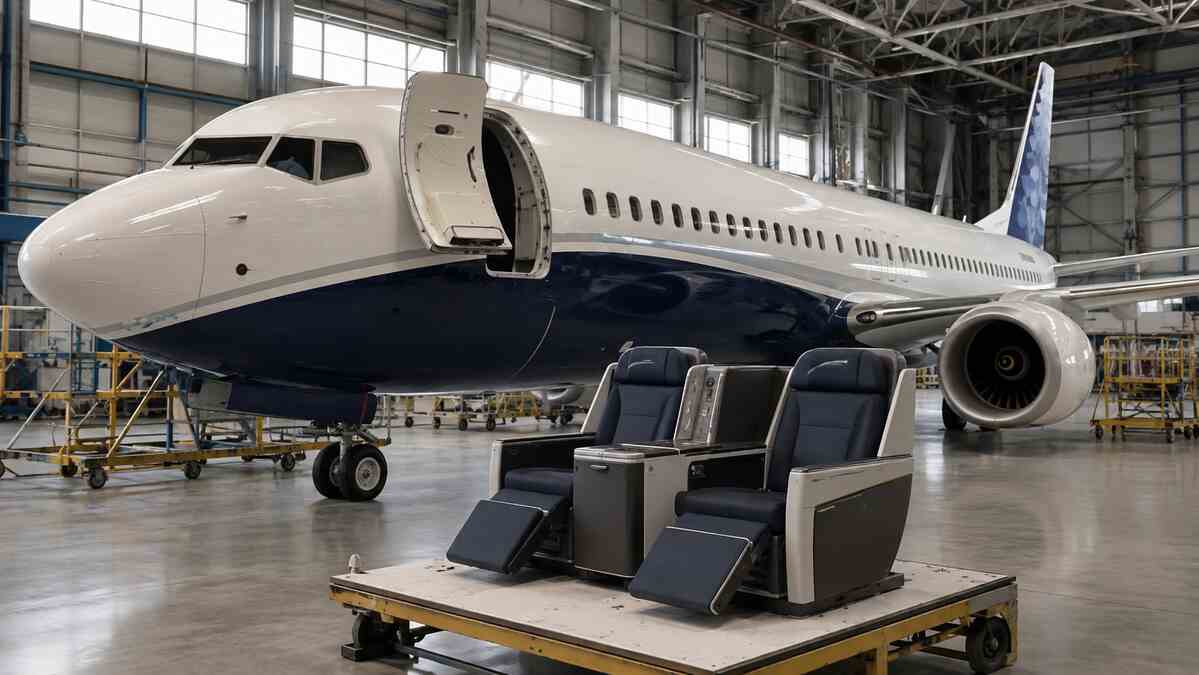
United Airlines is confronting a costly cabin-planning challenge as hundreds of lie-flat business-class seats intended for its delayed Boeing 737 MAX 10 fleet remain in storage. Although the aircraft is moving closer to regulatory approval, questions about its floor structure and mounting requirements could complicate the installation of United’s planned premium cabin.
The Chicago-based carrier originally viewed the MAX 10 as an important part of its premium narrowbody strategy. Selected aircraft were expected to operate high-value domestic routes, potentially replacing aging Boeing 757s while offering a more competitive business-class experience.
Premium MAX 10 Plans Face Structural Questions
United began evaluating lie-flat seating for the MAX 10 several years ago. In 2018, then-United President Scott Kirby said the airline was testing lie-flat seats for the aircraft.
The concept eventually developed into a dedicated premium subfleet with approximately 22 lie-flat seats arranged in a 1-1 configuration, giving every passenger direct aisle access. At one stage, United reportedly considered installing the cabin on as many as 50 MAX 10 aircraft.
Such a rollout would have required more than 1,100 seats, excluding additional units needed as operational spares.
The aircraft were expected to serve premium domestic markets such as Newark Liberty International Airport to Los Angeles International Airport and San Francisco International Airport to Washington Dulles International Airport.
However, certification delays affecting the MAX 10 have forced United to reconsider how the aircraft—and the seats purchased for it—will be deployed.
Hundreds of Seats Remain in Storage
United CEO Scott Kirby recently told CNBC that the carrier has a large number of lie-flat seats in storage because they do not fit other aircraft in its fleet.
Aircraft seats cannot be transferred freely between models, even when the planes belong to the same broad narrowbody category. Installation depends on seat-track positions, cabin curvature, floor strength, attachment points, electrical systems and the angle at which each seat is installed.
Regulators must also approve the complete installation, not merely the seat itself. That means a seat that meets crashworthiness and passenger-protection standards may still require additional certification before it can be used in a particular aircraft layout.
United therefore cannot simply move the stored seats into its Airbus narrowbody fleet.
Airbus Coastliner Program Offers an Alternative
United has shifted part of its premium transcontinental strategy toward the Airbus A321neo. Its planned Coastliner configuration will include 20 Polaris suites, 12 Premium Plus seats and 129 economy seats.
The airline expects 40 of its first 50 Coastliner aircraft to be operating by early 2028. The program will provide a higher-capacity premium product for selected long-distance domestic routes, reducing some of the pressure on the MAX 10 to perform every role originally envisioned for it.
The stored MAX 10 seats reportedly do not fit the Coastliner configuration, leaving United with limited options for repurposing them.
MAX 10 Certification Nears Completion
The MAX 10 has faced repeated delays since its originally planned introduction in 2020. Boeing completed the aircraft’s final planned certification flight on July 28, 2026, after 976 flights and more than 2,060 flight hours.
Boeing expects certification in 2026, followed by initial deliveries in 2027. United retains firm orders for 167 MAX 10 aircraft, with its current schedule providing for as many as approximately 20 deliveries in 2027.
Most of those aircraft could use United’s standard domestic configuration, reportedly consisting of 20 first-class recliners, 64 Economy Plus seats and 105 standard economy seats.
Engineering Changes Could Raise Costs
If the MAX 10’s floor beams or attachment points cannot support United’s proposed lie-flat layout, the airline and Boeing may need to revise the installation.
Possible solutions could include reinforced floor sections, revised fittings, load-spreading structures, lower-weight seats, altered seating angles or relocated attachment points. Each option could require further engineering analysis, testing and regulatory approval.
Lie-flat seats are heavier and mechanically more complex than conventional recliners. During an emergency landing, the seats can transfer substantial loads into the aircraft floor, making their precise positioning and attachment critical.
The reported issue does not mean lie-flat seating is impossible on the 737 MAX. Flydubai and Copa Airlines already operate flat-bed products on smaller MAX variants. Instead, the concern appears to involve United’s specific seat design, layout and installation method on the larger MAX 10.
United May Need to Revise Its Premium Strategy
United could continue seeking approval for the original configuration if the necessary modifications are technically and economically manageable. Alternatively, it could redesign the cabin or operate more MAX 10 aircraft with standard domestic first-class seats.
Delta Air Lines faced a comparable disruption when certification problems affected its planned premium Airbus A321neo cabin. Delta temporarily installed domestic first-class recliners in the unused space before selecting a different lie-flat product for future aircraft.
United’s situation is different because its seats are reportedly approved, while the outstanding concern involves their installation. Still, both cases demonstrate how seating certification can disrupt aircraft deployment and delay premium-cabin strategies.
The MAX 10 may soon clear its principal certification hurdle, but that milestone will not automatically solve United’s seating problem. The airline must now determine whether its original lie-flat cabin can be installed without extensive structural changes—or whether the stored seats will become an expensive reminder of a fleet plan overtaken by years of delays.
