


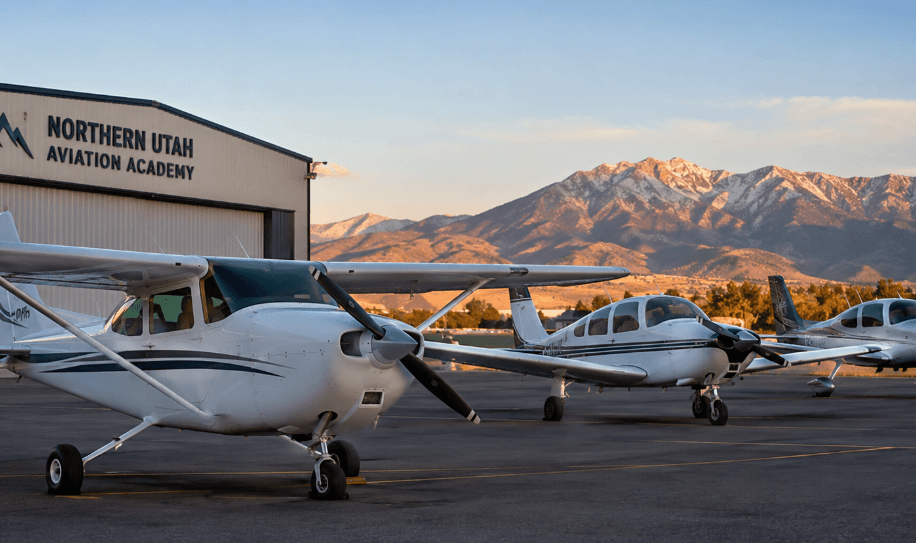
Northern Utah Aviation Academy (NUAA) is recruiting a founding Chief Flight Instructor to oversee the development of its planned Federal Aviation Administration (FAA) Part 141 pilot training program. The initiative will establish a structured flight training operation across two northern Utah airports, supporting the academy’s efforts to expand professional pilot education and aviation workforce development.
Announced on October 12, 2026, the recruitment effort focuses on building a training program at Ogden-Hinckley Airport (KOGD) and Brigham City Airport (KBMC). The selected instructor will play a central role in developing the academy’s training standards, managing flight operations, and coordinating with federal aviation regulators.
Northern Utah Aviation Academy Plans FAA Part 141 Flight Training Program
The academy currently provides flight instruction under FAA Part 61 regulations, which allow students to pursue pilot certifications through flexible training arrangements.
NUAA is preparing to establish a Part 141 program, which operates under FAA-approved training curricula and requires additional oversight, documentation, and instructional standards.
According to the academy, its Part 141 certification process remains in the pre-application stage.
The founding Chief Flight Instructor will be responsible for developing the operational and instructional framework needed to support the academy’s application and eventual certification.
Chief Flight Instructor to Lead Training Development
The position includes responsibility for creating Part 141 training syllabi, establishing stage-check procedures, maintaining student training records, and implementing instructor standardization practices.
The successful candidate will also oversee daily flight training operations, recruit and mentor flight instructors, and help maintain consistent instructional standards across both airport locations.
Another major responsibility will involve serving as the academy’s primary contact with the FAA throughout the Part 141 approval process.
This role will place the instructor at the center of NUAA’s transition from its existing Part 61 operations toward a more structured professional pilot training environment.
Chief Flight Instructor Qualifications and Experience Requirements
NUAA is seeking an experienced aviation professional with the certifications, flight experience, and instructional background required to lead the proposed training program.
Minimum Qualifications
Applicants must meet the following requirements:
-
Hold a commercial pilot certificate or Airline Transport Pilot (ATP) certificate, with ATP certification preferred.
-
Possess Certified Flight Instructor (CFI) and Certified Flight Instructor-Instrument (CFII) credentials.
-
Have at least 1,000 hours of pilot-in-command flight time.
-
Demonstrate a minimum of two years of flight instruction experience.
-
Meet the FAA chief instructor qualifications established under 14 CFR 141.35.
A Multi-Engine Instructor (MEI) rating is considered an additional advantage.
Preferred Aviation Experience
The academy also favors candidates with previous experience as a chief or assistant chief flight instructor.
Other preferred qualifications include experience developing FAA Part 141 programs, familiarity with Garmin G1000 avionics or other glass-cockpit systems, and practical experience operating aircraft in mountainous terrain and high-density-altitude conditions.
These operational skills are particularly relevant in northern Utah, where airport elevation, mountainous surroundings, and seasonal weather conditions can influence aircraft performance and flight training.
Flight Training Operations to Span Two Northern Utah Airports
NUAA plans to organize its expanded flight training activities around two airports serving the region.
Ogden-Hinckley Airport to Serve as Primary Training Base
Ogden-Hinckley Airport will function as the academy’s principal flight training location.
Situated near Ogden, north of Salt Lake City, the airport provides access to northern Utah’s aviation infrastructure and regional airspace.
Brigham City Airport will operate as a secondary training location, supporting aircraft operations, instructional routes, and future fleet development.
The two-airport arrangement is intended to provide additional operational flexibility as the academy develops its professional pilot training activities.
NUAA Training Fleet Includes Cessna, Piper and Cirrus Aircraft
Northern Utah Aviation Academy currently operates three aircraft models to support different stages of pilot education.
Its training fleet includes the Cessna 172S Skyhawk, Piper Archer TX, and Cirrus SR22.
These aircraft support instruction in several areas, including private pilot certification, instrument ratings, commercial pilot training, and aircraft transition training.
The combination of aircraft provides students with exposure to different cockpit configurations, flight characteristics, and avionics systems as they progress through their training.
Academy Pursues University Pilot Degree and Aircraft Maintenance Programs
Beyond its planned Part 141 certification, NUAA is developing additional aviation education opportunities.
The academy is working toward a university-integrated professional pilot degree pathway in collaboration with a Utah higher education institution.
The proposed arrangement would connect academic education with practical flight training, potentially allowing students to pursue college-level studies alongside professional pilot qualifications.
NUAA is also pursuing an FAA Part 147 aircraft maintenance technician training program.
Part 147 programs are designed to prepare students for careers in aircraft maintenance through FAA-regulated aviation maintenance education.
Together, these initiatives reflect the academy’s plans to develop training opportunities for both pilots and aircraft maintenance professionals.
Northern Utah Aviation Academy Focuses on Long-Term Training Expansion
The recruitment of a founding Chief Flight Instructor represents an important step in Northern Utah Aviation Academy’s planned expansion.
With Part 141 certification still in its early stages, the academy’s immediate priorities include establishing standardized training procedures, building its instructional leadership, and preparing for FAA review.
The proposed two-airport operation, university-connected pilot education pathway, and aircraft maintenance training initiative could broaden aviation education opportunities in northern Utah as NUAA advances its development plans.
