


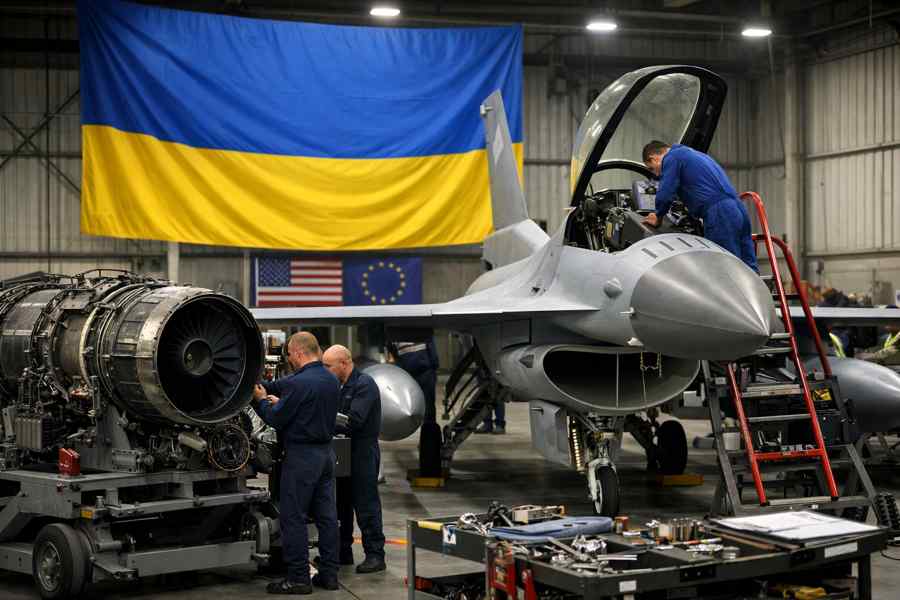
**BRUSSELS—**The U.S. Department of Defense has awarded a multi-year contract to Belgium-based Sabena Aerospace to provide engine and depot-level maintenance for European F-16 fighter jets destined for operations with Ukraine’s air force, underscoring Washington’s focus on long-term sustainment as Kyiv integrates advanced Western aircraft into combat service.
The agreement, issued by the U.S. Department of Defense, funds intermediate and depot-level maintenance as well as materials support for donated F-16s. Contract data released on Jan. 29, 2026, show that nearly $70 million has already been obligated against a total ceiling of $235 million, with work scheduled to be performed at Sabena Aerospace’s facilities in Brussels for at least three years.
Sustainment Focus as F-16 Operations Expand
Ukraine began operating F-16s in August 2024, marking a significant upgrade to its air combat capabilities. While pilot training and aircraft delivery have drawn the most attention, U.S. officials and allied planners have emphasized that sustaining high-tempo operations requires robust industrial maintenance networks well beyond what frontline units can provide.
The Sabena contract centers on intermediate and depot-level maintenance—categories that include complex inspections, repairs, and overhauls that exceed routine field maintenance. These services are critical as aircraft fly frequent sorties in contested environments, accelerating wear on engines and airframes.
Sabena Aerospace brings more than five decades of experience supporting Belgian military aviation and maintains a diverse fleet that has included A400M, C-130, Alphajet, A109, Mirage, and A-10 platforms. The company has also signaled interest in future European F-35 and SkyGuardian programs. Sabena declined to comment publicly on operational details of the new agreement.
European Donations Drive Fleet Growth
The maintenance award coincides with a steady expansion of European F-16 donations as NATO members retire legacy fleets in favor of the F-35 Lightning II. Confirmed commitments include 30 aircraft from Belgium, 19 from Denmark, 24 from the Netherlands, and 14 from Norway—one of the most substantial upgrades to Ukraine’s air power since the conflict began.
At a Ramstein meeting in October 2025, former Ukrainian Defence Minister Denys Shmyhal highlighted the role of F-16s in coordinating with ground-based air defense systems. Ukrainian authorities later reported that the aircraft intercepted and destroyed most of the 35 cruise missiles launched during a large Russian strike in December 2025, demonstrating early operational impact.
Additional Fighters on the Horizon
Beyond F-16s, Ukraine expects to receive other Western fighter aircraft to diversify its air combat capabilities. Defence Minister Mykhailo Federov has announced anticipated deliveries of French Mirage 2000 fighters and at least 100 Swedish JAS 39 Gripen aircraft.
Ukrainian officials are also exploring local production of British-made components used in the Gripen. Manufacturer Saab has said roughly 35 percent of Gripen components originate from U.K. suppliers, creating potential pathways for industrial cooperation.
Each platform offers distinct advantages: the F-16’s multirole flexibility and payload capacity, the Mirage-2000’s strength in high-speed interception, and the Gripen’s agility and relatively simple maintenance requirements. Together, a mixed fleet could complicate Russian air and missile defense planning while improving overall combat effectiveness.
Maintenance Infrastructure as a Strategic Enabler
Defense analysts note that aircraft donations alone do not ensure combat readiness. Sustainment contracts such as the Sabena award provide the backbone for availability by guaranteeing access to spare parts, engine support, and deep maintenance expertise.
As Ukraine integrates multiple fighter types, industrial hubs across Europe and North America are expected to play an increasingly central role in sustaining operations over the long term—often far from the front lines but essential to daily sortie generation.
The Enduring Relevance of the F-16
The F-16 Fighting Falcon, produced by Lockheed Martin, remains one of the most widely operated fighter jets in the world, with more than 3,100 aircraft flying in 29 countries and over 19.5 million flight hours logged. The latest Block 70/72 configuration incorporates advanced radar, cockpit upgrades, extended service life, and safety systems designed to keep the aircraft relevant through 2060 and beyond.
For Ukraine, the combination of donated aircraft and sustained industrial support signals a shift from short-term assistance to a longer-term effort to build a resilient, Western-integrated air force—one that can remain operational under the pressures of modern, high-intensity warfare.
