


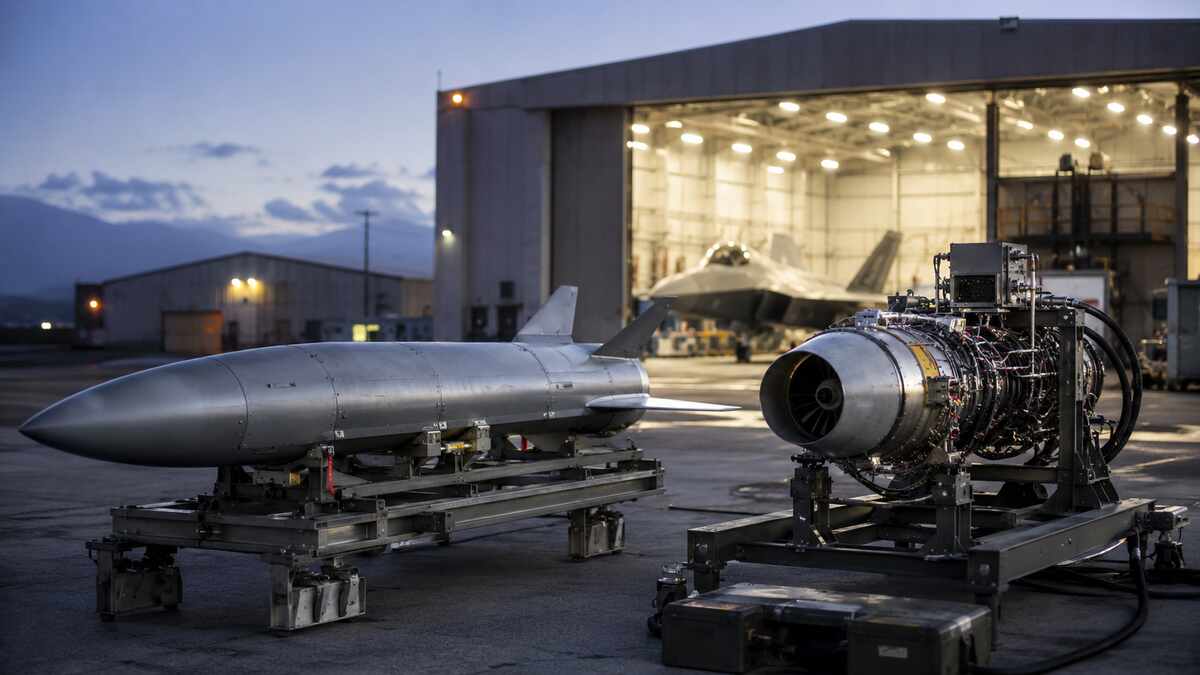
The U.S. Air Force has awarded GE Aerospace and Kratos Defense & Security Solutions an engineering, manufacturing and development contract for a new propulsion option for the Joint Air-to-Surface Standoff Missile. The award advances the GEK800 engine—now officially designated the F143-ZZ-100—as a potential second source for the long-range missile program.
The contract represents an important step toward qualifying the compact turbofan for production while expanding domestic capacity to manufacture affordable military engines at scale. It also supports broader Pentagon efforts to strengthen supply chains for cruise missiles, drones and autonomous aircraft.
F143 Engine Enters Next Phase of JASSM Program
The F143-ZZ-100 is an 800-pound-thrust turbofan designed for long-range missiles and uncrewed aircraft. GEK800 remains the development name used by GE Aerospace and Kratos, while F143-ZZ-100 is its formal military designation.
Under the Air Force award, the engine will move into the engineering, manufacturing and development phase as an alternative propulsion source for JASSM. Establishing a second supplier could increase production flexibility, reduce reliance on a single engine source and strengthen the resilience of the missile supply chain.
The small-engine design is intended to combine performance, affordability and scalable manufacturing. Those priorities have become increasingly important as the Department of Defense seeks larger inventories of long-range weapons and autonomous systems without allowing propulsion costs or manufacturing limitations to restrict production.
Development Builds on Ground and Altitude Testing
GE Aerospace and Kratos began collaborating on the GEK800 in 2023. The companies supported the effort with internal investment and assistance from the U.S. Air Force Research Laboratory during the Technology Maturation and Risk Reduction phase.
The partners subsequently completed more than 50 successful ground-engine starts at their testing facilities. The program advanced to altitude testing at Purdue University’s Maurice J. Zucrow Laboratories in 2025.
That campaign gathered performance data under a range of simulated operating conditions. The results supported the engine’s technical maturation and helped prepare the design for its transition into the current development stage.
Partnership Targets Affordable, High-Rate Manufacturing
GE Aerospace brings extensive experience in propulsion engineering, testing and large-scale manufacturing. Kratos contributes expertise in developing relatively low-cost engines for drones, missiles and other uncrewed platforms.
The companies are seeking to connect rapid engine development with a production model capable of delivering propulsion systems in large quantities. That industrial strategy is central to the Air Force’s broader effort to rebuild U.S. manufacturing capacity for compact military turbofans.
GE Aerospace and Kratos formalized a broader teaming agreement in 2025 covering the development, manufacturing, testing and potential fielding of the GEK800 and other low-cost expendable turbofan engines. The agreement expanded an earlier memorandum of understanding between the companies.
GEK800 Technology Supports Other Engine Programs
The GEK800 is being developed as part of a wider family of propulsion systems rather than as a single-purpose engine. Technical lessons from its development and altitude testing are also contributing to the GEK1500, a 1,500-pound-thrust engine intended for small Collaborative Combat Aircraft and other uncrewed platforms.
In February 2026, the Air Force awarded GE Aerospace and Kratos a $12.4 million contract to complete the GEK1500’s preliminary design. The larger engine is expected to pursue demanding performance and cost targets suitable for high-volume production.
GE426 Addresses Medium-Thrust Autonomous Aircraft
GE Aerospace is separately advancing the GE426 for the Air Force’s medium-thrust Autonomous Collaborative Platform initiative. The company received a contract on May 19, 2026, to move the engine through preliminary design review.
The GE426 is intended for autonomous combat aircraft capable of operating in coordinated formations with crewed military planes. It complements the GEK800 and GEK1500 by addressing a different thrust category and mission profile.
F143 Designation Clarifies Path Toward Qualification
The F143-ZZ-100 designation and development contract give the GEK800 a clearer path from technology testing toward a production-ready propulsion capability for JASSM.
For the Air Force, the program could provide both an additional missile-engine source and greater domestic manufacturing capacity. For GE Aerospace and Kratos, it offers an opportunity to demonstrate that a common development approach can support several classes of affordable military propulsion.
The GEK800 is focused on long-range missiles and uncrewed systems, while the GEK1500 extends the technology into higher-thrust applications. The GE426 adds another track for medium-thrust autonomous combat aircraft, creating a broader engine portfolio for emerging U.S. defense requirements.
