


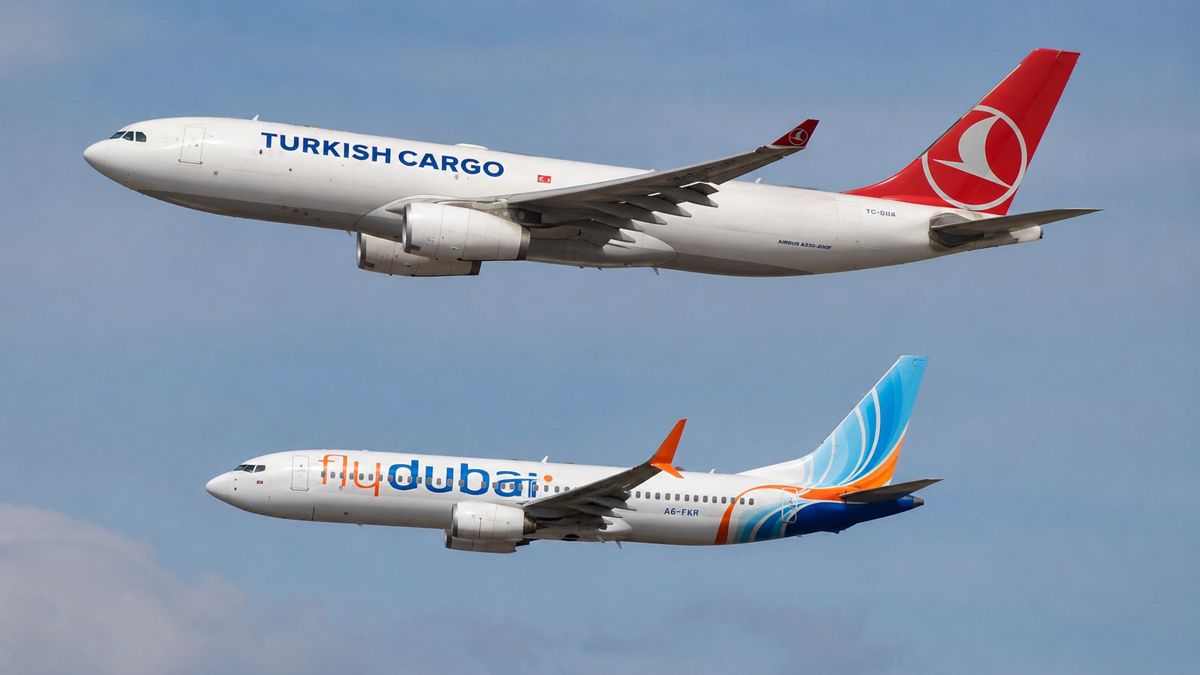
Indian Investigators Cite Cockpit Misinterpretation and Lack of Cross-Verification in Mumbai Airspace Incident
Indian aviation investigators have determined that a Turkish Airlines Cargo Airbus A330 freighter climbed without air traffic control clearance, triggering a loss of separation event involving a Flydubai Boeing 737 MAX 9 over western India last year.
The incident, which occurred inside Mumbai’s flight information region on Aug. 30, 2025, brought the two aircraft within less than 1,000 feet of vertical separation, according to findings released by India’s Aircraft Accident Investigation Bureau (AAIB).
The Turkish Airlines Cargo flight, operated by an Airbus A330-200F registered TC-JOO, was traveling from Chennai International Airport to Istanbul Airport. The Flydubai service, operated by a Boeing 737 MAX 9 registered A6-FKR, was flying from Dubai International Airport to Calicut International Airport.
At the time of the incident, the Flydubai aircraft was cruising at 35,000 feet with 173 passengers and crew onboard, while the Turkish cargo jet was maintaining 34,000 feet on the adjacent flight level.
AAIB Investigation Details
Unauthorized Climb Triggered Airprox Event
According to the AAIB report, the sequence began after the Turkish Airlines flight had reached cruise altitude. The aircraft captain then entered a controlled rest period, leaving the first officer as the pilot flying.
The first officer subsequently requested clearance from air traffic control to climb from 34,000 feet to 36,000 feet. Controllers denied the request because of nearby traffic and replied, “Unable due to traffic.”
The aircraft continued at its assigned altitude until the first officer later noticed an illuminated blue ATC message indicator light inside the cockpit.
Investigators said the officer mistakenly interpreted the light as confirmation that the climb request had been approved. However, the light only indicated the presence of a message and did not signify authorization from controllers.
Believing clearance had been granted, the first officer initiated the climb without further verification.
Traffic Advisories Activated on Both Aircraft
Flydubai Jet Was Positioned Ahead of Turkish Freighter
The AAIB report stated that the Flydubai Boeing 737 MAX 9 was approximately three nautical miles ahead of the Turkish freighter and offset about two nautical miles to the right when the unauthorized climb began.
As the aircraft converged, onboard collision avoidance systems generated Traffic Advisory alerts on both aircraft.
The captain of the Turkish Airlines Cargo flight then resumed control and checked the aircraft communication display. Investigators said he found only the original climb request, with no evidence that any climb clearance had been issued.
The captain then attempted to confirm the clearance through voice communication with air traffic control. After an initial unsuccessful attempt, controllers later confirmed during a second exchange that no climb authorization had been granted and instructed the Turkish aircraft to reduce speed.
Both aircraft eventually continued safely to their destinations without further incident.
Additional Separation Events Identified
Other Aircraft Also Affected During Incident
The AAIB investigation also revealed that the Turkish Airlines Airbus A330F experienced additional loss-of-separation events during the same occurrence involving other nearby traffic.
Investigators identified affected aircraft as a Qatar Airways Airbus A320 and an Emirates Boeing 777-300ER operating in the same airspace sector.
According to aviation publication FlightGlobal, investigators identified two primary causes behind the event: the “absence of required cross-verification” and “misinterpretation of the message light.”
The findings highlighted concerns about cockpit coordination procedures, particularly during periods when one pilot is in controlled rest.
Safety Recommendations Issued to Turkish Airlines
Investigators Call for Enhanced Communication Procedures
Following the investigation, the AAIB recommended that Turkish Airlines strengthen cockpit communication and verification procedures related to controller-pilot data link communications.
The agency also advised the airline to revise its operational manuals to discourage significant flight path or altitude changes during controlled rest periods unless operationally necessary.
Investigators emphasized that any major flight level changes should include mandatory cross-checking procedures to reduce the risk of communication errors and improve flight deck coordination.
Aircraft Background
According to aviation analytics company Cirium, the Airbus A330-200F involved in the incident entered service with Turkish Airlines in 2018 after previously operating with Malaysia Airlines between 2012 and 2017.
The Flydubai Boeing 737 MAX 9 entered commercial service in 2023 and remains part of the airline’s expanding narrowbody fleet.
