


United Airlines Raises Fees Amid Fuel Cost Pressure
CHICAGO — United Airlines has increased checked baggage fees across a wide range of routes, citing rising global jet fuel costs tied to geopolitical instability in the Middle East. The Chicago-based carrier said the new pricing took effect April 3 and applies to domestic routes as well as flights to Mexico, Canada, and Latin America.
The move marks the airline’s first baggage fee increase in two years and reflects mounting pressure across the aviation industry as oil price volatility drives up operating costs. United, which operates major hubs including Chicago O’Hare International Airport, joins a growing list of carriers adjusting ancillary fees to protect margins.
The fee hike comes at a time when airlines are balancing higher expenses without significantly altering flight capacity or base ticket pricing, a strategy widely observed across the sector.
New Baggage Pricing Structure Takes Effect
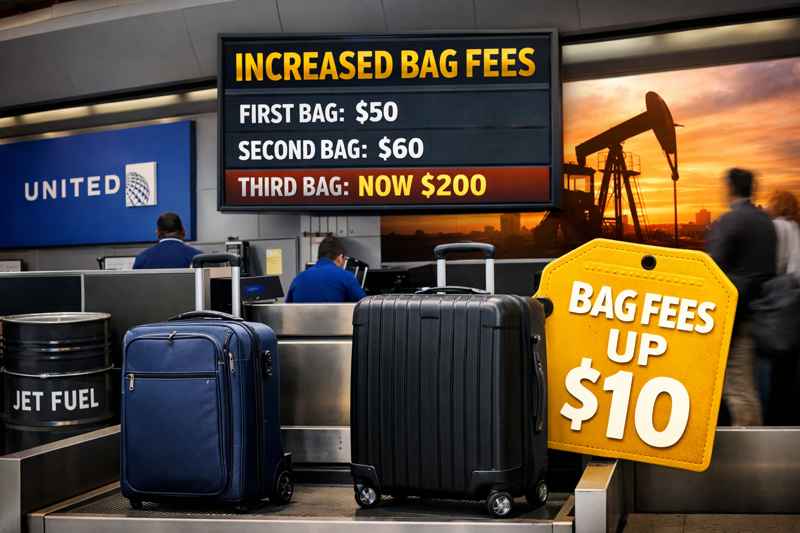
Under the revised pricing, United has raised fees for the first and second checked bags by $10. The updated structure sets the maximum cost of a first checked bag at $50 and a second at $60.
Fees for additional luggage have risen more sharply. A third checked bag now costs $200, up from $150, representing a $50 increase.
Despite the higher fees, United continues to offer a $5 discount for passengers who prepay for checked baggage online at least 24 hours before departure. The airline also maintains exemptions for certain customer groups, including members of its MileagePlus program, holders of United-branded Chase credit cards, active-duty military personnel, and premium cabin passengers, all of whom can still check bags without additional charges.
United confirmed that the pricing changes were implemented without prior notice, a tactic sometimes used by airlines to respond quickly to rapidly shifting cost conditions.
Industry analysts note that baggage fees remain a critical source of ancillary revenue, particularly during periods when fuel prices compress airline profitability.
Industry Trend Context
United’s decision follows a similar move by JetBlue Airways, which recently raised its checked baggage fees across both peak and off-peak travel periods. The sequence of increases highlights a broader industry trend of leveraging add-on fees to offset rising operational costs.
Rather than cutting routes or reducing flight frequency, many carriers are turning to ancillary revenue streams such as baggage, seat selection, and onboard services to maintain financial stability.
Fuel costs have surged globally, driven in part by geopolitical tensions and supply uncertainties. Airlines, which are highly sensitive to oil price fluctuations, have been forced to reassess both cost structures and pricing strategies.
According to PYOK, United’s CEO has previously suggested that oil prices could remain elevated, potentially peaking near $175 per barrel and staying above $100 per barrel for several years.
Such projections have prompted airlines to adopt a cautious approach, combining incremental revenue increases with selective cost controls.
Outside the United States, some carriers in Europe and Asia have responded by trimming flight schedules to reduce fuel consumption. United, however, has so far avoided broad network reductions, though it has indicated that unprofitable routes could be adjusted if conditions worsen.
Impact on Travelers
For passengers, the immediate effect is clear: higher costs for checked luggage starting April 3. Travelers who check multiple bags will feel the most significant impact, particularly due to the steep increase in fees for third and additional items.
Those who plan ahead may be able to reduce costs by prepaying for baggage online. However, for many leisure travelers and infrequent flyers, the higher fees represent an added expense that could influence travel decisions.
Frequent flyers and premium customers are largely shielded from the changes due to existing baggage benefits, reinforcing airlines’ broader strategy of rewarding loyalty while increasing revenue from occasional travelers.
The adjustments underscore a growing divide in airline pricing models, where base fares remain competitive but additional services carry increasing costs.
As fuel prices continue to fluctuate, further changes to airline fee structures may follow, making ancillary charges an increasingly important factor in the total cost of air travel.
