


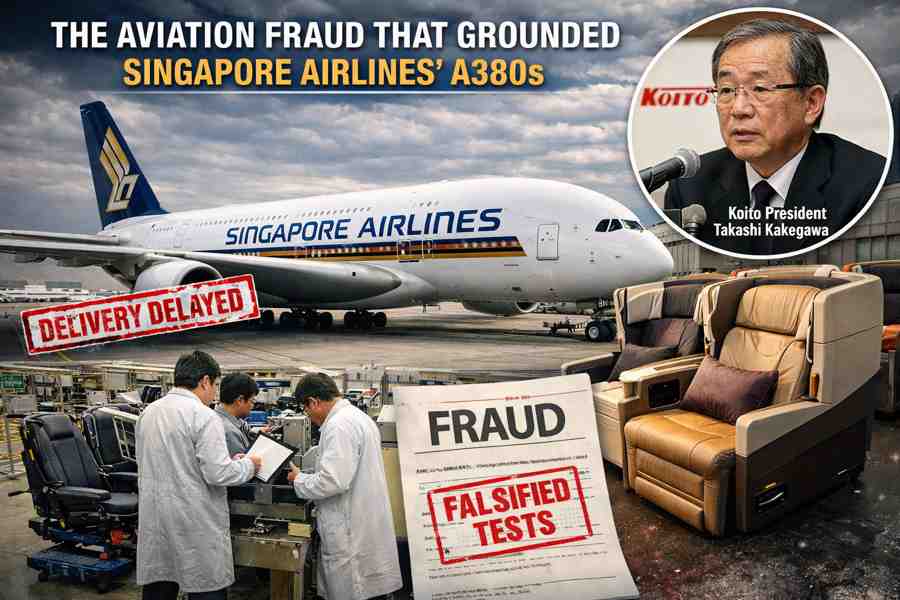
SINGAPORE — A sweeping aviation fraud involving falsified safety tests by Koito Industries disrupted aircraft deliveries around the world in 2009–2010, delaying new jets for Singapore Airlines and forcing regulators to re-examine more than 150,000 aircraft seats across global fleets.
The scandal, which unfolded amid heightened scrutiny of aviation safety following the global financial crisis, centered on Koito’s long-running practice of fabricating certification data for aircraft seats. Regulators later determined that the misconduct spanned roughly 15 years and affected about 1,000 aircraft operated by 32 airlines in 24 countries.
A Flagship Aircraft Left Waiting
The impact on Singapore Airlines was immediate and highly visible. In late 2009, the carrier’s 11th Airbus A380, tail number 9V-SKK, sat fully completed but undelivered at Toulouse Airport. The aircraft, intended to join the fleet in January 2010, featured Koito-manufactured Business Class seats that were central to the airline’s premium brand strategy.
Delivery was postponed by six months—not due to Airbus production issues, but because regulators suspended approvals for Koito seats amid growing concerns about certification integrity. By that point, Singapore Airlines had installed more than 1,800 Koito Business Class seats across its A380, A340, and Boeing 777 fleets, along with First Class seats on newer 777-300ER aircraft.
Early Warnings and Regulatory Escalation
The scandal began quietly in early 2009 when Japan Civil Aviation Bureau issued a verbal warning to Koito after discovering uncertified seat fabrics supplied to Japan Airlines. What appeared to be a limited compliance lapse soon raised broader questions about Koito’s manufacturing controls and testing records.
European regulators soon intervened. In September 2009, the European Union Aviation Safety Agency withdrew Koito’s Production Organisation Approval, halting production of seats for Airbus aircraft worldwide. EASA spokesman Dr. Daniel Höltgen said, “Our withdrawal of the POA is what I would describe as an emergency measure. EASA’s directive applies to all Airbus planes, even if they are flown outside Europe.”
That decision effectively stranded Singapore Airlines’ A380 in Toulouse and triggered a global review of already installed seats.
A Public Confession in Tokyo
On February 8, 2010, Koito President Takashi Kakegawa publicly acknowledged deliberate falsification of safety data. He stated, “Fraudulent acts were conducted across the organization.
Our wrongful acts concerning seats for aircraft severely impair our credibility as an enterprise that engages in aviation related business, and we feel remorse for, and sincerely apologise for, having caused considerable inconvenience and concern to customers and other parties.”
He added, “The whole section in charge was systematically involved in it.”
JCAB official Shigeru Takano confirmed the depth of the misconduct, saying, “Fraudulent acts can be traced back to the mid-1990s, as far back as we have records. It was an organizational fraud, as such conduct has been found in multiple divisions.”
How the Fraud Worked
Investigators later found Koito had cheated on multiple certification requirements, including crashworthiness, flammability, and structural integrity tests. Techniques ranged from recycling data from unrelated seat models to forging regulatory stamps and manipulating test software readouts. Unauthorized materials were also substituted during production.
The Federal Aviation Administration characterized the scale as unprecedented. FAA spokesman Les Dorr Jr. said, “The scope and the extent of these activities are not like anything we have observed before.”
Costly Consequences for Singapore Airlines
For Singapore Airlines, the fallout meant delayed aircraft, halted cabin refits, and broken promises to premium passengers. Three additional A380 deliveries were postponed, and a major Boeing 777 refit program stretched to nearly two years instead of months. The airline ultimately received about S$79 million in compensation from Boeing and Koito—far short of covering operational disruption and reputational damage.
A company spokesman said in February 2010, “We are working closely with Koito, the aircraft manufacturers and relevant regulatory authorities. We expect the issues will be resolved soon,” a statement that proved optimistic as regulatory reviews dragged on.
An Industry-Wide Reckoning
Globally, airlines including Japan Airlines, All Nippon Airways, and Thai Airways faced grounded aircraft and delivery delays. Thai Airways later won more than US$107 million in damages. Regulators imposed long compliance timelines, with some Koito seats allowed to remain in service for years under strict monitoring.
Despite millions of passengers having flown on uncertified seats, no accidents or injuries were linked directly to the failures. As Runway Girl Network later observed, “The Koito scandal is widely considered the most serious deception ever to beset the aircraft interiors sector, and many insiders still scratch their heads over how it could have gone unnoticed, seemingly for several years, by the Japan Civil Aviation Bureau.”
Koito has since exited the aircraft seat business entirely. The episode remains a stark reminder that even in one of the world’s most tightly regulated industries, systemic deception can persist—until a single grounded aircraft brings it to light.
