


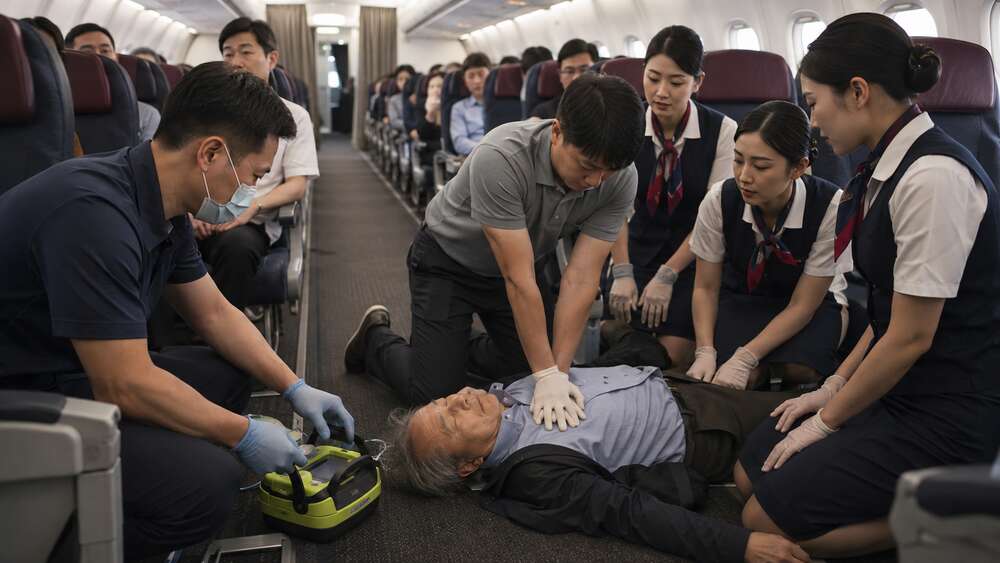
Singapore Airlines has recognized three cabin crew members whose rapid response helped save a 71-year-old passenger after his heart stopped shortly before a flight was scheduled to depart Barcelona for Singapore.
Chief stewardess Serene Koh, leading steward Idris Abu and inflight manager Kueh Joo Tong were among 29 individuals and teams honoured at the airline’s CEO Service Excellence Awards in Singapore. Their recognition highlighted the importance of emergency training and coordinated action during an in-flight medical crisis.
Passenger Found Without Pulse Before Departure
The emergency occurred on October 13, 2025, as the Singapore Airlines flight prepared to leave Barcelona-El Prat Airport for Singapore Changi Airport.
A cabin crew member alerted Koh that a passenger had lost consciousness. When Koh reached the 71-year-old man, she found him unresponsive, without a pulse and not breathing.
Koh and Abu quickly moved the passenger onto the aircraft floor and began cardiopulmonary resuscitation. Koh then instructed Kueh to retrieve the aircraft’s medical equipment, including an automated external defibrillator.
The crew also requested assistance from passengers with medical training. Two doctors and two trained first-aiders responded and joined the emergency effort.
CPR and AED Treatment Continue for 20 Minutes
Koh alternated performing CPR with one of the doctors while other crew members assisted with the medical response and worked to keep the remaining passengers calm.
The resuscitation effort continued for approximately 20 minutes. During that period, the passenger received two shocks from the AED before his pulse eventually returned.
Koh said her immediate priority was determining whether the passenger had regained a spontaneous pulse and resumed breathing.
The man’s wife remained beside him throughout the emergency. Koh recalled that she was crying and pleading with the crew to save her husband, asking them to do so “at whatever cost”.
Although the passenger’s pulse was initially faint, he had begun breathing again. He remained unconscious and did not respond verbally, according to Kueh.
Annual Emergency Training Guides Crew Response
Kueh, who had worked for Singapore Airlines for 34 years, said the carrier’s cabin crew members undergo annual training to prepare for emergencies of this nature. He said the training gave the team the knowledge needed to respond quickly and systematically.
Despite his more than three decades with the airline, the Barcelona incident was the first time Kueh had encountered a medical emergency involving a passenger whose heart had stopped.
Koh, meanwhile, had performed CPR twice previously during her 26-year career with Singapore Airlines. The Barcelona emergency marked the third time she had carried out CPR while on duty.
The crew’s response demonstrated how airline safety responsibilities extend beyond routine cabin operations. Cabin crew members are trained to recognize serious medical conditions, administer CPR, operate defibrillators and coordinate with medical professionals who may be travelling on board.
Passenger Undergoes Surgery in Barcelona
Once the passenger’s pulse had returned, emergency medical personnel boarded the aircraft and removed him for transport to a Barcelona hospital.
According to accounts of the incident, doctors later performed surgery and inserted a stent into a blocked artery to restore blood flow to his heart.
The passenger remained in Barcelona for approximately one month while recovering before returning home to Sydney, Australia.
Koh and Kueh learned about a month after the emergency that the passenger had experienced an arrhythmia and that his heart had stopped during the incident.
Flight Reaches Singapore on Schedule
The medical emergency delayed the flight’s departure by about one hour. Despite leaving Barcelona late, the aircraft arrived in Singapore at approximately 5 a.m. and remained on schedule.
Kueh said he was pleased that the coordinated response had given the passenger a chance to survive. Reflecting on the personal significance of the emergency, he said, “It’s somebody’s grandfather, somebody’s father.”
The incident involved immediate CPR, two AED shocks, assistance from medically trained passengers and close coordination among the cabin crew. The recognition presented to Koh, Abu and Kueh underscored the role that preparation and decisive action can play when a passenger experiences a life-threatening medical emergency.
