


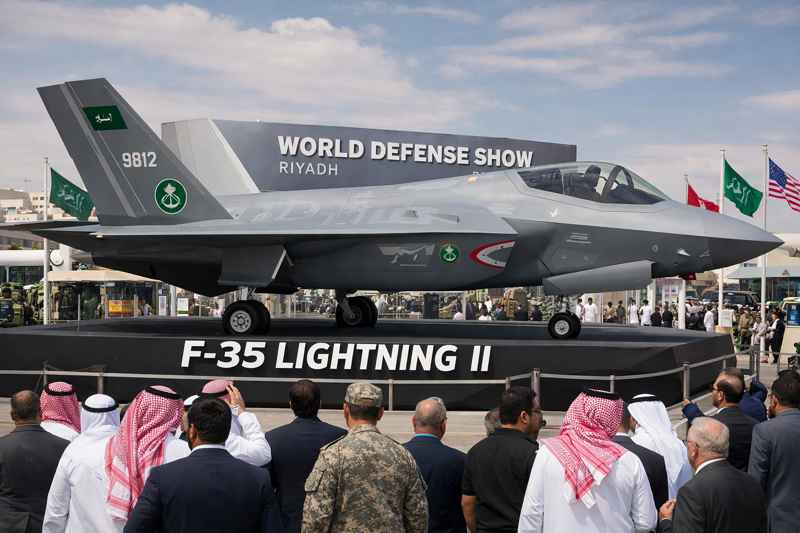
Saudi Arabia has reignited speculation over a potential acquisition of the Lockheed Martin F-35 Lightning II after displaying a full-scale mockup of the stealth fighter bearing Royal Saudi Air Force markings at the World Defense Show in Riyadh. The high-profile exhibit has drawn attention from defense analysts and industry executives, signaling renewed ambition even as major political and regulatory hurdles remain unresolved.
The World Defense Show, which returned on February 8, 2026, has quickly become one of the Middle East’s most closely watched defense industry gatherings. Hosted by Saudi Arabia, the event brings together manufacturers and policymakers from the United States, Europe, Russia, and China, offering Riyadh a platform to highlight both its procurement priorities and its growing defense industrial base.
A Symbolic Display at a Strategic Venue
The F-35 Lightning II mockup was among the most scrutinized displays at the show. Featuring Saudi insignia on the tail and fuselage, the aircraft model attracted large crowds and intense discussion among regional and international observers.
Saudi Arabian Military Industries said it was showcasing more than 60 domestically developed defense products at the exhibition. These ranged from aerospace systems and electronics to command-and-control platforms and maintenance solutions, underscoring the kingdom’s push to expand local manufacturing and technical expertise.
The presence of the F-35 mockup stood out against that backdrop. While not an operational aircraft, the display was widely interpreted as a public signal of Saudi interest in acquiring the fifth-generation fighter, rather than a confirmation of an imminent deal.
US Approval Without a Contract
The appearance of the mockup follows recent diplomatic developments between Riyadh and Washington. Saudi Arabia received US approval to pursue the F-35 after a strategic defense agreement signed in Washington in November 2025 designated the kingdom as a key non-NATO partner.
That approval, however, stopped short of authorizing a sale. No formal contract, production slot, or delivery timeline has been announced by either government. Defense analysts note that such approvals often represent only the first step in a lengthy process involving congressional review, technology safeguards, and policy alignment.
“The display is best understood as a statement of intent,” one regional analyst said privately, adding that it also serves a marketing purpose by keeping the aircraft visible in discussions about the future of the Royal Saudi Air Force.
Longstanding Ambitions and Persistent Obstacles
According to Eurasian Times, Saudi Arabia has sought access to the F-35 since at least 2017 as part of a broader modernization effort. The aircraft would mark a significant leap in capability, offering advanced sensors, low observability, and networked combat features designed for high-end warfare.
Yet approval to negotiate does not guarantee delivery. Any eventual deal would remain subject to US congressional oversight and strict controls on sensitive technology. A key consideration is Israel’s qualitative military edge, a long-standing US policy ensuring Israel maintains superior military capabilities in the region. Objections linked to this principle have historically complicated advanced arms sales to Arab states.
Despite these constraints, Saudi officials have increasingly emphasized defense self-reliance and closer strategic alignment with Western partners, suggesting continued interest in navigating the complex approval process.
The UAE’s Experience as a Cautionary Tale
The United Arab Emirates provides a notable precedent. Abu Dhabi pursued the F-35 for more than a decade and came close to securing a deal after US approval in 2020. Preliminary agreements were signed, raising expectations of a breakthrough.
The process later stalled under a subsequent US administration amid concerns over technology security and the UAE’s ties with China. Ultimately, the deal unraveled, prompting Abu Dhabi to pivot toward alternative suppliers. In 2021, the UAE finalized a major purchase of French Rafale fighters, while F-35 discussions faded.
For Saudi Arabia, the UAE’s experience highlights the political and geopolitical complexities surrounding the stealth fighter. Strategic alignment, technology assurances, and broader foreign policy considerations are likely to prove decisive.
More Than a Mockup
The F-35 model on display in Riyadh has therefore taken on symbolic weight. Beyond its physical presence, it reflects Saudi aspirations to field cutting-edge air power, US strategic calculations in the Middle East, and a regional arms market shaped as much by diplomacy as by performance.
Whether the mockup ultimately foreshadows a contract or joins a list of unrealized ambitions remains uncertain. For now, it has succeeded in placing Saudi Arabia’s F-35 ambitions firmly back in the spotlight.
