


Qatar Airways has begun shifting a portion of its widebody fleet into long-term storage, signaling mounting operational pressure as geopolitical tensions and uneven travel demand disrupt the airline’s recovery trajectory.
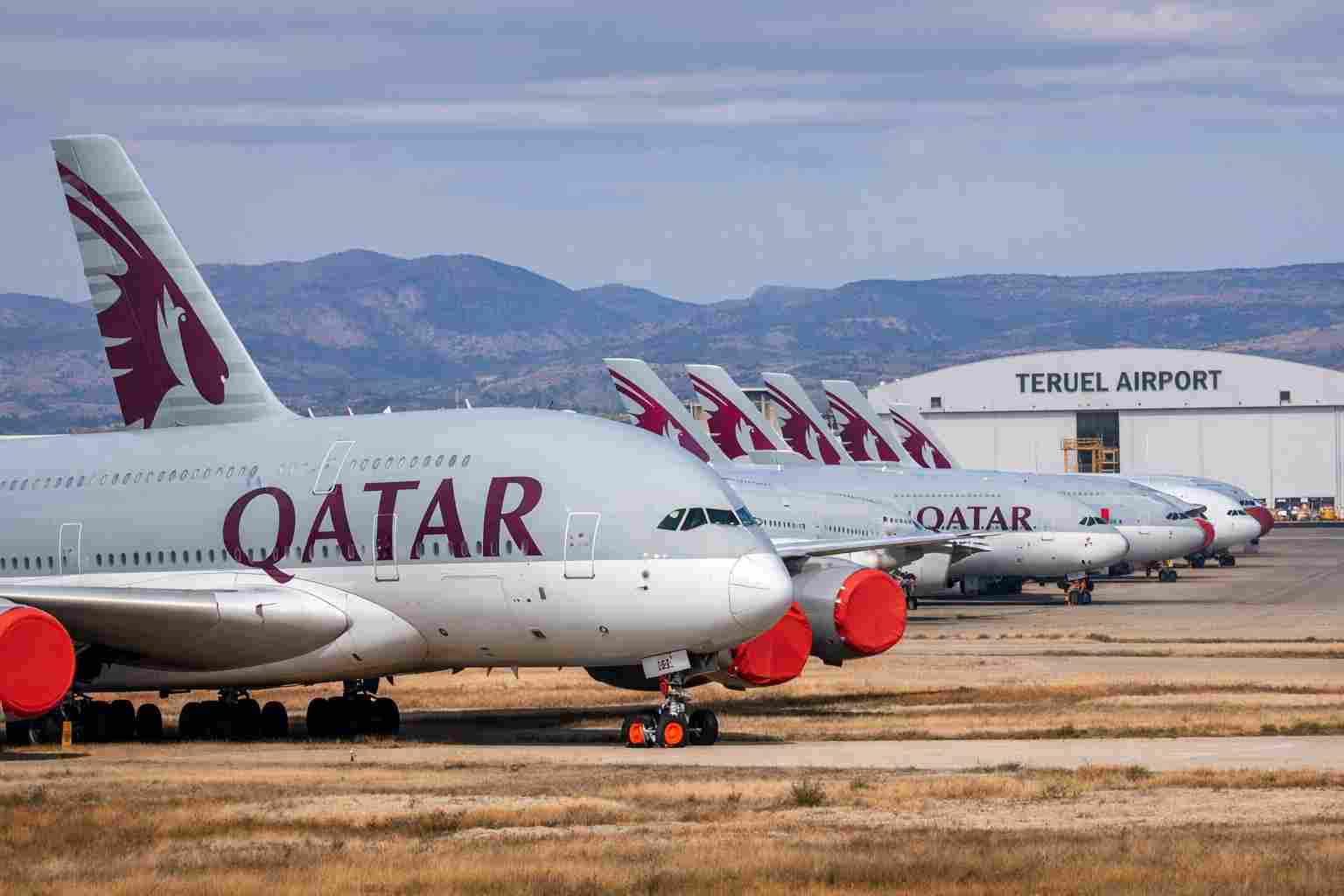
The Doha-based carrier, Qatar Airways, is relocating Airbus A380s, A350s, and other widebody aircraft to Teruel Airport, a long-term storage and maintenance facility widely used by global airlines during downturns. The move follows a sharp pullback in flight activity at Hamad International Airport, highlighting a more cautious operational strategy amid ongoing regional instability.
Fleet Sent to Long-Term Storage
Qatar Airways is placing multiple widebody aircraft into deep storage at Teruel Airport (TEV), a facility operated by Tarmac Aerosave that specializes in long-term parking, maintenance, and recycling. The site can accommodate up to 120 aircraft and is widely used by global carriers during periods of reduced demand.
According to PYOK, the airline transferred five aircraft to Teruel on Friday. This included one Airbus A380 (A7-APC), previously grounded at London Heathrow Airport, along with four other widebody jets stranded across international locations since late February.
These aircraft include Airbus A350-900 units positioned at Cape Town International Airport, King Shaka International Airport, and Jomo Kenyatta International Airport, as well as a Boeing 787-9 Dreamliner held at O.R. Tambo International Airport.
Earlier in the week, four Airbus A330 aircraft departed Hamad International Airport (DOH) for Teruel under non-commercial flight numbers. These ferry flights indicate that the airline is proactively reducing exposure at its Doha hub while managing fleet utilization.
Capacity Cuts Reflect Weak Demand
The storage decision comes after a rapid shift in operational planning. Qatar Airways initially ramped up to 135 daily flights but quickly scaled back to just 43 flights within days, signaling that demand recovery has fallen short of expectations.
This sharp reduction suggests that demand remains unstable, forcing the airline to adjust capacity and defer full-scale operations. The storage of high-capacity aircraft like the Airbus A380 further highlights expectations of a prolonged recovery period.
Cost Control and Operational Strategy
Beyond demand concerns, the move reflects a clear cost-control strategy. Parking aircraft at major hubs such as Heathrow can incur substantial fees, making long-term storage facilities like Teruel a more economical option during prolonged downturns.
By relocating aircraft to Spain, the airline can reduce overhead costs while preserving the condition of high-value assets for future use. The approach mirrors broader industry practices adopted during periods of economic uncertainty.
Security Concerns Shape Decisions
In addition to financial considerations, security risks remain a key driver behind Qatar Airways’ actions. The ongoing threat of missile and drone activity in the region has heightened concerns about aircraft safety at Doha.
Relocating aircraft away from potential conflict zones reduces exposure to risk and ensures the protection of critical fleet assets. This precautionary strategy reflects the challenges airlines face when operating in geopolitically sensitive regions.
Regional Recovery Remains Uneven
Qatar Airways’ cautious stance contrasts with the more aggressive recovery strategy of Emirates, which is currently operating more than 350 daily flights through Dubai International Airport.
However, uncertainty persists across the region, and it remains unclear whether Emirates—or other carriers—can fully restore pre-crisis capacity within expected timelines. The divergence in strategy highlights the uneven pace of recovery in global aviation.
As geopolitical risks continue to weigh on demand and operations, Qatar Airways’ decision to store part of its fleet underscores a broader industry reality: recovery in international air travel remains fragile, and airlines must remain flexible in the face of ongoing uncertainty.
