


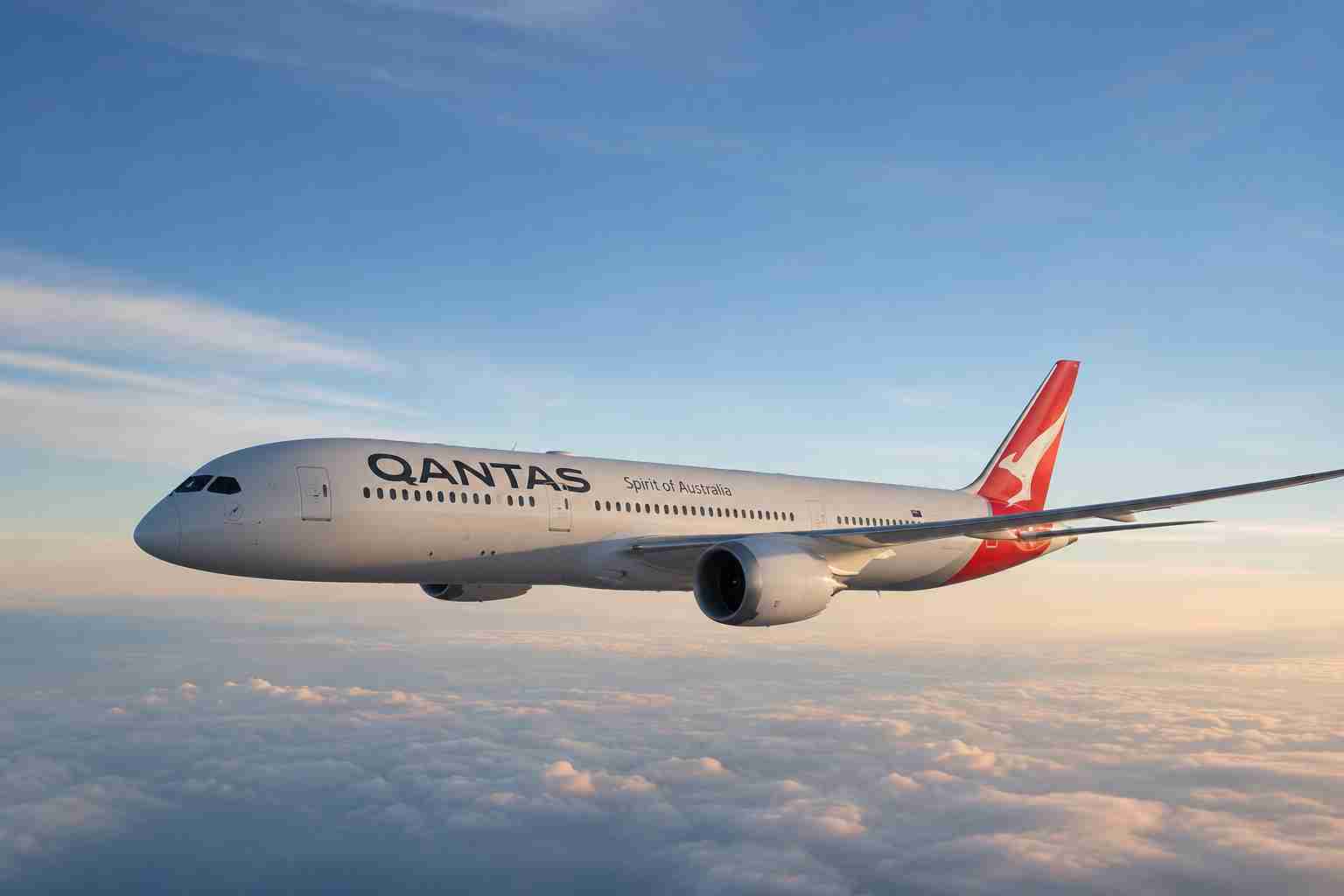
PERTH — Qantas Airways continues to operate one of the aviation industry’s most demanding scheduled passenger services, with its nonstop flight between Perth Airport and London Heathrow testing the practical limits of the Boeing 787-9 Dreamliner.
Spanning approximately 7,829 nautical miles (14,500 kilometers), the route ranks among the longest commercial passenger flights in operation today. While the Boeing 787-9 is certified to fly the distance, the service underscores the gap between an aircraft’s advertised range and the realities of day-to-day airline operations.
Industry experts note that published range figures are typically calculated under ideal conditions. In actual service, factors such as weather patterns, fuel requirements, airspace restrictions, payload weight, and regulatory reserves can significantly affect how far an aircraft can travel without operational adjustments.
The Perth–London route has become a high-profile example of how airlines manage those variables while maintaining safety standards and commercial viability on ultra-long-haul flights.
Managing Performance at the Edge of Aircraft Capability
Weather and Fuel Considerations Influence Operations
Boeing lists the 787-9 Dreamliner with a maximum range of roughly 7,830 nautical miles under optimal conditions. However, airlines rarely encounter such conditions in daily operations.
Headwinds, elevated temperatures, route deviations, and mandatory reserve fuel requirements all reduce the aircraft’s effective operating range. On a route as long as Perth–London, even small changes in operating conditions can have a measurable impact on flight planning.
One of the most critical factors is fuel management. The Boeing 787-9 can carry approximately 33,398 gallons (126,429 liters) of fuel. However, fuel density varies with temperature, creating additional challenges for airlines operating from hot-weather destinations.
During Perth’s summer months, warmer jet fuel expands in volume while becoming lighter in mass. As a result, even when tanks are filled to capacity, the aircraft may carry less fuel by weight than it could under cooler conditions.
According to operational estimates, the difference can reach around 1,500 kilograms of usable fuel. While such a reduction may be negligible on shorter routes, it becomes far more significant on flights lasting more than 17 hours, where fuel margins are carefully calculated.
Weight Management Plays a Key Role
The route also highlights the importance of payload management. Every passenger, checked bag, cargo container, catering item, and additional piece of equipment contributes to the aircraft’s overall weight.
As a result, travelers may occasionally notice empty seats on flights that would otherwise be expected to operate at full capacity. In some cases, those seats are intentionally left unsold to reduce overall aircraft weight and create room for additional fuel when operating conditions require larger reserves.
This balancing act is a routine part of ultra-long-haul operations, where airlines must continuously assess the trade-offs between payload and fuel capacity.
External factors can make those calculations even more complex. Temporary airspace closures in parts of the Middle East have previously forced Qantas to alter its routing between Australia and Europe. Such detours can add several hundred kilometers and increase flight times by as much as 45 minutes.
Although those changes may appear minor, they can substantially increase fuel consumption and reserve requirements, potentially pushing the aircraft beyond its practical operating margins.
During periods of extended airspace disruption, Qantas temporarily reintroduced a stopover in Singapore because the Boeing 787-9 could no longer complete the journey nonstop while carrying a commercially sustainable payload.
Lessons Shaping Qantas’ Future Long-Haul Strategy
Project Sunrise Drives Selection of Airbus A350-1000
Operational experience gained from the Perth–London service has helped shape Qantas’ plans for the next generation of ultra-long-haul flights.
Rather than relying on the Boeing 787-9 for even longer routes, the airline selected the Airbus A350-1000 for its upcoming Project Sunrise operations connecting Sydney with London and New York.
Those future services are expected to cover more than 17,000 kilometers and could approach flight durations of nearly 22 hours, according to aviation publication Simple Flying.
The Airbus A350-1000 offers greater fuel capacity and increased operational flexibility, providing larger performance margins for missions that extend beyond the capabilities of current Perth–London operations.
For Qantas, the Perth–London route remains both a technological milestone and a practical case study in the complexities of ultra-long-haul aviation. While aircraft manufacturers continue to push range capabilities further, the route demonstrates that successful nonstop operations depend on much more than maximum advertised range.
Weather conditions, payload restrictions, fuel planning, and operational flexibility all play critical roles in ensuring flights can be completed safely and efficiently. As airlines expand the boundaries of long-distance travel, the Perth–London service continues to illustrate the intricate planning required to keep some of the world’s longest flights in the air.
