


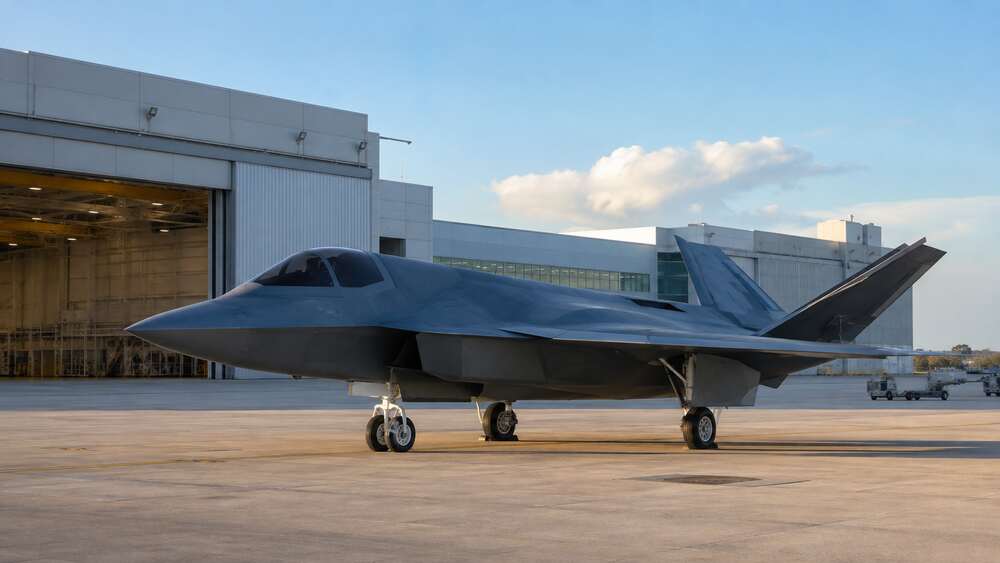
Northrop Grumman has expanded its advanced aircraft development operations in Melbourne, Florida, opening a 300,000-square-foot engineering facility as competition intensifies for the U.S. Navy’s next-generation F/A-XX fighter program.
The new building can accommodate more than 1,200 engineers and contains 17 secure laboratories dedicated to advanced aircraft, mission systems and related technologies. The investment significantly increases the company’s research and engineering capacity as the Navy moves toward a decision on the multibillion-dollar program.
Northrop Grumman and Boeing are considered the leading contenders for F/A-XX, which is expected to begin replacing the Navy’s F/A-18E/F Super Hornet fleet during the 2030s. The Navy has targeted August 2026 for its selection, placing additional attention on Northrop Grumman’s latest expansion.
Northrop Grumman Increases Engineering Capacity in Melbourne
Northrop Grumman’s Melbourne campus now supports approximately 5,000 employees and serves as an important centre for the company’s advanced aeronautics operations.
The expanded facility is intended to bring engineers, researchers and secure development laboratories together in one location. This arrangement could help shorten development timelines and improve collaboration across complex aircraft and subsystem programs.
Tom Jones, corporate vice-president and president of Northrop Grumman Aeronautics Systems, has described Melbourne as the centre of the company’s sixth-generation aircraft work.
Some of the activities taking place within the building are classified and cannot be publicly disclosed. However, the company has indicated that the facility will support the development of future combat aircraft and advanced systems designed for U.S. military customers.
The investment also reflects Northrop Grumman’s broader effort to increase the speed at which it can design, test and deliver sophisticated military aviation technology.
F/A-XX Competition Shapes Future of Carrier Aviation
The F/A-XX program is expected to play a central role in the Navy’s future carrier air wing, operating alongside the F-35C Lightning II and a growing number of uncrewed aircraft.
Northrop Grumman’s concept reportedly emphasizes stealth, extended range and the ability to coordinate multiple systems across a contested battlespace. This approach goes beyond traditional close-range fighter performance and responds to the Navy’s need to operate farther from increasingly capable maritime threats.
Stealth, Range and Networked Operations
The proposed aircraft reportedly features a tailless configuration and dorsal engine intakes intended to reduce its radar signature. It is also expected to carry weapons internally, preserving stealth while providing the payload and range required for operations in heavily defended environments.
Another major feature is the aircraft’s anticipated role as a networked command platform. The crewed fighter could operate with autonomous or collaborative combat aircraft performing surveillance, electronic warfare and strike missions.
These supporting aircraft could move ahead of the crewed platform, gathering intelligence, disrupting enemy systems or engaging targets while reducing the risks faced by pilots.
B-21 Raider Experience Supports Sixth-Generation Strategy
Northrop Grumman is drawing on its experience developing the B-21 Raider stealth bomber as it pursues the Navy contract.
The B-21 program combines low-observable technology, advanced networking and an open-system architecture. That design approach allows capabilities to be added through software improvements and technology upgrades without requiring a complete redesign of the aircraft.
Open Architecture Could Improve Long-Term Adaptability
A similar open-architecture strategy could be important for F/A-XX because the Navy expects the fighter to remain operational for decades. The ability to integrate new sensors, weapons and software more quickly would help the platform respond to evolving threats throughout its service life.
Northrop Grumman is emphasizing this adaptability as a key part of its proposal, particularly as military aviation becomes increasingly dependent on software, data sharing and coordinated operations involving crewed and uncrewed systems.
The program could also attract international attention. Australia operates 24 F/A-18F Super Hornets alongside F-35A Lightning II fighters and EA-18G Growlers, according to Australian Aviation, giving the country a potential strategic interest in future U.S. carrier-aircraft developments.
Northrop Grumman’s Melbourne expansion represents both a substantial industrial investment and a calculated move ahead of the Navy’s anticipated F/A-XX decision. With additional engineering capacity and secure research infrastructure in place, the company is positioning itself to compete for a defining role in the next generation of U.S. carrier-based combat aviation.
