


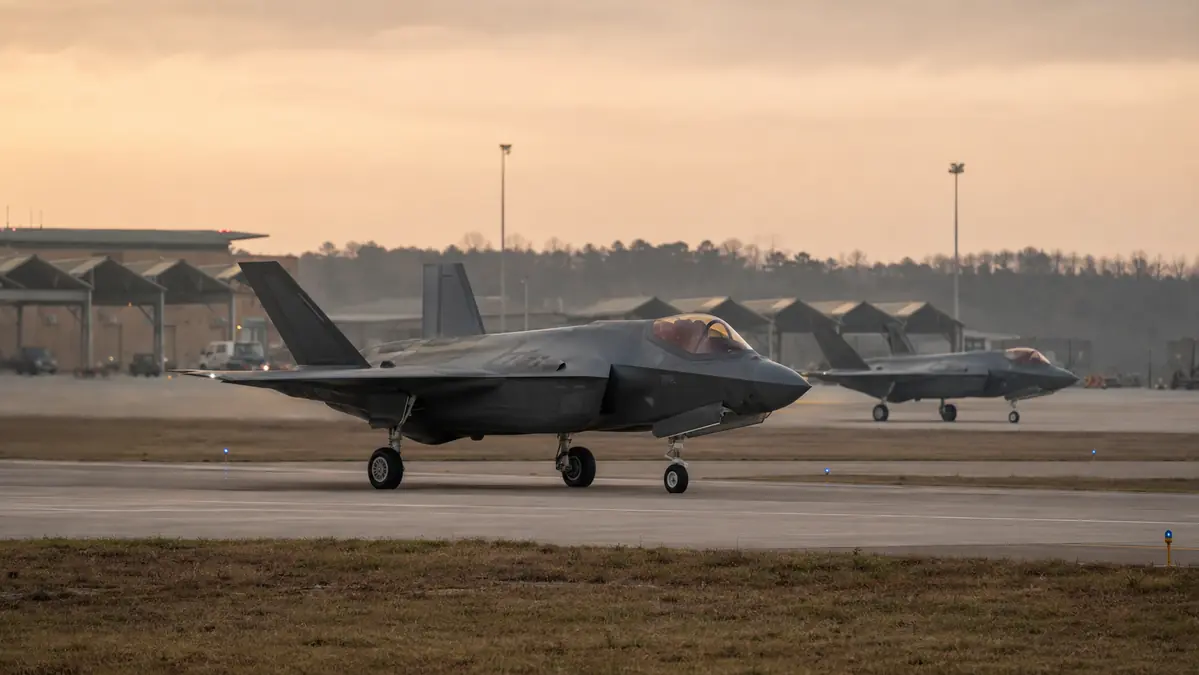
Alabama’s Red Tails Test F-35A Operations in Contested Pacific Scenario
MONTGOMERY, Ala. — The Alabama Air National Guard’s 187th Fighter Wing tested its ability to keep F-35A Lightning II aircraft operational during simulated attacks, communications failures and other battlefield disruptions as part of a major combat-readiness exercise at Montgomery Regional Airport.
Known as the Red Tails, the wing conducted Operation Tuskegee Thunder from Aug. 12 through Aug. 14 at Dannelly Field. The exercise coincided with the unit’s combat-readiness inspection and represented an important milestone in its transition from the F-16 Fighting Falcon to the more advanced F-35A.
The training placed airmen in a simulated Pacific operating environment, where they were required to generate and sustain combat airpower while confronting chemical threats, unmanned aircraft systems, casualties and attacks on the installation.
Exercise Tests Operations Under Simulated Attacks
Operation Tuskegee Thunder was designed to determine whether the 187th Fighter Wing could continue launching and supporting aircraft when normal operating conditions deteriorated.
Pilots conducted simulated offensive and defensive counter-air missions while personnel across the installation responded to rapidly changing threats. Aircraft operations continued alongside force-protection measures, emergency medical responses and efforts to preserve command-and-control capabilities.
Exercise officials introduced new scenarios throughout the three-day event. Airmen encountered simulated live-fire incidents, hostile unmanned aircraft and ground attacks. Security forces also responded to simulated gate runners attempting to breach the installation.
Communications and Medical Teams Face Disruptions
When primary communications became unavailable, units activated alternate, contingency and emergency systems. Those procedures allowed commanders and operational teams to exchange information while other activities continued across the base.
Medical personnel treated simulated casualties during mass-casualty events, while participating Army units assisted with mock medical evacuations. The scenarios required different organizations to coordinate their responses without interrupting the larger F-35A mission.
Personnel were expected to return quickly to their operational responsibilities after addressing each threat. Pilots continued flying, maintainers prepared aircraft for new missions, and support teams protected the infrastructure, equipment and supplies required to sustain operations.
F-35A Transition Reshapes Wing Training
The 187th Fighter Wing received its first F-35As at Dannelly Field in December 2023, beginning the replacement of its F-16 fleet. The conversion involves more than acquiring new aircraft, requiring extensive training, infrastructure changes and new maintenance and operational procedures.
The F-35A is the conventional takeoff and landing version of the fifth-generation Joint Strike Fighter. Its advanced sensors, low-observable design and data-sharing capabilities are intended to support operations in heavily contested environments.
Since receiving the aircraft, the Red Tails have expanded their training through nighttime flights, large-force exercises and operations conducted from distributed locations.
In 2025, the wing supported Exercise Resolute Force Pacific by deploying personnel and equipment across the Pacific region. The training helped personnel practice operating from multiple locations rather than relying on a single major base.
The wing continued that approach during Exercise Sentry South 26-2 earlier in 2026. F-35As operated from Dannelly Field while a smaller maintenance group worked from a forward operating location.
Such distributed operations are intended to make military aviation units more resilient by reducing their dependence on large, centralized installations that could become targets during a conflict.
Entire Wing Supports F-35A Combat Power
Operation Tuskegee Thunder emphasized that combat readiness depends on the entire organization, not solely on pilots or aircraft.
Operations personnel planned missions, maintainers prepared F-35As for flight, and logistics teams moved equipment and supplies. Communications specialists maintained the flow of information, security forces defended the installation, and medical personnel responded to casualties.
Air Force Lt. Col. Martin Smith, an F-35 pilot assigned to the 187th Fighter Wing, noted that operating a fifth-generation aircraft in a contested environment requires contributions from every section of the wing. The exercise reflected that approach by connecting aircraft generation with installation defense, communications and emergency response.
The training also exposed personnel to conditions such as fatigue, incomplete information and sudden operational changes that could emerge during an actual conflict.
Col. John D. Caldwell, commander of the 187th Fighter Wing, emphasized that sustained readiness ultimately depends on the airmen responsible for keeping operations moving under pressure.
The inspection marked another step in the Red Tails’ multiyear F-35A transition. By combining flight operations with casualty response, base defense, contingency communications and distributed maintenance, the wing tested the broader system needed to keep fifth-generation combat aircraft in the air.
