


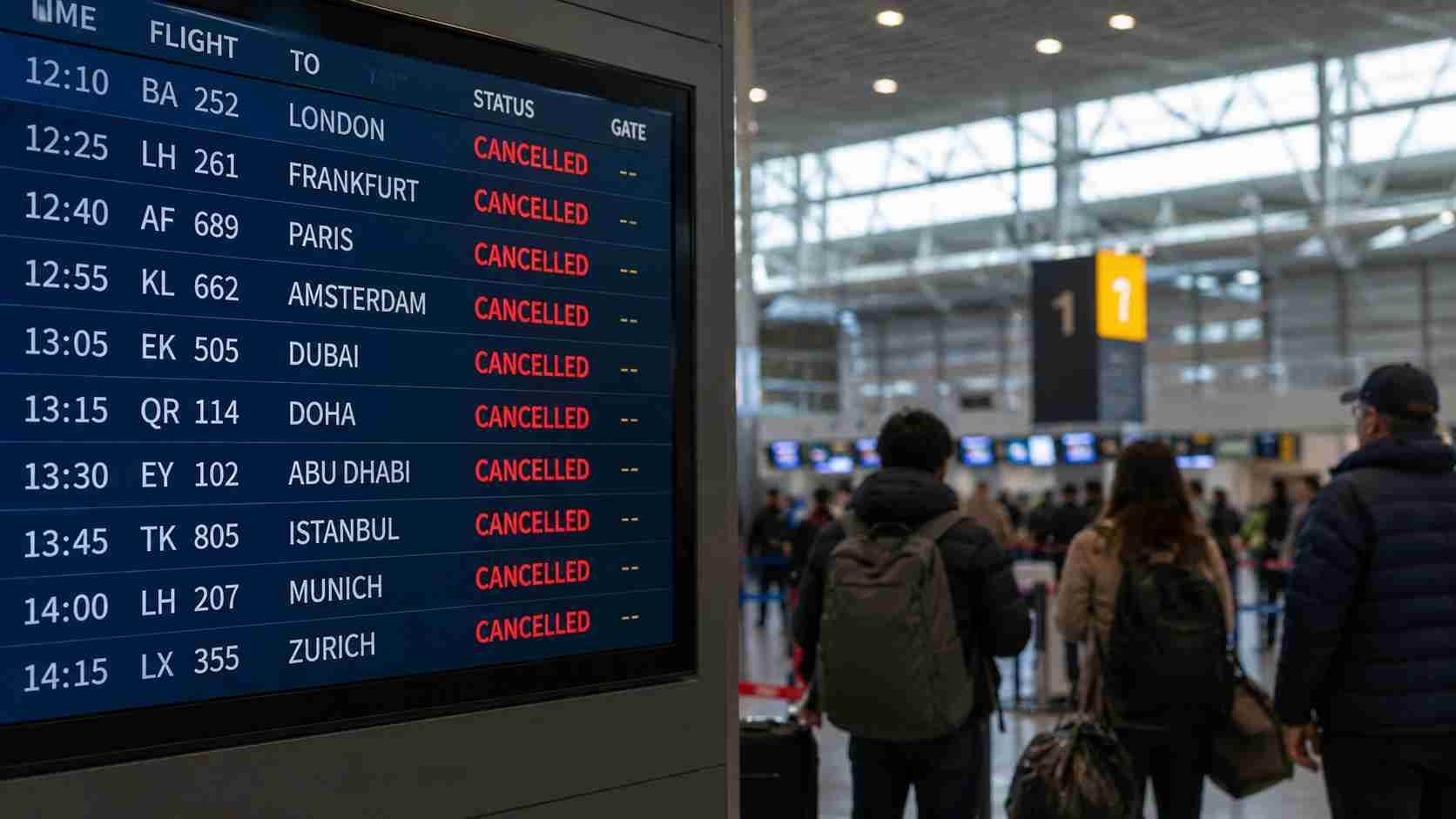
U.S. warns travelers of heightened security risks while airlines extend Middle East route suspensions amid escalating regional tensions
WASHINGTON, D.C. — The United States has issued a new Worldwide Caution advisory, urging Americans to exercise increased vigilance as escalating military tensions with Iran continue to disrupt international travel and aviation across the Middle East.
The advisory, released by the U.S. Department of State on July 18, warns of potential security threats, periodic airspace closures, and widespread flight cancellations affecting travelers around the globe. The notice comes as international airlines continue extending suspensions of flights to several Middle Eastern destinations, reflecting growing operational and safety concerns.
The updated travel warning follows a sharp escalation in hostilities between Washington and Tehran, including the deaths of U.S. service members in Jordan and subsequent American military strikes targeting Iran.
Escalating Conflict Prompts Worldwide Security Alert
The State Department’s Worldwide Caution advisory advises U.S. citizens—particularly those traveling in or through the Middle East—to remain alert as the regional security environment becomes increasingly unpredictable.
Officials cautioned that evolving military activity could result in sudden airspace restrictions and flight disruptions extending beyond countries directly involved in the conflict. The advisory also warned that individuals and facilities associated with the United States could face heightened security risks due to actions by groups aligned with Iran.
The warning reflects growing concerns that regional instability may continue affecting both commercial aviation and international travel for an extended period.
U.S. Military Response Follows Deadly Attack
The advisory came shortly after reports that two American service members were killed in Jordan while preparing to defend against Iranian ballistic missile and drone attacks. According to U.S. Central Command, the incident marked the first U.S. military fatalities caused by Iranian fire since March. Officials also reported that a third service member remains missing in action.
In response, U.S. forces launched a new round of airstrikes against Iran under the direction of President Donald Trump.
According to U.S. Central Command, the military operation was intended to target Islamic Revolutionary Guard Corps forces responsible for attacks on American troops in Jordan while also reducing Iran’s ability to threaten commercial shipping passing through the strategically important Strait of Hormuz.
The operation represented the eighth consecutive night of U.S. strikes against Iranian targets. Iranian state media later reported explosions in Bandar Abbas and on Qeshm Island despite a memorandum of understanding signed between the two countries in June.
American Citizen Released from Iran
The heightened tensions also coincided with the release of an American citizen who had been detained in Iran since 2024.
President Donald Trump announced that Dena Karari had been freed and was safely outside Iran. According to her attorney, Karari had traveled to Iran to visit family when authorities confiscated both her American and Iranian passports before subjecting her to extensive questioning and placing her under an exit ban.
Her lawyer said she was targeted because of her leadership role with the Children of Mehr Foundation, a nonprofit organization supporting disadvantaged children in Iran under a license issued by the U.S. Office of Foreign Assets Control.
Airlines Continue Extending Middle East Flight Suspensions
The deteriorating security environment has forced airlines worldwide to continually reassess operations across the Middle East, with many carriers extending cancellations well into late 2026 while others cautiously restore limited service.
Delta Air Lines continues to suspend flights between Atlanta and Tel Aviv through December 18, although service from New York’s John F. Kennedy International Airport to Tel Aviv is scheduled to resume on September 6. The airline has also postponed the planned launch of its Boston-Tel Aviv route indefinitely.
Air Canada has extended cancellations to both Tel Aviv and Dubai through October 24, while Air France has suspended Beirut service until August 2. KLM temporarily halted flights to Riyadh, Dammam, and Dubai during the recent period of elevated tensions.
British Airways has implemented one of the broadest reductions among European carriers. Flights to Doha remain suspended until August 1, while Riyadh service is paused until August 8. Operations to Dubai, Tel Aviv, Bahrain, and Amman have been suspended through the end of the summer travel season, with service expected to resume on October 25. When flights restart, the airline plans to reduce frequencies to one daily flight for Dubai, Doha, Riyadh, and Tel Aviv, while removing Jeddah from its route network entirely.
The Lufthansa Group has also significantly scaled back operations in the region. Lufthansa and SWISS have suspended Dubai flights until September 13, while Lufthansa, SWISS, Austrian Airlines, and Brussels Airlines have extended suspensions to destinations including Abu Dhabi, Amman, Beirut, Dammam, Riyadh, Erbil, Muscat, and Tehran through October 24.
Other international carriers have taken similar measures. ITA Airways, Singapore Airlines, Japan Airlines, Finnair, Cathay Pacific, airBaltic, and IndiGo have all adjusted schedules, delayed route resumptions, or continued avoiding portions of Middle Eastern airspace in response to the evolving security situation.
Global Aviation Faces Continued Uncertainty
The latest U.S. travel advisory underscores how rapidly escalating geopolitical tensions can ripple through the global aviation industry. With airlines prioritizing passenger and crew safety while monitoring military developments, travelers heading to or transiting through the Middle East may continue experiencing schedule changes, cancellations, and longer travel times.
As governments and airlines closely monitor the conflict, aviation analysts expect route adjustments and operational disruptions to remain in place until regional security conditions stabilize.
