


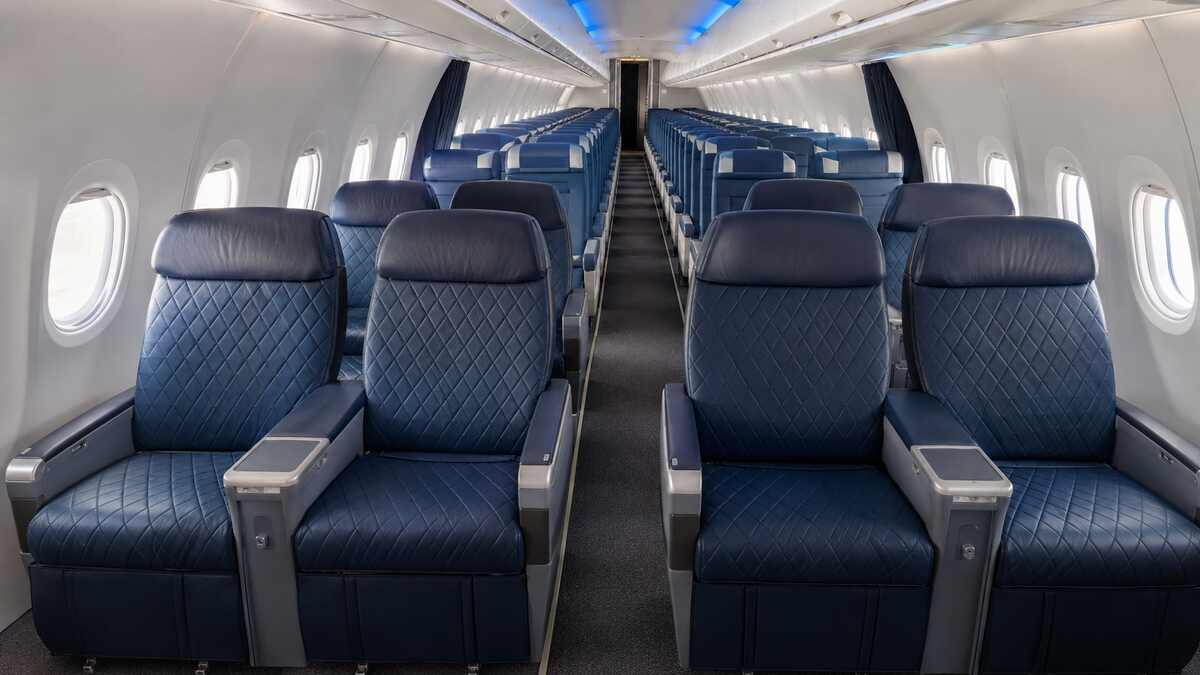
JetBlue Airways is reportedly preparing to introduce a domestic first-class cabin on its Airbus A320 fleet, marking another step in the carrier’s push toward higher-margin premium travel. The proposed layout would add 12 BlueFirst seats without increasing the aircraft’s total capacity, resulting in fewer EvenMore seats and potentially less space for standard economy passengers.
The airline is expected to formally reveal the new product on September 1. The reported configuration, identified as 3R0, would retain 162 seats while significantly changing the mix of products offered in the forward cabin.
JetBlue Plans Three Rows of BlueFirst Seats
Aviation industry source JonNYC reports that the redesigned A320 will include three rows of BlueFirst seats in a 2-2 arrangement. That would give JetBlue 12 dedicated domestic first-class seats on each retrofitted aircraft.
Unlike a conventional economy row containing six seats, each BlueFirst row would accommodate four passengers. The configuration would establish a distinct premium cabin on JetBlue aircraft that do not offer the airline’s lie-flat Mint product.
The introduction of BlueFirst is part of the carrier’s wider JetForward strategy, which is focused on improving revenue through premium products and other operational initiatives.
EvenMore Capacity Drops From 30 to 18 Seats
JetBlue is not expected to increase the total number of premium and extra-legroom seats on the aircraft. Instead, the airline would change the balance between those products.
The existing A320 configuration has 30 forward EvenMore seats. Under the reported redesign, that number would fall to 18, with 12 BlueFirst seats occupying the space.
When exit-row and other extra-legroom options are included, the aircraft would continue to offer 42 seats across its premium and enhanced-space categories. However, 12 seats would move from EvenMore into the more expensive BlueFirst product.
That could reduce availability for Mosaic loyalty members and other passengers who regularly select EvenMore. The product, introduced in January 2025, includes additional space, earlier boarding, dedicated overhead-bin access, complimentary alcoholic beverages, premium snacks and priority security where available.
Economy Passengers Could See Reduced Legroom
Maintaining 162 seats while introducing a physical first-class cabin presents a cabin-planning challenge. The reported seat map extends through row 28, compared with row 27 on JetBlue’s current A320 layout.
JetBlue has not confirmed the final seat pitch for the redesigned aircraft. Previous reporting suggested that standard economy pitch could decline from approximately 32 inches to about 30 inches.
Such a reduction would represent a notable change for an airline that has historically promoted relatively generous economy legroom as a competitive advantage.
For comparison, American Airlines operates some Airbus A320 aircraft with 12 first-class seats and 150 total seats. JetBlue’s reported configuration would accommodate the same number of first-class passengers while retaining 12 additional seats overall.
BlueFirst Supports JetBlue’s Premium Revenue Strategy
JetBlue has been expanding its premium offerings as management attempts to strengthen revenue and improve the airline’s financial position. The carrier previously considered installing two or three first-class rows on non-Mint aircraft before expanding its planning framework to three or four rows.
The company is targeting a premium seating mix of approximately 27% across its fleet. Its reported three-row A320 layout fits within that objective while avoiding a reduction in total passenger capacity.
BlueFirst could be particularly valuable on routes connecting major East Coast markets with popular leisure destinations. New York remains central to JetBlue’s network, with roughly half of its flights touching the market, while Boston Logan International Airport is another major operating base.
The airline has reported stronger performance from premium products. Premium revenue per available seat mile, or RASM, increased approximately 13% in the second quarter, compared with growth of about 11% in the Main cabin.
Financial Benefits Will Depend on Passenger Demand
JetBlue has estimated that its completed onboard product overhaul could deliver approximately five points of RASM improvement. BlueFirst has been identified as one of the most significant remaining earnings opportunities under the JetForward plan.
However, the outcome will depend on pricing, demand, aircraft utilization and JetBlue’s ability to sell premium seats without relying heavily on discounts. Larger premium cabins can generate higher revenue during strong travel periods but create a risk of unsold inventory when demand weakens.
JetBlue continues to operate under financial pressure after reporting a $602 million net loss in 2025 and an additional $566 million loss during the first half of 2026. It also carries approximately $8.5 billion in debt and expects a full-year adjusted operating margin between negative 2% and negative 5%.
The carrier has shifted much of its planned non-Mint fleet retrofit work into 2027, meaning the broader financial benefits of BlueFirst may not become evident until late 2028 or 2029. The redesigned A320 could strengthen JetBlue’s premium proposition, but the trade-off may be fewer EvenMore seats and a tighter experience for economy passengers.
