


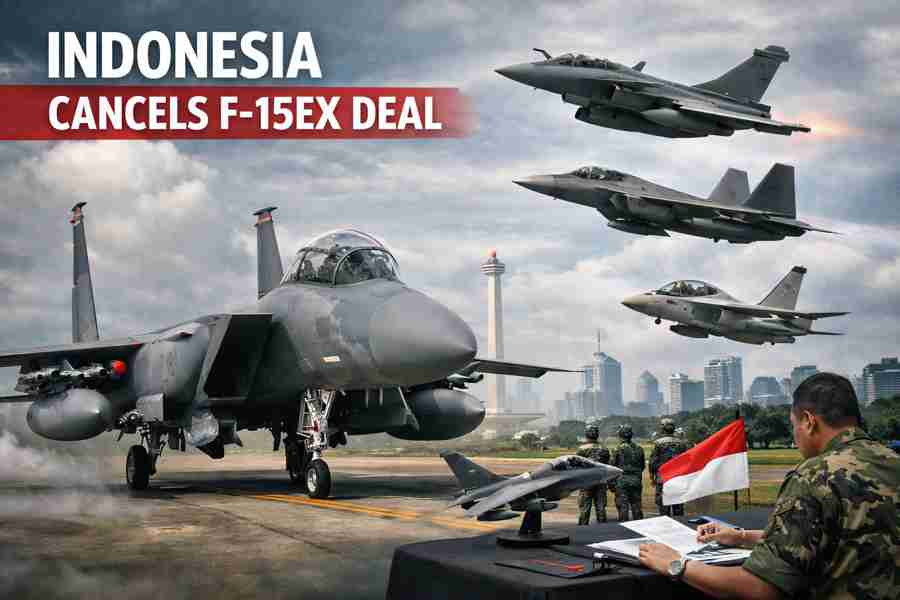
Indonesia has formally abandoned plans to acquire up to 24 F-15EX Eagle II fighter jets from Boeing, ending nearly two years of intermittent negotiations conducted under the U.S. Foreign Military Sales (FMS) framework. The decision, confirmed by Boeing during the Singapore Airshow, reflects a broader recalibration of Jakarta’s defense procurement strategy as it balances cost, capability, and long-term sustainability.
The move closes the door on what once appeared to be a major defense deal between Indonesia and the United States, while underscoring the increasingly complex choices facing emerging economies modernizing their air forces.
Negotiations Stall After Initial Commitments
Indonesia’s interest in the F-15EX dates back to early 2022, when the U.S. State Department approved a potential sale of the advanced fighter jet. The aircraft was initially marketed as the F-15ID, later redesignated as the F-15IND for export. In August 2023, Indonesia formally committed to purchasing up to 24 jets, and a memorandum of understanding was signed in St. Louis, Missouri, home to Boeing’s F-15 production line.
Despite these steps, talks failed to progress into a binding contract. Boeing declined to elaborate on the reasons behind the breakdown, referring inquiries to the Indonesian and U.S. governments involved in the FMS process. No official explanation has been released by Jakarta.
Industry observers point to several likely factors, including rising acquisition and lifecycle costs, delivery timelines, and Indonesia’s expanding commitments to other high-profile fighter programs.
Rafale Program Takes Center Stage
Indonesia’s defense modernization has increasingly been anchored by its acquisition of 42 Rafale multirole fighters from Dassault Aviation. Deliveries of the French-built jets are already underway, and the aircraft are expected to form the backbone of the Indonesian Air Force’s future combat fleet.
The arrival of the Rafales likely reduced the urgency to add another heavy fighter platform such as the F-15EX. Operating multiple advanced aircraft types significantly increases training, maintenance, and logistics costs—an issue that defense planners typically seek to avoid in order to control long-term spending.
Managing a Diverse and Aging Fleet
The Indonesian Air Force currently operates a mixed fleet that includes Western and Russian-built aircraft. Its inventory includes early-model F-16A/B Block 15 OCU fighters delivered starting in 1989, later-acquired and upgraded F-16C/D variants, and Russian-made Su-27 and Su-30 fighters delivered between 2003 and 2008.
However, international sanctions linked to Russia’s invasion of Ukraine have complicated maintenance and supply chains for Russian aircraft, creating operational challenges. These constraints have added pressure on Jakarta to streamline its fleet and reduce dependence on platforms that are difficult to sustain.
KF-21 Partnership Offers Long-Term Alternative
Indonesia also remains a partner in South Korea’s KF-21 Boramae fighter development program, holding a 20 percent stake through state-owned aerospace firm PT Dirgantara Indonesia. The country is expected to eventually procure around 50 KF-21 aircraft.
While Indonesia has faced delays in meeting some of its financial commitments to the program, renewed participation could reduce the need for additional Western fighter purchases. Supporting Rafales, KF-21s, and legacy aircraft simultaneously would require substantial budget allocations, making fleet consolidation an increasingly attractive option.
Trainer Fleet Modernization Moves Forward
At the Singapore Airshow, Italy’s Leonardo signed a letter of intent with Indonesian authorities and PT ESystem Solutions Indonesia to supply M-346F Block 20 advanced trainer aircraft. The M-346 platform is intended to replace aging trainer jets such as the Hawk and will support both advanced pilot training and limited light combat roles.
The decision aligns with Indonesia’s broader emphasis on building a sustainable force structure that supports modern fighters with appropriate training infrastructure.
Boeing Sees Demand Elsewhere
While Indonesia’s withdrawal represents a setback, Boeing continues to see global demand for the F-15EX platform. Israel has ordered 25 F-15IA fighters based on the same design, South Korea is upgrading its F-15K fleet through 2037, and Poland has expressed potential interest. In the United States, the Air Force plans to expand its F-15EX fleet from 98 to 129 aircraft under future budget proposals.
Boeing also maintains defense ties with Indonesia through other programs, including AH-64 Apache attack helicopters.
Strategic Shift, Not a Retreat
Despite canceling the F-15EX purchase, Indonesia continues to build one of Southeast Asia’s most capable air forces. Ongoing Rafale deliveries, participation in the KF-21 program, and modernization of training aircraft point to a strategy focused on cost control, operational efficiency, and long-term capability growth rather than rapid fleet expansion.
Indonesia’s defense modernization remains firmly on track—just with clearer priorities and tighter financial discipline.
