


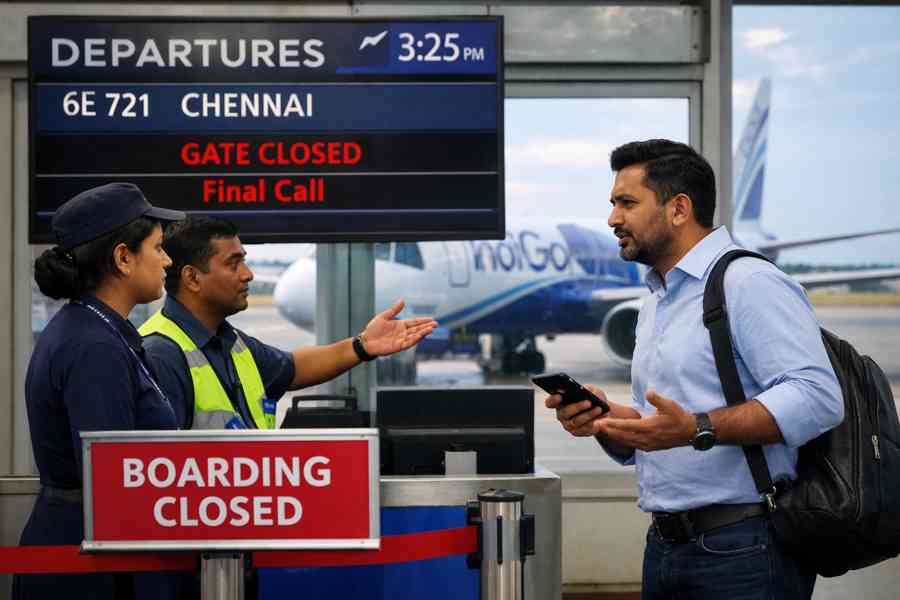
A missed domestic flight at Tiruchirappalli airport has triggered a public dispute between India’s largest airline and a former aviation industry executive, raising broader questions about airport display systems, boarding protocols, and passenger communication.
Vijay Gopalan, former chief executive officer of AirAsia, said he was denied boarding on an IndiGo flight to Chennai after relying on flight status information that indicated boarding had not yet begun. IndiGo, however, maintained that its staff followed standard procedures and that boarding announcements were made on schedule.
The incident occurred at Tiruchirappalli airport, commonly known as Trichy, and resulted in Gopalan missing a scheduled conference in Chennai.
Conflicting Accounts Over Boarding Status
The disputed flight was scheduled to depart Tiruchirappalli for Chennai at 2:55 p.m. Gopalan had completed web check-in in advance and arrived at the airport around 1 p.m., well ahead of departure. After clearing security, he moved to the airport lounge to continue working while monitoring the Flight Information Display System (FIDS).
According to Gopalan’s account, the departure time on the display screens changed several times over the course of the afternoon. He said the time was first updated from 2:55 p.m. to 3:10 p.m., then to 3:15 p.m., and later to 3:25 p.m. Throughout this period, the display reportedly continued to show “security clearance” rather than “boarding,” leading him to believe that the boarding process had not yet started.
The lounge, he noted, was only a short walk from the boarding gate, reinforcing his assumption that there was sufficient time to reach the aircraft once boarding commenced.
Missed Flight and Gate-Level Dispute
Around 3:05 p.m., Gopalan said airline staff contacted him by phone to ask about his location. When he reached the gate shortly afterward, he was informed that final boarding announcements had already been made and that the aircraft was ready for departure.
He alleged that ground staff were dismissive during the interaction and suggested that passengers were responsible for arriving at the gate on time regardless of display information. Gopalan later shared his frustration publicly, arguing that inconsistent and inaccurate display updates were the primary cause of the confusion.
He rejected the notion that frequent flyers should be expected to disregard airport information systems and independently calculate gate closure times, particularly when official screens suggested boarding had not begun.
Rebooking and Missed Engagement
Following the missed flight, Gopalan said airline representatives initially asked him to pay a rebooking fee of Rs 3,000. After intervention by airport authorities, the fee was reduced to Rs 1,800. He was eventually rebooked on a later flight along with a colleague and another affected passenger.
Despite being accommodated on an alternate service, the delay caused him to miss a scheduled conference in Chennai, an outcome he described as professionally disruptive.
IndiGo’s Response and Operational Context
IndiGo responded publicly by stating that the airport’s flight display system had experienced a temporary issue. The airline emphasized that the Flight Information Display System is managed by the airport operator and not by the airline itself.
The carrier added that boarding announcements were made in line with standard operating procedures and that the passenger did not arrive at the gate before boarding closed. IndiGo said its staff assisted the affected passengers in arranging alternate travel to complete their journeys.
Broader Implications for Passenger Communication
Airlines typically close boarding gates 20 to 25 minutes before scheduled departure to ensure on-time performance. Passengers are generally advised to remain near their gates, even when using lounges, and to rely on boarding announcements in addition to display screens.
However, the Trichy incident underscores how discrepancies between airport display systems and real-time boarding activity can create confusion, particularly when departure times are adjusted. Industry observers note that accurate, synchronized communication between airport operators and airlines is essential to maintaining passenger confidence and avoiding similar disputes.
As air travel volumes continue to rise, the episode highlights the operational challenges that can emerge when technology, human processes, and passenger expectations fall out of alignment.
