


Gulf Carriers Scale Back Superjumbo Operations as Regional Conflict Reshapes Networks
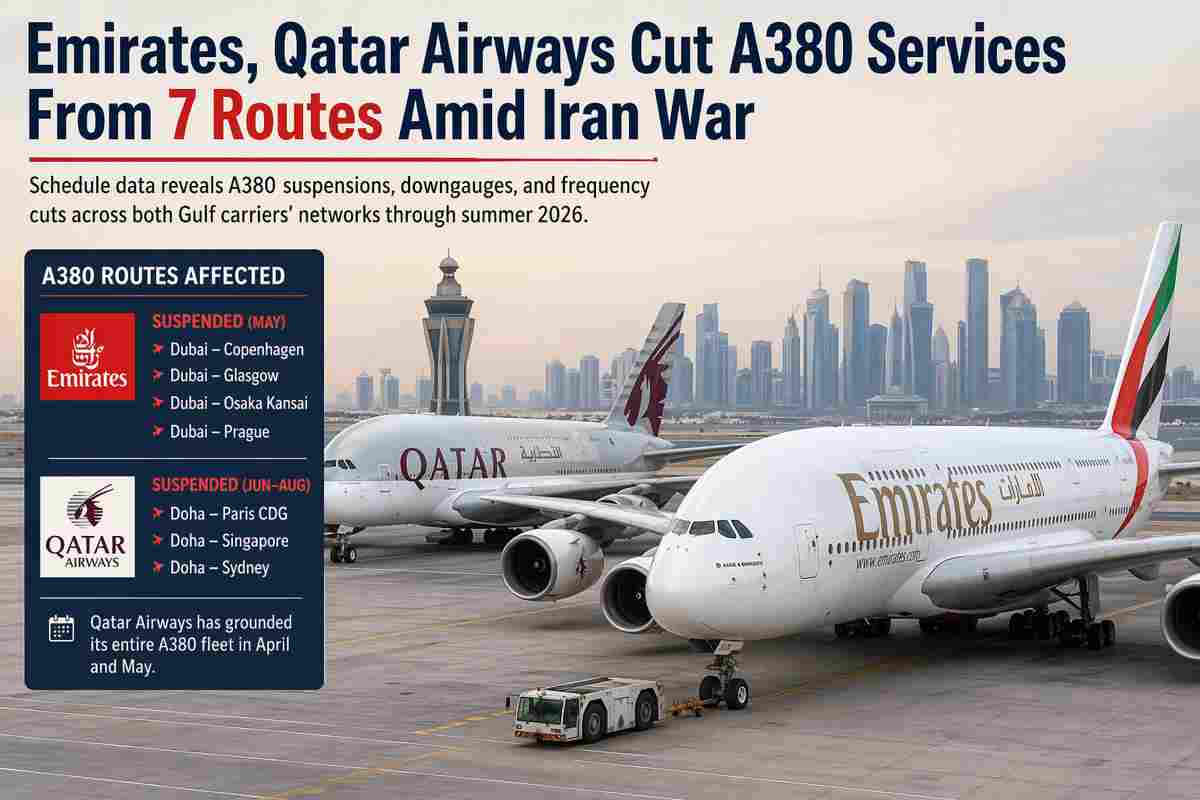
DUBAI — Middle Eastern aviation giants Emirates and Qatar Airways have removed Airbus A380 aircraft from seven routes combined, underscoring how the ongoing Iran war is forcing major network adjustments across the Gulf aviation sector.
Schedule data from Cirium Diio and OAG shows four route suspensions by Emirates and three by Qatar Airways, alongside broader capacity cuts, aircraft downgrades, and frequency changes extending through summer 2026.
These latest moves build on earlier disruptions. Qatar Airways has already grounded its entire A380 fleet during April and May, while Emirates has reduced its A380 flying by roughly one-third year-over-year, partly due to ongoing cabin retrofit programs on its superjumbo fleet.
Emirates Suspends A380 Service on Four Routes
Emirates will halt A380 operations in May on flights from Dubai to Copenhagen, Glasgow, Osaka Kansai, and Prague. While the suspension is currently limited to May, schedule patterns suggest it could extend into June.
Each route had been assigned a different A380 configuration. Copenhagen and Prague were scheduled to receive the airline’s high-density, two-class 615-seat aircraft. Glasgow was set for a 519-seat, four-class configuration including first class, while Osaka was planned with the smaller 468-seat version.
Replacement aircraft vary across the network. Emirates will deploy Boeing 777-300ER jets on three routes, using different seating configurations depending on the destination. Copenhagen stands out as the most significant downgrade.
Instead of the A380, the airline will operate its Airbus A350-900 in a three-class, 298-seat layout — the lowest-capacity widebody in its fleet. The shift represents a substantial capacity reduction from the originally planned 615 seats. Emirates is already scheduled to introduce regular A350 service to Copenhagen starting in late October.
Frequency Adjustments Across Europe and Asia
Beyond route suspensions, Emirates is also scaling back A380 frequencies on several key European routes. Flights from Dubai to Milan Malpensa, Munich, and Zurich will drop to once daily in May.
In Milan’s case, the reduction applies only to the standalone Dubai–Milan service and does not affect the airline’s fifth-freedom route onward to New York JFK.
Other markets are seeing increased capacity. London Gatwick will gain an additional daily A380 flight, rising from two to three per day — the highest frequency since December. Meanwhile, Bali will see A380 service double to twice daily beginning in May.
Qatar Airways Extends A380 Cuts Through Summer
Qatar Airways is implementing deeper and longer-lasting reductions. Following a complete A380 grounding in April and May, the airline will suspend superjumbo service on routes from Doha to Paris Charles de Gaulle, Singapore, and Sydney throughout the summer season.
The 517-seat A380 is not expected to return to those routes until September 16.
In the interim, Qatar Airways will substitute smaller aircraft. Paris will be served by the Boeing 777-300ER, while Singapore will receive a mix of Airbus A350-900 and A350-1000 aircraft. Sydney will be operated exclusively by the A350-1000.
However, not all A380 operations are being reduced. The airline will increase A380 frequency to London Heathrow from one to two daily flights starting June 16, maintaining that level through July and August. Bangkok will also see an upgrade, with A380 service rising from ten weekly flights to twice daily over the same period.
Etihad Also Adjusts Superjumbo Plans
A third Gulf carrier, Etihad Airways, is also modifying its A380 deployment. The airline had planned to launch daily A380 service between Abu Dhabi and Singapore at the end of April, but that start date has been pushed to June 15. The service is expected to continue through 2027.
Sharp Divergence in A380 Capacity Trends
A comparison of schedules from May through August versus the same period last year highlights diverging strategies among the Gulf carriers.
Etihad’s A380 capacity is down approximately 10% year-over-year. Emirates, despite current disruptions, has increased its A380 operations by about 3%, largely because peak summer months remain relatively stable.
Qatar Airways, however, faces the most significant contraction. The airline’s total A380 flights are down 59% through August. Even excluding the full May grounding, its summer A380 schedule is still nearly half of last year’s levels, reflecting a 48% year-over-year decline.
Regional Instability Continues to Reshape Aviation Networks
The evolving adjustments by Emirates, Qatar Airways, and Etihad Airways illustrate how geopolitical instability is directly influencing fleet deployment, route planning, and capacity management in one of the world’s most strategically important aviation hubs.
As the Iran war continues, further schedule changes and capacity shifts across the Gulf region are likely in the months ahead.
