


Delta Expands Revenue Strategy Beyond Ticket Sales
ATLANTA — Delta Air Lines is increasingly positioning the travel experience as a continuous revenue opportunity, using free Wi-Fi, artificial intelligence, digital platforms, and partner integrations to keep customers engaged throughout their journey rather than only during the flight itself.
Speaking at the TD Cowen 10th Annual Future of the Consumer Conference, Delta Chief Marketing and Product Officer Ranjan Goswami described how the airline is building a broader digital ecosystem designed to generate revenue through customer engagement, commerce, content consumption, and loyalty partnerships.
The strategy reflects a growing shift within the airline industry, where carriers are looking beyond airfare sales and traditional ancillary fees to create new forms of recurring customer interaction.
According to Delta, the objective is to connect passengers with airline services, partner products, entertainment, shopping opportunities, and travel-related offerings through a single integrated digital experience.
According to View from the Wing, Delta is increasingly treating the travel day as a series of monetizable customer interactions rather than limiting revenue opportunities to the flight itself.
Delta’s Free Wi-Fi Strategy Goes Beyond Connectivity
Airline Wants Passengers to Remain Inside Its Digital Ecosystem
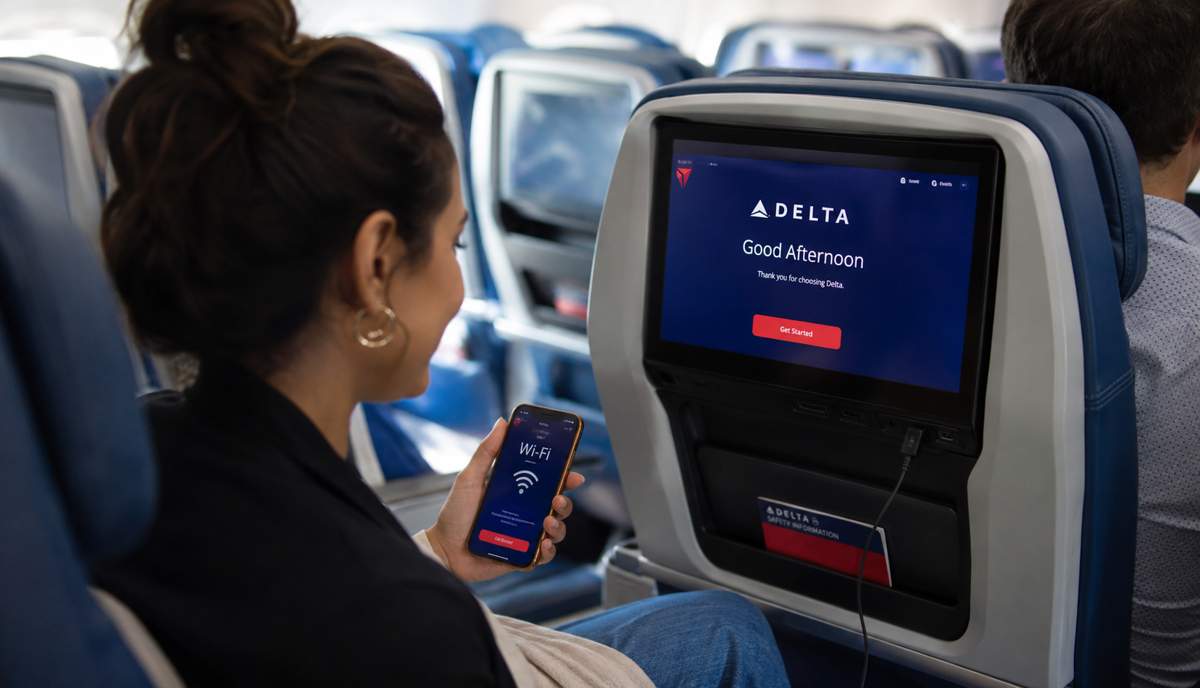
Delta’s investment in free onboard Wi-Fi appears to be driven by more than customer convenience.
During the presentation, Goswami explained that approximately 50% of Delta passengers currently log into the airline’s digital platforms during their journey. Of those users, around 30% continue engaging with Delta-generated content instead of immediately navigating away to unrelated online destinations.
Those engagement figures help explain why the airline continues expanding its onboard connectivity infrastructure across the fleet.
Rather than viewing Wi-Fi solely as an amenity, Delta sees connectivity as a gateway to a broader digital marketplace where passengers can interact with branded content, targeted offers, partner promotions, and travel-related services.
The airline’s strategy effectively transforms onboard connectivity into a logged-in marketing channel that can support multiple revenue streams during the travel day.
Amazon LEO and Commerce Expansion
Delta also highlighted its involvement with Amazon LEO during the conference discussion.
According to Goswami, the initiative is not solely about internet access. He said the broader vision includes shopping, gaming, cloud services, entertainment, and digital commerce opportunities enabled through onboard connectivity.
The airline stated that approximately 500 aircraft are involved in the rollout, including both newly delivered aircraft and older jets transitioning from existing connectivity agreements.
The comments reinforce Delta’s broader position that inflight internet infrastructure can support commercial activity well beyond passenger browsing.
Artificial Intelligence Becomes Central to Delta’s Customer Experience
Delta Concierge Expansion Planned for Next Month
Artificial intelligence is emerging as another major component of Delta’s long-term growth strategy.
The company’s Delta Concierge platform is designed to simplify customer interactions using natural language conversations that reduce the number of steps required to complete common travel tasks.
Delta recently introduced rebooking and cancellation capabilities through the platform, allowing passengers to manage disruptions more efficiently within the airline’s app ecosystem.
At present, approximately 5% of Delta app users have access to the beta version of Delta Concierge. The airline said access is expected to expand to all app users next month.
The broader objective is to create a more seamless digital relationship between passengers and the airline while increasing opportunities for engagement across multiple stages of the travel experience.
New Partnerships Could Expand Delta’s Reach Beyond Flights
Lodging and Vacation Services May Become Larger Focus Areas
Delta also confirmed that two new Delta Sync partnerships are scheduled to launch in July.
According to the airline, one initiative will involve an existing long-term partner, while the second will introduce a new partner to the platform.
The carrier suggested that lodging and vacation-related services could become increasingly important areas for future growth. Potential opportunities may include expanded Airbnb integration, additional hotel partnerships, or broader vacation booking services tied directly into Delta’s digital ecosystem.
Such initiatives would further extend Delta’s commercial reach beyond the aircraft cabin and into other parts of the travel industry.
The airline also disclosed that only approximately 50% of its widebody fleet currently features Delta One Suites, the carrier’s enclosed premium cabin product first introduced nearly a decade ago.
Industry Claims Draw Attention
Historical Context Challenges Some Competitive Assertions
Some of the remarks made during the presentation have generated discussion within the aviation industry.
Goswami suggested that Delta led the airline sector in areas such as free onboard Wi-Fi and premium business-class suites with doors. However, several competitors introduced similar offerings earlier.
JetBlue Airways launched free onboard Wi-Fi before Delta implemented its own free connectivity service. Meanwhile, both JetBlue and Qatar Airways introduced enclosed premium cabin suites prior to the debut of Delta One Suites.
While those historical comparisons provide additional context, they do not substantially alter Delta’s broader strategy of expanding monetization opportunities across the customer journey.
Delta’s Long-Term Vision Centers on the Entire Travel Journey
Delta’s presentation offered one of the clearest indications yet that the airline sees future growth extending far beyond airfare sales alone.
Free Wi-Fi is no longer being positioned strictly as a customer benefit. Instead, it serves as a tool that helps Delta maintain continuous engagement with travelers throughout the day.
By combining onboard connectivity, artificial intelligence, loyalty partnerships, shopping opportunities, entertainment, and travel services into a unified platform, Delta is attempting to generate revenue from a much larger portion of the passenger experience.
The strategy reflects a broader transformation in the airline industry, where digital engagement and ecosystem-based commerce are becoming increasingly important components of long-term profitability.
