


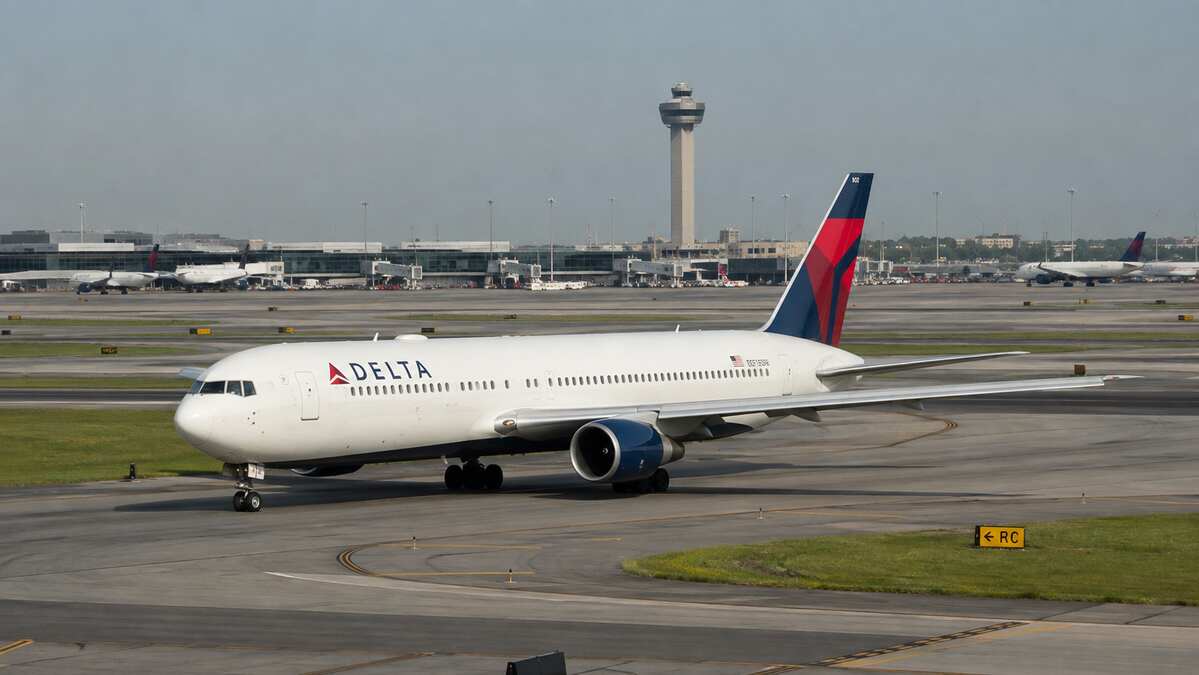
A tense radio exchange between a Delta Air Lines pilot and a ground controller at New York’s John F. Kennedy International Airport has drawn attention to cockpit radio monitoring and professional communication during busy taxi operations.
Delta Flight DL773, operated by a Boeing 767-300ER, was preparing to depart JFK for Los Angeles International Airport on August 22, 2026, when its crew appeared to miss multiple calls from ground control.
Delta Crew Misses Repeated Taxi Instructions at JFK
The exchange occurred at approximately 10 a.m. while Flight DL773 was taxiing toward Runway 4L. The controller instructed the aircraft to cross Runway 31L at Taxiway Kilo Echo, hold short of Kilo and follow a JetBlue aircraft.
After receiving no immediate response, the controller repeated the instruction and advised the crew that the transmission was intended for Delta 773. The pilot then responded, but the conversation quickly became confrontational.
The exchange continued:
JFK ATC: Delta 773 heavy, when able, cross 31L at KE, hold short of K, follow JetBlue.
JFK ATC: Delta 773 heavy, that was for you.
Delta pilot: Okay, go ahead.
JFK ATC: Ma’am, this is the second time I’ve had to repeat myself twice. Is everything okay?
Delta pilot: Uh, yes, everything is wonderful. We were just speaking here. Yes, please go ahead.
JFK ATC: You’re busy in there. Should I get you a follow-me vehicle?
Delta Pilot: Stop being rude.
JFK ATC: It’s not being rude. It’s a safety question. Me repeating myself multiple times to an aircraft that stopped is not being rude. Delta 773 heavy, do you need a follow-me vehicle?
The audio and a visualization of the interaction were published by the YouTube channel You can see ATC.
Controller’s Sarcastic Remark Draws Scrutiny
The controller’s suggestion that the Delta aircraft might need a follow-me vehicle became the most notable part of the recording.
Follow-Me Vehicle Reference Escalates Exchange
Airports generally use follow-me vehicles to guide aircraft or ground vehicles when crews require additional navigational assistance. In this instance, the controller’s reference appeared sarcastic because the aircraft was already receiving instructions by radio.
An unidentified voice subsequently told the controller to stop being rude. The controller denied that characterization and argued that repeatedly calling an aircraft without receiving a response constituted a legitimate safety concern.
While the controller had an operational reason to seek confirmation from the crew, the sarcastic wording added tension to what otherwise could have remained a routine correction.
Missed Radio Calls Raise Operational Questions
Flight crews operating at major airports are expected to monitor the assigned air traffic control frequency and respond when their callsign is transmitted. A single missed call is not unusual, but multiple unanswered transmissions can become significant when an aircraft is moving through an active taxi environment.
The Delta pilot explained that crew members had been speaking inside the cockpit. The recording, however, does not independently establish why the transmissions were missed or whether the crew was addressing another operational matter.
A brief acknowledgment or apology might have ended the disagreement more quickly. Likewise, the controller could have communicated the same safety concern without using sarcasm.
JFK Taxi Operations Demand Close Attention
JFK is among the busiest and most operationally complex airports in the United States. Multiple runway crossings, intersecting taxiways and simultaneous aircraft movements require precise coordination between pilots and controllers.
Taxi clearances may contain several instructions, including runway crossings, routing changes and hold-short requirements. Missing part of a clearance can interrupt traffic flow or create confusion about an aircraft’s intended movement.
In this case, the controller later directed Flight DL773 to cross Runway 31L at Kilo Echo, join Kilo 4 and hold short of Kilo. The crew correctly read back the revised clearance and continued taxiing.
Delta Flight Continues Without Major Disruption
Flight DL773 was scheduled to operate from New York to Los Angeles using a Boeing 767-300ER. Although the ground-control exchange briefly interrupted the taxi process, the supplied information does not indicate that it led to a cancellation, diversion or other major operational disruption.
The incident illustrates two distinct concerns: pilots must remain attentive to radio calls during ground operations, while controllers should communicate safety issues clearly and professionally. In a complex operating environment such as JFK, both disciplined monitoring and measured communication are essential to maintaining safety and efficiency.
