


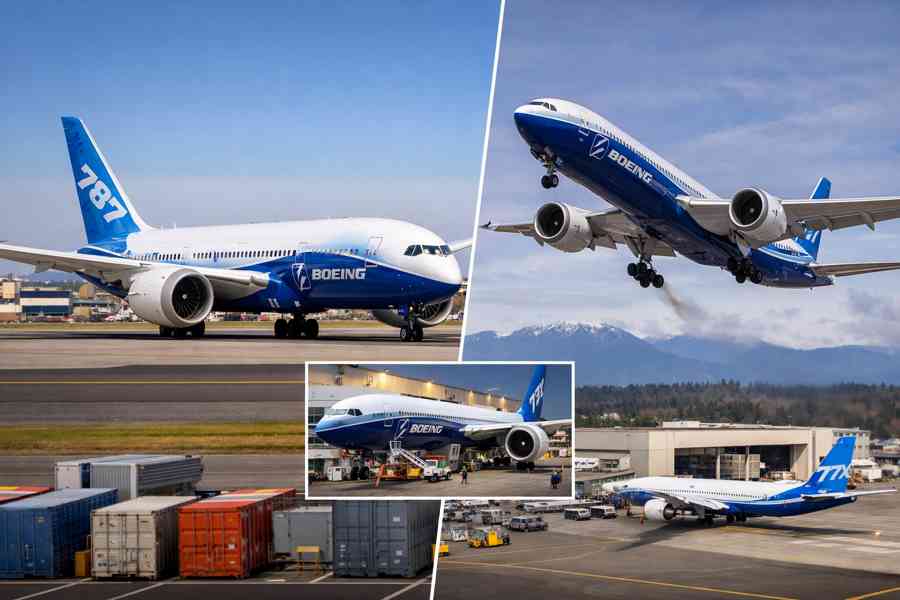
Boeing is moving forward on two of its most important commercial aircraft programs, advancing certification work on an upgraded 787 Dreamliner while preparing the first production flight of its long-delayed 777X. The developments signal incremental progress as the U.S. planemaker works toward new customer deliveries and seeks to strengthen its competitive position in the long-haul widebody market.
Higher MTOW 787 Dreamliners Set for 2026 Deliveries
Boeing confirmed plans to begin delivering higher Maximum Takeoff Weight (MTOW) versions of the 787 Dreamliner starting in early 2026. The upgrades apply to the 787-9 and 787-10 variants and are designed to improve range and payload capability without changing the aircraft’s fuel capacity.
Under the modification, the 787-9 will gain an additional 4,540 kilograms in allowable takeoff weight, while the larger 787-10 will see an increase of 6,450 kilograms. Boeing says the added capability equates to roughly 400 nautical miles of additional range or up to six tons of extra cargo payload, giving airlines more flexibility in route planning and aircraft utilization.
The smaller 787-8 is not included in the MTOW increase program.
The enhanced versions are already moving through Boeing’s production system and certification process. According to Reuters, airlines are expected to benefit from improved operational economics, particularly on long-haul or cargo-heavy routes where payload restrictions have previously limited performance.
Operational Flexibility for Airlines
The higher MTOW option allows carriers to optimize their networks by either flying longer distances or carrying more cargo, depending on market needs. This flexibility is especially valuable as airlines look to maximize revenue from belly cargo while maintaining passenger service.
Boeing officials also confirmed to Reuters that the company’s production lines can build standard and higher MTOW versions of the 787 simultaneously. That approach allows airlines to select configurations tailored to their specific operational requirements without disrupting delivery schedules.
Aircraft equipped with the upgraded weight limits are expected to be delivered during the first half of 2026. Boeing has not disclosed which airline will receive the first aircraft, but multiple carriers have expressed interest in the enhanced capability.
Competitive Position Against Airbus
The Dreamliner competes directly with the Airbus A350 family, particularly the A350-900 and A350-1000. The increased MTOW improves the 787’s competitiveness by expanding mission flexibility while preserving its fuel efficiency advantages.
Since entering service with All Nippon Airways in 2011, the 787 has become one of Boeing’s most successful widebody programs, accumulating more than 2,000 firm orders worldwide. Over 1,200 aircraft are currently in service, operating with major airlines including British Airways, Lufthansa, Air France, Singapore Airlines, United Airlines, American Airlines, and Qatar Airways. Emirates is also set to join the list of Dreamliner operators as deliveries begin.
The upgrade is expected to further support demand as airlines modernize fleets and retire older, less efficient aircraft.
First Production 777X Flight Planned
In a separate development, Boeing is preparing for the first flight of a production-standard 777X, which is expected to take place in April. The milestone marks a critical step in the certification process for the next-generation widebody, which has experienced significant delays since its launch in 2013.
Testing activity is ongoing at Boeing’s Everett, Washington, assembly site. Fuel system testing is currently underway at Paine Field, with engine evaluations also planned as part of certification preparation. A Reuters reporter observed the aircraft at a fuel dock this week, indicating that preparations are progressing.
Certification Role of Production Aircraft
While Boeing already operates a fleet of dedicated 777X flight test aircraft, regulators also require testing with production-configured airplanes built to customer delivery standards. These flights help verify performance and systems without specialized test instrumentation.
Boeing has indicated that production aircraft can support tests that do not require unique flight test equipment, providing regulators with data representative of real-world delivery configurations. Approval from the Federal Aviation Administration is required before the aircraft can enter commercial service.
Delays, Costs, and Market Pressure
The 777X program is now running roughly six years behind its original schedule, and Boeing has recorded about $15 billion in charges related to development challenges and schedule extensions. Despite the setbacks, the aircraft remains central to Boeing’s long-haul strategy, intended to replace older 747s and earlier 777 models while complementing the smaller 787.
Airbus has increased competitive pressure in the large widebody segment, pushing Boeing to demonstrate progress on the 777X. Lufthansa was among the earliest customers, placing its order in the same year the program was launched.
Boeing CEO Kelly Ortberg recently acknowledged a potential issue involving GE Aerospace engines used on the aircraft, but the company expects the matter will not delay planned first deliveries. Current expectations still point to initial customer deliveries beginning next year, pending successful certification.
