


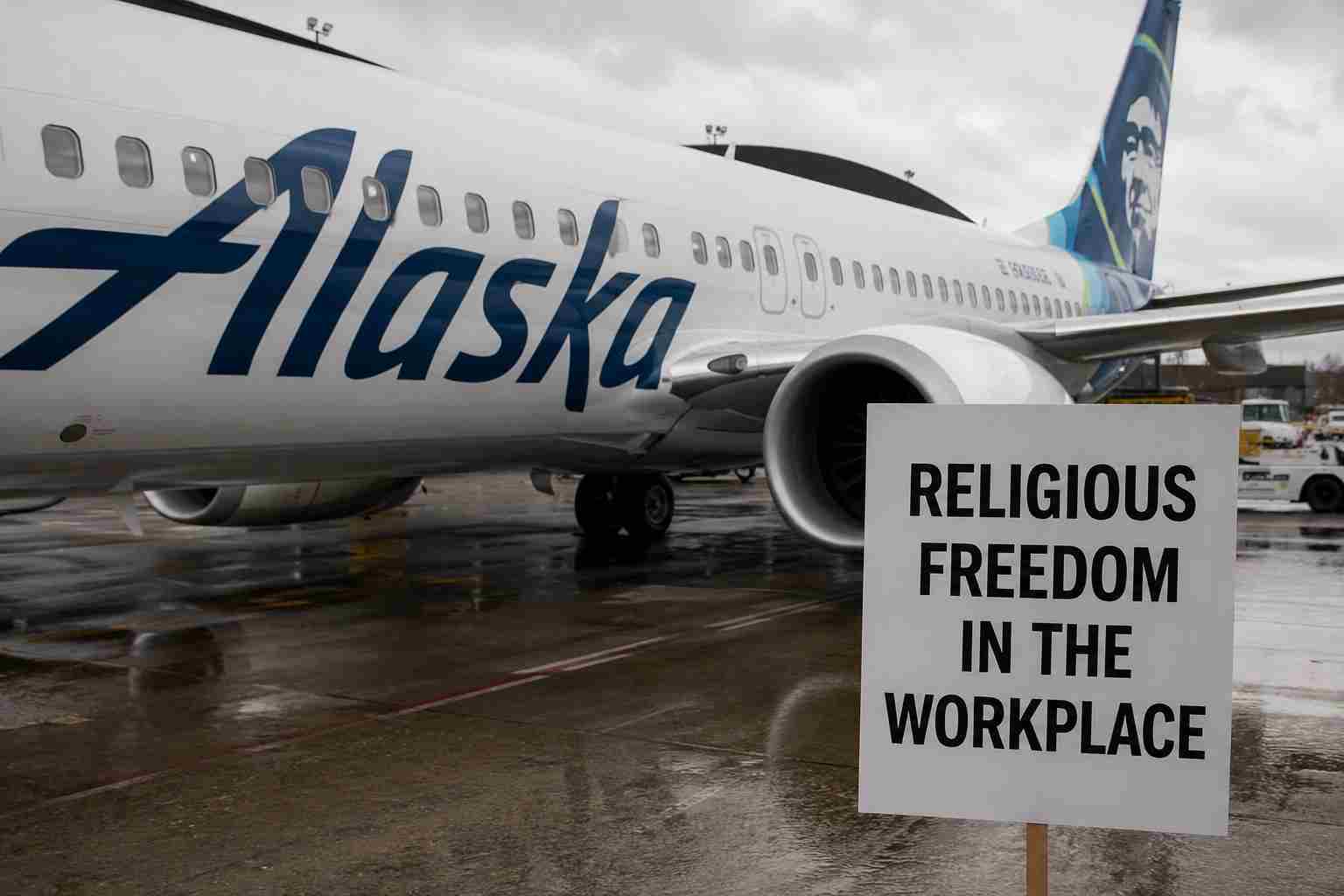
Ninth Circuit sends dispute over 2021 firings back for jury trial in Seattle
Case raises questions about workplace speech, religious rights, and union conduct
A federal appeals court has revived a religious discrimination lawsuit against Alaska Airlines and the Association of Flight Attendants-CWA, sending the case back to Seattle for a jury trial and reopening a contentious dispute over employee speech and religious rights.
The U.S. Court of Appeals for the Ninth Circuit ruled on June 24, 2026, that two former flight attendants presented sufficient evidence for a jury to determine whether they were terminated because of their Christian beliefs. The decision overturns a prior lower court ruling that had dismissed the claims before trial.
The case, Brown v. Alaska Airlines, Inc., No. 24-3789, centers on the 2021 termination of flight attendants Marli Brown and Lacey Smith after they questioned the airline’s public support for the proposed Equality Act on an internal employee platform.
Court Finds Evidence Could Support Religious Bias Claims
Writing for the three-judge panel, Judge Daniel A. Bress concluded that the plaintiffs had provided enough evidence to allow a jury to assess whether unlawful discrimination occurred. The ruling does not determine liability but instead allows the claims to proceed to trial in the U.S. District Court for the Western District of Washington.
The panel found that both Alaska Airlines and the union could be subject to scrutiny under federal civil rights law, particularly under Title VII, which prohibits employment discrimination based on religion.
The plaintiffs are represented by First Liberty Institute, a conservative Christian legal organization. The group argued that the firings reflected hostility toward religious viewpoints in the workplace.
Internal Debate Over Equality Act Sparked Dispute
The conflict began in early 2021 when Alaska Airlines posted a message on its internal communication platform, Alaska’s World, expressing support for the Equality Act. The proposed legislation sought to expand federal nondiscrimination protections to include sexual orientation and gender identity.
The company invited employees to comment, despite internal awareness that the issue raised concerns among religious staff. Testimony cited in court records indicated that company leadership knew such concerns had been repeatedly expressed.
Smith, who had worked for the airline for six years, posted a brief question asking whether a company could regulate morality. Brown submitted a more detailed response arguing that the legislation could undermine religious freedom and affect spaces such as shelters and prisons.
Both comments were subsequently deleted by the airline, and the company closed further discussion while initiating investigations into the two employees.
Firings and Disciplinary Process Under Scrutiny
During her disciplinary interview, Brown identified her comments as rooted in her religious beliefs, emphasized respect for LGBTQ colleagues, and requested a religious accommodation. Her supervisor reportedly found her sincere and initially recommended only documenting the discussion.
Despite that recommendation, Alaska Airlines terminated Brown, stating that her comments violated company anti-harassment policies by equating LGBTQ individuals with predators.
Smith, following advice from union representatives, described her post as philosophical rather than religious. She was also terminated, although she had previously been under disciplinary warning.
The appeals court found that a jury could question whether the airline’s stated reasons for termination were pretextual, particularly in Smith’s case, where the panel split 2-1 in allowing her claim to proceed.
Union Conduct Plays Central Role
The court also highlighted the role of the flight attendants’ union, finding that its conduct could support claims of bias. Internal communications showed union officials actively engaging with management during the investigation.
Among the evidence cited were messages from a union leader criticizing the employees and internal statements suggesting that disciplinary action should be taken. The court concluded that a reasonable jury could interpret these actions as evidence of anti-religious bias.
Although the union argued that the termination decisions ultimately rested with the airline, the court rejected that defense, noting that unions still have a legal duty to fairly represent their members.
The panel unanimously revived claims against the union for both plaintiffs.
Policy Changes and Broader Implications
Following the incident, Alaska Airlines revised its internal communication policies, eliminating its previous “three-strikes” commenting system and introducing stricter rules prohibiting religious and political discussions on its platform.
The airline had initially responded publicly to the posts, emphasizing that its support for the Equality Act was rooted in anti-discrimination principles and aligned with company values. It later removed the comments entirely and tightened moderation policies.
What Comes Next
The case now returns to federal court in Seattle, where it is expected to proceed to a jury trial unless a settlement is reached. Representatives for Alaska Airlines declined to comment on the ruling, while the union did not respond to requests for comment.
The decision comes amid a growing number of legal disputes involving workplace speech, religious expression, and corporate diversity policies. Similar cases involving airline employees at other carriers have also drawn national attention, underscoring ongoing tensions between inclusion initiatives and religious accommodation in the workplace.
As the case moves forward, it is likely to serve as a significant test of how courts balance those competing interests under federal employment law.
