


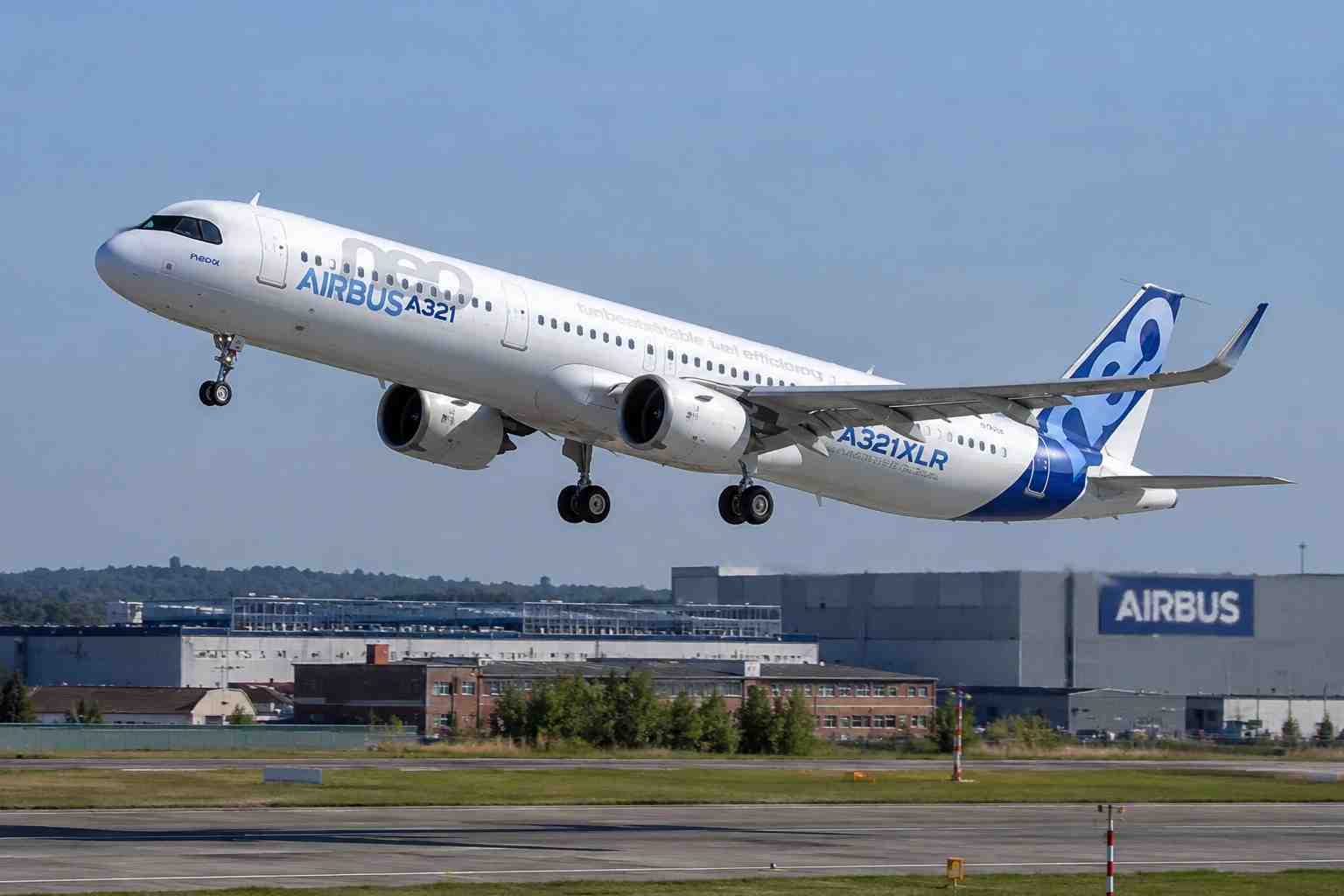
TOULOUSE, France — Airbus is preparing a major upgrade for its best-selling A320 Family as the aircraft manufacturer seeks to improve production efficiency, reduce manufacturing complexity, and keep its single-aisle aircraft competitive well into the next decade.
The new package, known as STEP4—short for Synchronized Targeted Embodiment Point—will introduce a combination of proven technologies from the recently launched A321XLR alongside new structural and systems improvements. The enhancements will be applied across the A320neo, A321neo, and A321XLR families in phases.
The move comes more than 40 years after the A320 program entered commercial service, reflecting Airbus’ long-standing strategy of continuously improving existing aircraft rather than developing entirely new designs.
A321XLR Sets the New Design Standard
The A321XLR, which entered commercial service in late 2024 with launch customer Iberia, now serves as the design foundation for the broader A320 Family.
Airbus began developing the STEP4 package while the A321XLR itself was still in design and production. The initiative focuses on transferring successful innovations from the long-range aircraft to higher-volume variants while introducing additional improvements intended to simplify manufacturing and maintenance.
Rather than launching an all-new aircraft, Airbus is extending the capabilities of its existing platforms by integrating mature technologies and increasing design commonality across the family.
A key objective is maintaining operational compatibility with aircraft already in service while reducing production complexity across Airbus assembly lines.
A321neo Receives Proven A321XLR Technology
Wing and Flight System Improvements
Among the most significant changes, the A321neo will adopt several features originally developed for the A321XLR.
These include a redesigned, lighter wing incorporating a single-slotted inboard flap that replaces the current double-slotted configuration. The aircraft will also receive forward cabin temperature zones, an upgraded electronic rudder (e-Rudder), new generic flight control laws, an updated Flight Data Management Unit, and enhanced Multi-Functional Runway Lights (MFRL).
The new e-Rudder is designed to reduce aircraft weight while improving reliability and lowering long-term maintenance requirements.
Torsten Hartung, Head of A320 Family Development, explained the strategy behind the upgrades:
“We are putting the good ingredients from our XLR development on our high-volume platform onto the A321neo. How do we do that? By ‘marrying’ various new features, including the improved wing, which we have developed for the XLR, onto the A321neo.”
Hartung said the modernization effort makes practical sense because the A321neo already has an established production base.
“The A321neo, being an established programme, was a prime candidate to benefit from modernisation of its flight controls and other aspects. It was logical therefore to take features (ie. the wing, e-Rudder and the associated control laws) which have already been developed for the XLR and then implemented back into the A321neo.”
Airbus expects the increased component commonality to streamline manufacturing while also simplifying maintenance and operational support for airline customers.
Enhanced Takeoff Performance and Structural Upgrades
New Systems Improve Operational Flexibility
The A321neo will also gain the optional Enhanced Takeoff Performance Improvement (ETOC) package, previously introduced on the A350 and later incorporated into the A330neo.
The system improves takeoff performance by introducing intermediate flap positions, allowing airlines to optimize payload capabilities at airports with operational constraints. Airbus has adapted the technology specifically for the A321neo, where it works alongside the aircraft’s new wing design.
Beyond aerodynamic improvements, both the A321neo and A321XLR will receive a new Cobra Duct auxiliary power unit air intake positioned on the upper fuselage to improve cabin air quality.
Additional structural enhancements include upgraded corrosion protection for the cabin floor, cargo compartment, and passenger doors, along with reinforced cabin flooring to accommodate evolving passenger and baggage weight standards. Airbus is also expanding the use of LED lighting systems, including runway and beacon lights.
The corrosion protection package incorporates titanium seat rails and titanium cover sheets on the upper deck, while improvements to drainage systems, sealants, and panel sills strengthen durability in the lower deck.
Standardized Systems to Reduce Airline Operating Costs
STEP4 also introduces a standardized Flight Data Interface and Management Unit (nFDIMU) across the entire A320 Family.
The updated system offers greater data-processing capability, increased operational flexibility, and higher levels of parts commonality among aircraft variants. Airbus expects the changes to simplify spare parts inventories and maintenance planning for airline operators managing mixed A320 Family fleets.
The A320neo will receive many of the STEP4 improvements in stages. While it will not adopt A321-specific features such as the redesigned wing, enhanced takeoff package, or forward cabin temperature zones, it will gain common structural upgrades, corrosion-prevention measures, the Cobra Duct system, updated flight controls, the e-Rudder, and reinforced cabin floors over time.
By extending technologies pioneered on the A321XLR across its single-aisle lineup, Airbus aims to strengthen production efficiency, improve fleet commonality, and ensure the A320 Family remains competitive in the global narrowbody market well beyond 2030.
