


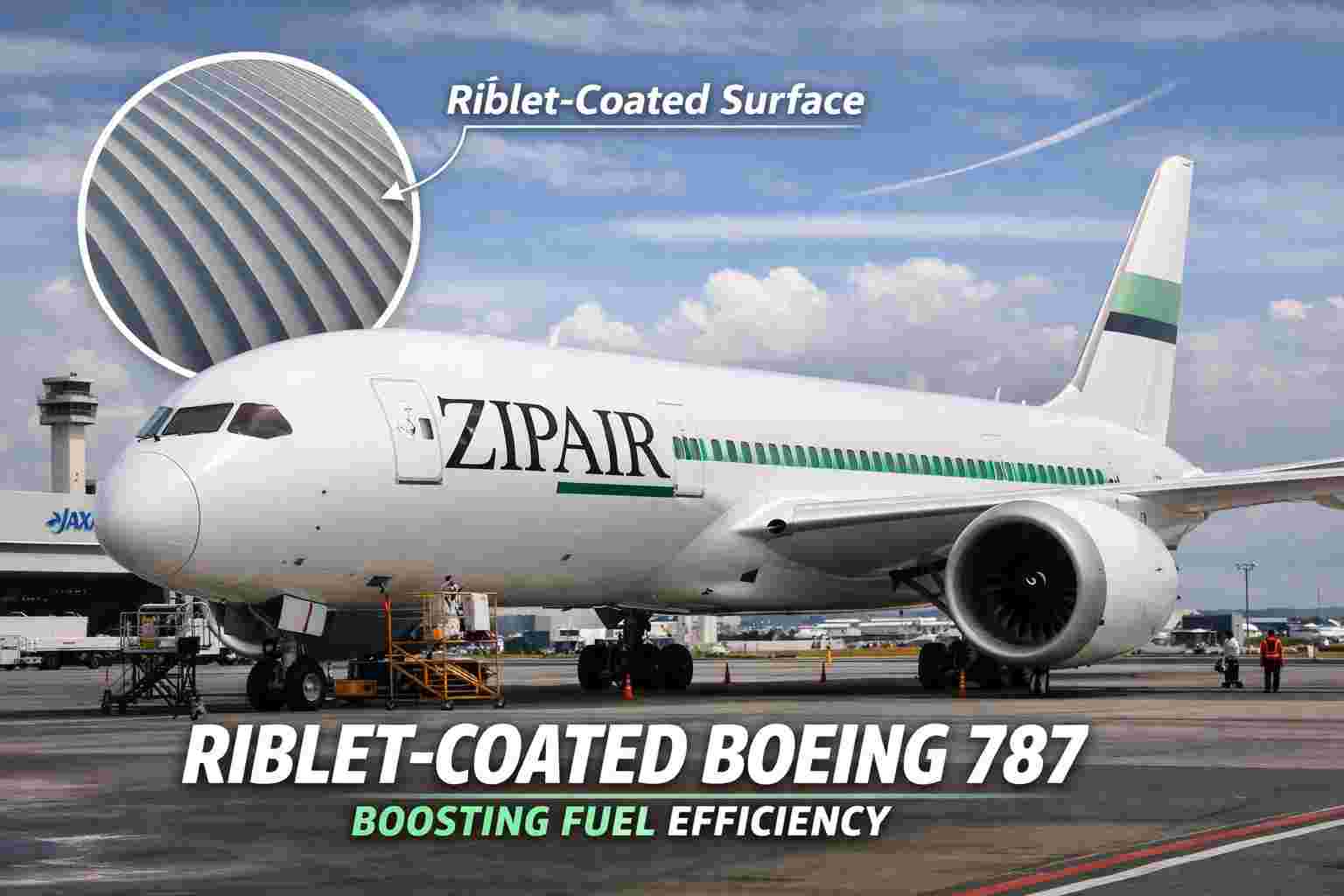
TOKYO — Budget long-haul carrier ZIPAIR, a brand under Japan Airlines, has begun operating its first Boeing 787-8 aircraft coated with a riblet-shaped surface treatment designed to reduce aerodynamic drag and improve fuel efficiency. The aircraft entered international service in late January 2026, marking the first application of the technology on a ZIPAIR jet and signaling a broader push by Japanese aviation stakeholders to lower carbon emissions through incremental efficiency gains.
The aircraft, registered JA851J, was prepared primarily at Narita International Airport, where the coating was applied before being introduced into scheduled service. ZIPAIR operates the aircraft on international routes, where fuel efficiency improvements can generate outsized economic and environmental benefits due to long cruise segments.
Collaboration Across Aviation and Research Sectors
The riblet initiative is the result of a joint effort involving ZIPAIR, Japan Airlines, Japan Aerospace Exploration Agency (JAXA), and O-Well Corporation. Together, the partners aim to demonstrate that advanced surface technologies can be deployed efficiently on in-service aircraft while maintaining operational and appearance standards.
Riblets are microscopic, groove-like structures inspired by shark skin. When aligned with airflow along an aircraft’s surface, they reduce skin-friction drag during cruise flight. Even marginal reductions in drag can translate into meaningful fuel savings over thousands of flight hours annually, directly lowering carbon dioxide emissions.
Improved Application Method Reduces Downtime
The coating on the ZIPAIR aircraft was applied using an enhanced Paint-to-Paint Method, which allows riblet textures to be formed directly on top of existing paint layers. A water-soluble mold is used to imprint the riblet pattern, minimizing the need for repainting and reducing material waste.
According to the companies involved, application efficiency improved through the introduction of new positioning and crimping jigs, which increased accuracy and shortened installation time. Portions of the work were also completed earlier at Haneda Airport, enabling faster overall deployment without extended aircraft downtime.
Proven Fuel and Emissions Benefits
Japan Airlines has already demonstrated the performance potential of riblet coatings on its own fleet. In January 2025, the airline introduced large-scale riblet application on a Boeing 787-9 aircraft, later expanding the coated area to the upper fuselage in November 2025.
Based on JAXA estimates, cruise drag reduction improved from 0.24 percent to 0.31 percent following the expansion. Over one year of operations on long-haul routes such as Narita–Frankfurt, that improvement can reduce fuel consumption by approximately 154 metric tons and cut carbon dioxide emissions by about 492 metric tons per aircraft annually.
While the percentage gains may appear small, industry analysts note that across a global fleet, such improvements could deliver substantial cumulative reductions in fuel costs and emissions.
Advancing Next-Generation Riblet Designs
Beyond current applications, research teams are testing a higher-performance riblet geometry known as the sharp single bevel riblet. Shaped like a single-bevel blade in cross-section, the design has demonstrated skin-friction drag reductions of approximately 6 to 6.5 percent in testing, compared with around 5 percent for conventional riblets.
Engineers are now focused on evaluating the new design’s durability, resistance to weathering, and long-term performance stability under real-world airline operating conditions. These assessments are critical before wider commercial adoption can proceed.
J-SPARC Framework Supports Commercialization
The riblet project is being advanced under JAXA’s Space Innovation through Partnership and Co-creation program, known as J-SPARC. The initiative is designed to bridge government research and private-sector deployment, accelerating the commercialization of aerospace technologies with measurable operational impact.
Future work will concentrate on verifying long-term coating durability, ensuring visual consistency across aircraft exteriors, and expanding riblet coverage to additional airframes. For ZIPAIR and its parent group, the technology represents a pragmatic step toward meeting carbon neutrality commitments while also addressing rising fuel costs in a competitive long-haul market.
As airlines worldwide search for near-term solutions to decarbonize operations, riblet coatings offer a clear example of how small aerodynamic refinements can yield tangible economic and environmental returns when scaled across global fleets.
