


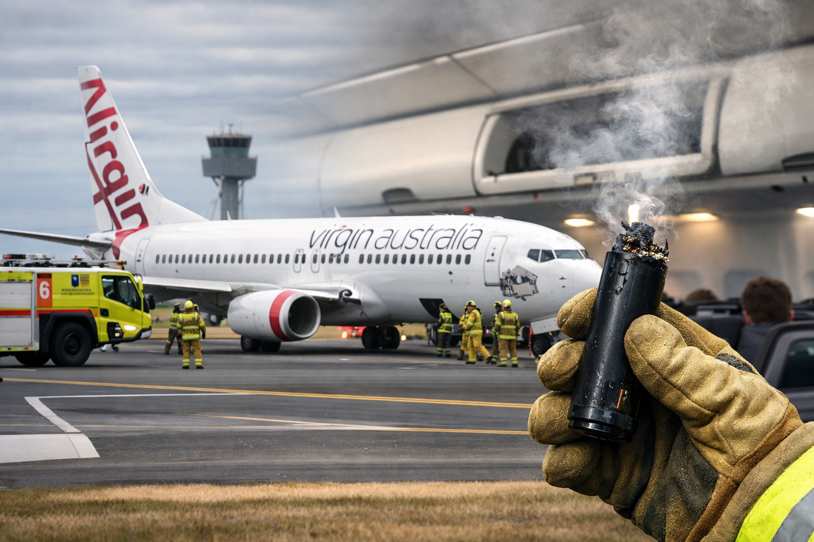
A Virgin Australia passenger flight traveling from Brisbane Airport to Melbourne Airport declared an emergency Sunday after a vape device activated and caught fire inside the aircraft cabin during descent.
Flight VA328, operated by a Boeing 737, departed Brisbane on Sunday afternoon and was approaching Melbourne when the incident occurred. Emergency services were placed on standby as the aircraft approached the airport. The plane landed safely at approximately 4:20 p.m., and no injuries were reported among passengers or crew.
Emergency Declared During Approach
The incident occurred during the final phase of the flight when a vape device activated unexpectedly inside the cabin.
Virgin Australia flight VA328 issued a PAN call during its approach to Melbourne after a vape device activated inside the aircraft cabin. A PAN call signals an urgent situation that requires attention but does not represent an immediate threat to the aircraft or passengers.
The aircraft, a Boeing 737 operating from Brisbane Airport (BNE) to Melbourne Airport (MEL), continued its descent while the crew managed the situation on board. Airport authorities in Melbourne activated emergency procedures and positioned response teams near the runway as a precaution.
The aircraft landed safely shortly after 4:20 pm. Aviation Rescue firefighters followed the aircraft after landing and removed the vape device from the cabin to eliminate any further risk.
Virgin Australia confirmed that no passengers or crew members were injured during the incident. The airline credited the crew’s quick response for safely containing the device, the Sydney Morning Herald reported.
Lithium Battery Risks on Aircraft
The event highlights ongoing safety concerns in aviation related to lithium-ion batteries used in many personal electronic devices, including vaping products.
Vapes use rechargeable lithium-ion batteries, which can overheat or ignite if damaged, overcharged, or exposed to high temperatures. These batteries are widely used in consumer electronics and are considered a known fire risk in aviation environments.
Airlines require passengers to carry devices powered by lithium batteries in cabin baggage rather than checked luggage. This rule allows crew members to respond quickly if a battery overheats or catches fire.
The growing number of battery-powered devices carried by passengers has increased the potential for such incidents. According to the Civil Aviation Safety Authority, travelers now carry an average of four battery-powered devices during flights.
Airlines Tighten Policies on Portable Batteries
The incident comes amid broader safety concerns across the aviation industry regarding lithium battery-powered devices carried by passengers.
Several airlines have recently implemented stricter rules governing the use of portable battery packs and similar devices during flights. These measures are designed to reduce the risk of onboard battery fires.
Virgin Australia began restricting the use of power banks in December due to fire risks. Qantas introduced similar restrictions during the same period.
Virgin also reviewed its power bank policy in July after a midair incident on a flight between Sydney Airport and Hobart Airport, where crew members had to extinguish a battery fire.
Airports have also experienced similar incidents. In November, Melbourne Airport evacuated about 150 people from the Qantas international business lounge after a passenger’s power bank ignited in his pocket.
These events have increased awareness across the aviation industry about the fire hazards linked to lithium batteries and rechargeable electronic devices frequently carried by travelers.
