


Social Media Outrage Ignites Over Misread Label
An Air Canada passenger’s viral video claiming she was served a six-month-expired in-flight meal quickly triggered intense online criticism—until viewers realized the allegation was based on a date-format misunderstanding rather than any lapse in food safety.
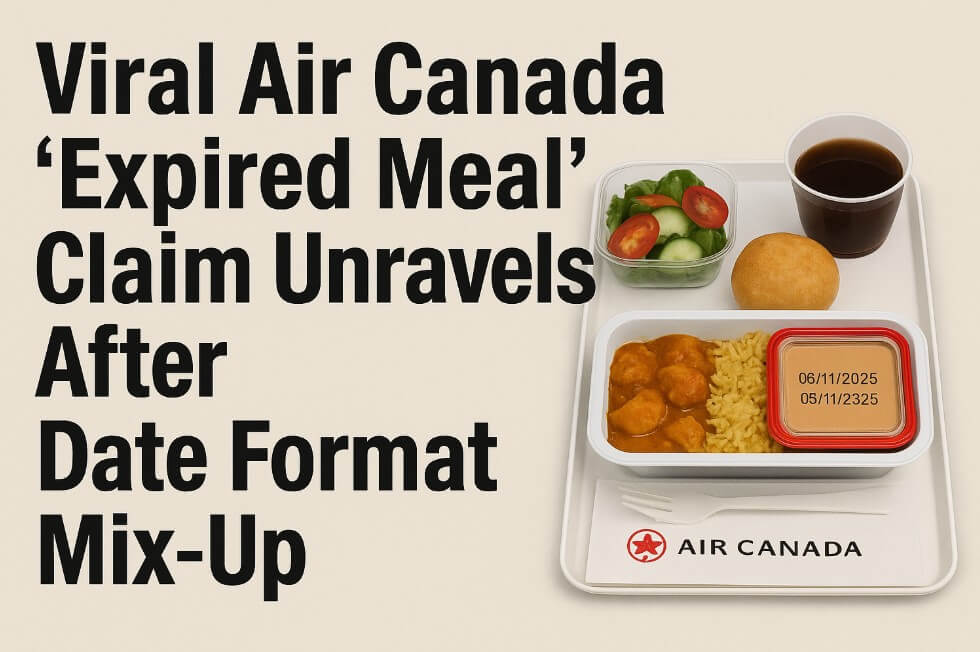
The traveler, departing Toronto Pearson Airport (YYZ), posted a video that zoomed in on two printed labels reading “05/11/2025” and “06/11/2025.” Interpreting the dates using the U.S. month-day-year format, she assumed “05/11” meant May 11 instead of 5 November, concluding the food had expired months earlier. The clip amassed millions of views within hours.
According to the press release, “The passenger posted the video confidently, millions watched it, and criticism toward the airline multiplied rapidly based on the false assumption.”
International vs. U.S. Date Standards at the Center of Confusion
Air Canada and its Toronto-based catering partners follow the international day-month-year system, meaning the meal was properly labeled for the same week as the flight. The misunderstanding—common among U.S. passengers traveling abroad—became the driving force behind the controversy.
The press release notes the chain of events: the passenger believed she had caught a serious safety lapse, and the video’s confident tone encouraged viewers to accept the claim at face value. The allegation gained speed even as the underlying assumption went unverified.
She later confronted a flight attendant, who explained that in-flight meals may be frozen and stored for long periods before service. But rather than clarifying the issue, the explanation deepened her suspicion. As the release states, “Instead of reducing concern, this reinforced her belief that something was wrong.”
The narrative continued spreading across social media even though the meal was correctly dated. “The video continued spreading, further amplifying a narrative that the airline had distributed unsafe food even though the labeling aligned correctly with the week of the flight.”
Travel site View from the Wing reported that the escalation was driven largely by unfamiliarity with global date formats rather than any actual safety concern.
Past Incidents Renew Discussion About Airline Food Age
Although the Air Canada episode turned out to hinge on a misunderstanding, the uproar resurfaced memories of real food-safety lapses in commercial aviation.
The release recalls several industry examples: United Airlines has previously served expired meals dating back to the early days of buy-on-board programs. In 2022, American Airlines offered pretzels manufactured before the pandemic. American also served curry dishes that were 16 months old; the carrier said those items were still within industry norms but later worked with vendors to reduce production time to 40–60 days.
The press release added context from the culinary world as well: “Celebrity chef Nigella Lawson has noted that curries should not be frozen longer than three months,” underscoring the gap between restaurant standards and airline food-storage practices.
Before the pandemic, shelf-life policies varied widely among major U.S. airlines. United permitted meals up to six months old, Delta allowed 12 months, and American provided for 18 months of storage. The industry has also seen labeling errors, including an easyJet sandwich printed with an expiration date nearly a decade before being served—a mistake widely attributed to a printing glitch rather than excessive storage.
A Case Study in Global Travel Literacy
Despite renewed debate about airline catering, the Air Canada controversy ultimately underscored a simpler problem: contrasting cultural norms. According to the press release, “The core issue did not center on food quality but on cultural expectations.”
Much of the world uses the day-month-year format, and confusion arises when passengers assume U.S. standards apply globally. Social media further amplifies these misunderstandings, where rapid reactions often outpace fact-checking.
The release suggests that printing months in full could help reduce misinterpretations for American travelers. However, the broader lesson is that international travelers should be aware of global formatting differences. As the statement concludes, “the most practical takeaway is that passengers should understand global formatting differences rather than expect their domestic standard abroad.”
A Viral Reminder About Accuracy Online
The Air Canada incident illustrates how quickly misinformation can spread when a simple misunderstanding goes unnoticed. A mislabeled—or misinterpreted—date can turn into a global debate within hours, reminding travelers and social-media audiences alike to pause before drawing conclusions.
Stay tuned for further updates, and follow us on social media for the latest developments.
