


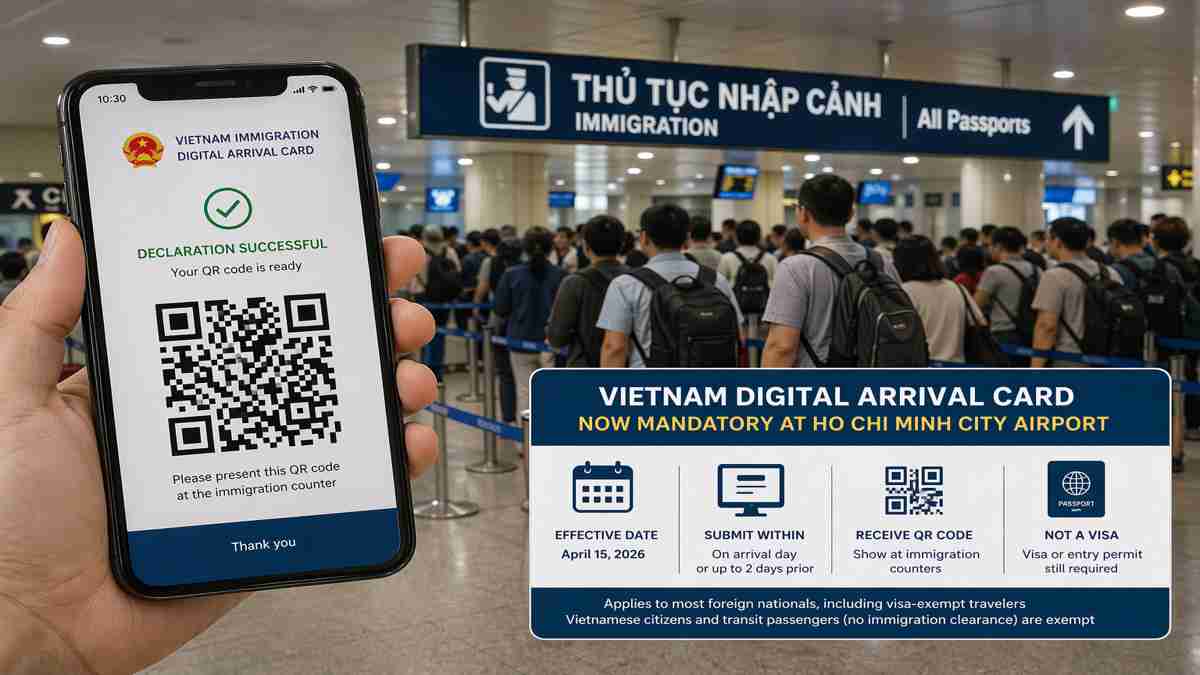
New pre-arrival QR system aims to ease congestion at Tan Son Nhat International Airport
HO CHI MINH CITY — Vietnam has introduced a mandatory Digital Arrival Card for most foreign travelers entering via Tan Son Nhat International Airport (SGN), marking a significant shift in its border processing system as authorities attempt to manage growing passenger volumes and long immigration queues.
The requirement, effective April 15, 2026, positions Vietnam alongside other regional adopters of digital immigration procedures and is designed to streamline entry at the country’s busiest aviation gateway.
The policy directly affects international passengers arriving in Ho Chi Minh City, including those connecting to domestic flights. Major carriers such as Vietnam Airlines and Singapore Airlines, both of which operate frequent services into SGN, are expected to notify passengers of the change, though early indications suggest uneven communication across airlines.
Transition from paper forms to digital system
Immigration authorities move to modernize entry procedures
Vietnam’s Immigration Department has implemented the online pre-arrival declaration to replace traditional paper-based arrival forms, part of a broader push to modernize border control systems and reduce administrative bottlenecks.
Under the new system, travelers must submit personal, passport, and travel information electronically before arrival. Upon successful submission, passengers receive a QR code that must be presented and scanned at immigration checkpoints.
The requirement applies to most foreign nationals, including visa-exempt visitors and overseas Vietnamese traveling on foreign passports. Vietnamese citizens and transit passengers who do not pass through immigration control are exempt.
Authorities emphasized that the Digital Arrival Card does not replace visa requirements. Travelers are still required to obtain appropriate visas or entry permits before completing the declaration process.
Submission window and process requirements
Travelers face tight timeline for completing declaration
The submission process is constrained by a limited time window. Travelers can complete the Digital Arrival Card either on the day of arrival or up to two days prior, with the system preventing earlier submissions.
Passengers must provide detailed information, including passport details, purpose of travel, accommodation address, and onward travel plans. The system verifies submissions באמצעות a one-time password sent via email before generating the QR code confirmation.
According to Mainly Miles, officials strongly advise saving the QR code digitally and carrying a backup copy. While passengers can complete the declaration upon arrival using QR links available at the airport, authorities caution that last-minute submissions may increase processing times rather than reduce them.
Addressing congestion at Vietnam’s busiest airport
Long queues and delays prompt digital shift
The introduction of the Digital Arrival Card comes as Tan Son Nhat International Airport continues to experience persistent congestion, particularly during peak arrival periods.
Immigration queues frequently exceed 500 passengers, with waiting times ranging from 30 minutes to over an hour, and in some cases extending to nearly two hours during evening rush periods.
By digitizing passenger information in advance, authorities aim to reduce manual data entry at immigration counters and improve overall throughput. The system is expected to allow immigration officers to process travelers more efficiently, potentially easing crowding in arrival halls.
However, industry observers note that the early phases of implementation may face operational challenges as both travelers and airport staff adjust to the new requirements.
Potential nationwide rollout under consideration
Expansion to other airports likely but timeline unclear
Although the system is currently limited to Ho Chi Minh City’s Tan Son Nhat International Airport, infrastructure is already in place to expand the Digital Arrival Card to other major entry points, including Hanoi and Da Nang.
This signals a likely nationwide rollout in the near future, though authorities have not announced a formal timeline.
The effectiveness of the program will depend heavily on consistent communication from airlines and compliance from travelers. Gaps in awareness or incomplete submissions could undermine efficiency gains, particularly during the initial rollout phase.
If successfully implemented, the Digital Arrival Card could significantly improve arrival processing at one of Southeast Asia’s busiest aviation hubs and align Vietnam more closely with regional digital immigration standards.
