


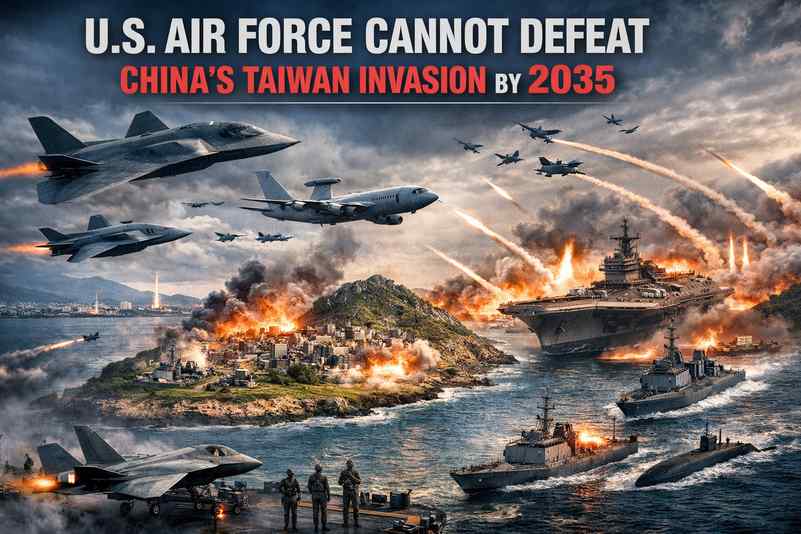
WASHINGTON, D.C. — The U.S. Air Force’s current modernization plans would likely leave it unable to defeat a Chinese invasion of Taiwan by 2035, according to a new unclassified wargame from the Mitchell Institute for Aerospace Studies that raises fresh questions about the Pentagon’s force structure and spending priorities in the Indo-Pacific.
The report, released April 9, examined how future Air Force force mixes might perform in a simulated conflict involving Chinese military action against Taiwan. Roughly 60 participants—including active-duty Airmen, industry officials and allied representatives—took part in the exercise, which compared the Air Force’s current projected modernization path with a more ambitious force redesign.
Researchers concluded that the Air Force’s existing trajectory would struggle to generate enough survivable combat power to stop a large-scale invasion, particularly if Chinese forces are able to sustain reinforcements from the mainland.
Current Force Structure Faces Major Operational Constraints
Missile Threats and Distance Undermine U.S. Air Operations
The exercise divided participants into two teams representing alternative future force structures.
“Team Doolittle” modeled the Air Force’s current modernization plan over the next decade, while “Team Mitchell” represented a more expansive modernization strategy featuring greater investment in next-generation aircraft and autonomous systems.
Team Mitchell fielded fewer total fighter aircraft overall but deployed more B-21 Raider bombers, Collaborative Combat Aircraft drones, E-7 battle management aircraft and sixth-generation F-47 stealth fighters.
The wargame simulated a conflict in 2035 across three phases: deterring a Chinese invasion of Taiwan, countering the invasion while striking mainland Chinese targets, and sustaining combat operations during a prolonged war.
Both teams encountered the same core strategic problem early in the exercise: basing aircraft close to Taiwan increased sortie rates but left them vulnerable to Chinese missile strikes, while operating from more distant bases reduced aircraft availability and slowed combat tempo.
According to the report, ground losses from Chinese missile attacks emerged as the most severe operational challenge—greater than aircraft losses in direct aerial combat.
As a result, both teams adopted a distributed “split-basing” strategy, dispersing forces across multiple locations and conducting attacks in waves rather than maintaining continuous pressure.
More Advanced Force Mix Performs Better, But Still Faces Challenges
Strategic Strike Capability Proves Decisive
The two force structures diverged significantly once full-scale combat began.
Team Doolittle, which relied more heavily on non-stealth aircraft and long-range standoff munitions, focused exclusively on stopping the invasion fleet moving toward Taiwan.
Team Mitchell, by contrast, was able to both challenge the invasion directly and launch deep strikes into mainland China, targeting logistics and reinforcement nodes supporting the assault.
Retired Col. Mark Gunzinger, project leader and co-author of the report, said Team Doolittle’s inability to generate sufficient long-range penetrating strike and counter-air sorties was the central weakness of the current force mix.
Wargame analysts found that the force ultimately failed because Chinese forces could continue reinforcing the invasion from secure positions on the mainland, beyond the reach of most U.S. strike assets.
Team Mitchell’s stealth-heavy force structure, built around penetrating aircraft with self-contained targeting and strike capabilities, gave it a stronger chance of disrupting Chinese operations at their source.
Lt. Gen. Jason Armagost, Deputy Commander of Air Force Global Strike Command, described strategic attack as the mechanism to “compel an adversary to change their strategy” and force systemic failure in their operational approach.
Inventory Shortages Threaten Long-Term Warfighting Capacity
Neither Team Could Sustain Extended Combat Operations
Despite Team Mitchell’s stronger performance, neither force was able to sustain operations over a prolonged conflict.
The report found that attrition rates in the Pacific scenario exceeded the aircraft inventories available to both teams, underscoring what analysts described as the cumulative impact of decades of force reductions.
Gunzinger said the shortfall reflects a structural readiness issue stemming from long-term cuts to Air Force combat aircraft inventories.
The report argues that the service no longer possesses sufficient depth to absorb the losses expected in a high-intensity war against a near-peer adversary such as China.
Mitchell Institute Calls for Force Expansion and Budget Rebalancing
To address the deficiencies identified in the simulation, the report issued 12 recommendations aimed at rebuilding what it called a “balanced Air Force with the capacity to win.”
Key proposals include increasing procurement of B-21 bombers and F-47 fighters, expanding air base defenses throughout the Pacific’s first and second island chains, and rebalancing investment between standoff weapons and penetrating strike platforms.
The institute also recommended developing a blended space- and air-based intelligence, surveillance and reconnaissance architecture to improve targeting resilience in contested environments.
In a broader budgetary recommendation, the report urged the Pentagon and Congress to shift defense resources away from the U.S. Army and toward the Air Force and Navy, arguing that the Army’s role in a Western Pacific conflict would be comparatively limited.
The findings are likely to intensify debate in Washington over defense spending priorities as the Pentagon continues to adapt its force posture to deter China in the Indo-Pacific.
With concerns over Taiwan growing and China rapidly expanding its military capabilities, the report suggests the United States may need to accelerate modernization plans—and significantly expand force capacity—if it hopes to maintain credible deterrence in the region by the mid-2030s.
