


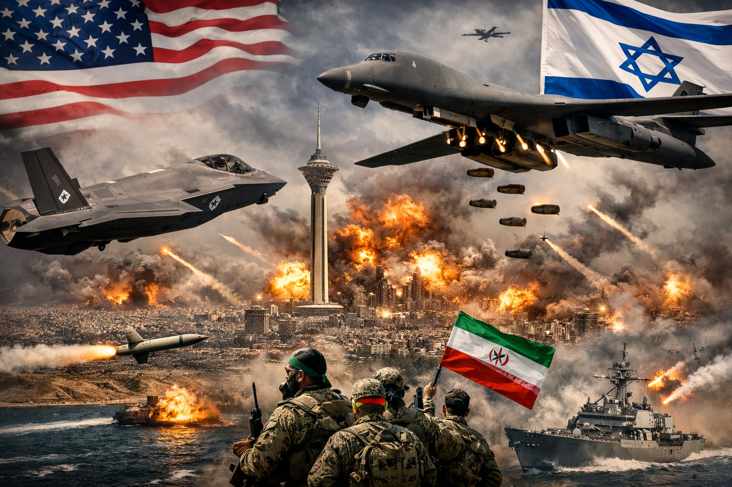
WASHINGTON, D.C. — The United States and Israel have launched a sweeping military campaign against Iran, carrying out large-scale aerial strikes aimed at crippling the country’s missile forces, leadership, and military infrastructure. The operation, which began on February 28, represents one of the most extensive coordinated air offensives in the region in recent decades.
Officials say the primary objective is to reduce Iran’s ability to threaten neighboring countries and disrupt international shipping routes. The campaign relies heavily on stealth fighters, long-range bombers, drones, and precision-guided missiles, marking a technologically intensive phase of modern warfare.
Surprise Strike Opens the Campaign
The military operation began with a surprise daytime strike on Iran’s capital on February 28. U.S. and Israeli forces initiated the campaign after the U.S. government authorized the mission—named Operation Epic Fury—on February 27 at 3:38 PM EST.
According to defense officials, the initial phase combined cyber and space warfare with conventional strikes. U.S. Cyber Command and Space Command reportedly targeted Iranian communications networks and sensor systems before the first missiles were launched.
At 1:15 AM EST on February 28, RTX Tomahawk cruise missiles struck multiple Iranian targets. Within the first 48 hours of the operation, U.S. forces reported hitting approximately 1,250 targets across the country.
Military analysts have compared the campaign with previous airpower-driven operations such as NATO’s 1999 bombing campaign in Yugoslavia and coalition airstrikes in Libya in 2011, where sustained aerial pressure contributed to major political changes.
Rapid Air Superiority Achieved
Coalition forces quickly established air superiority over Iranian territory, allowing surveillance and strike aircraft to operate with minimal resistance.
Uncrewed aircraft including the General Atomics MQ-9A Reaper and Israel’s Elbit Systems Hermes 900 conducted reconnaissance and battle damage assessment missions. Israeli fighter jets were reportedly operating over Tehran within 48 hours, highlighting the rapid collapse of Iranian air defense coverage.
The early phase of the war also produced several notable aerial combat incidents. An Israeli Lockheed Martin F-35 shot down an Iranian Yakovlev Yak-130 trainer aircraft, marking the first known instance of an F-35 destroying a crewed aircraft in combat.
Other regional forces also engaged Iranian aircraft and drones. United Kingdom F-35 fighters intercepted hostile drones over Jordan, while Qatar reported shooting down two Iranian Sukhoi Su-24 aircraft.
In a separate incident, Kuwait mistakenly shot down three U.S. F-15 fighters in a friendly fire event. All six crew members survived.
Early Targets: Leadership and Strategic Assets
Initial strikes focused heavily on Iran’s political and military leadership as well as strategic defense systems.
Reports indicate that Iran’s Supreme Leader Ayatollah Ali Khamenei and several senior military and intelligence officials were killed during the early stages of the campaign. Coalition forces also targeted air defense systems, missile launch infrastructure, and command centers across the country.
Iran’s air defense network reportedly offered limited resistance, partly because many systems had already been damaged during earlier confrontations with Israeli and U.S. forces the previous year.
Iran’s Missile and Drone Response
Iran responded with large-scale launches of ballistic missiles and one-way attack drones targeting military bases and infrastructure throughout the region.
Missile strikes and drone attacks affected Israel, Gulf Arab states, Turkey, and Azerbaijan. Several attacks hit military installations and nearby civilian infrastructure.
One strike destroyed a tactical operations center, killing six U.S. service members. Another incident inside Iran reportedly resulted in more than 150 civilian deaths when a school was struck during the exchange of attacks.
Israeli defense officials previously estimated Iran possessed roughly 3,000 ballistic missiles. However, coalition strikes rapidly reduced launch capabilities by destroying missile sites and support infrastructure.
By March 4, U.S. Chairman of the Joint Chiefs of Staff Gen. Dan Caine reported that Iranian ballistic missile launches had decreased by 86 percent, while one-way drone launches had fallen by 73 percent.
Regional Air Defenses Activated
Several countries across the Middle East activated advanced air defense systems to intercept incoming Iranian attacks.
The United Arab Emirates reported intercepting 137 ballistic missiles on the first day of fighting. That number rose to 165 within 24 hours and eventually reached 196 by March 5.
UAE radar systems also tracked 1,072 attack drones, intercepting 1,001 of them. Only 71 drones reached UAE territory.
During these defensive operations, the UAE deployed the South Korean KM-SAM Block II air defense system in combat for the first time.
New Weapons and Naval Engagements
The conflict has also introduced several new weapons systems into active combat.
The United States deployed the SpektreWorks Low-Cost Unmanned Combat Attack System, a drone designed to replicate the concept of Iran’s Shahed-136 loitering munition. U.S. Central Command described the system as a low-cost strike weapon capable of overwhelming air defenses.
The U.S. also debuted the Lockheed Martin Precision Strike Missile, a long-range ground-launched weapon intended to replace the Army Tactical Missile System.
Naval engagements have been significant as well. Near Sri Lanka, a U.S. Navy submarine sank an Iranian vessel in what officials described as the first American torpedo attack since World War II. Additional U.S. naval strikes destroyed more than 20 Iranian ships, including the Shahid Bagheri drone carrier and Iran’s most advanced submarine.
Rising Costs and Supply Concerns
The intensity of the campaign has raised concerns about weapon stockpiles. By early March, the United States had dropped more than 2,000 munitions while Israel had used approximately 5,000.
The Center for Strategic and International Studies estimated that the first 100 hours of combat cost about $3.7 billion.
President Donald Trump addressed supply concerns, stating U.S. munition stocks were “good” but not where the administration ultimately wanted them to be. Defense officials also confirmed efforts to increase production capacity within the defense industrial base.
Outlook for the Conflict
U.S. and Israeli officials say the campaign could continue for several weeks as coalition forces target remaining missile systems, naval assets, and military logistics networks.
Although airpower has significantly degraded Iran’s capabilities, analysts caution that the long-term political and strategic consequences of sustained aerial warfare remain uncertain.
