


Test Flight Incident Raises Questions Ahead of Key 2026 Procurement Decision
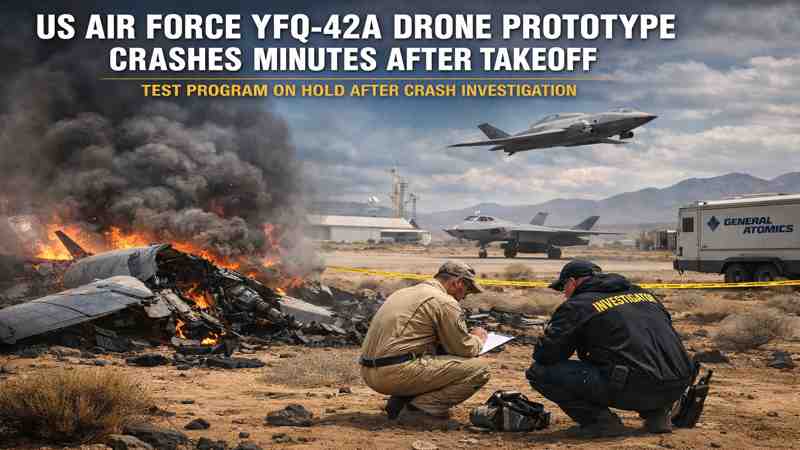
A prototype unmanned combat drone developed for the U.S. Air Force crashed shortly after takeoff in California on April 6, 2026, forcing contractor General Atomics Aeronautical Systems to suspend all test flights as investigators work to determine the cause.
The aircraft, identified as the YFQ-42A, is part of the Air Force’s high-profile Collaborative Combat Aircraft (CCA) program, which is expected to reach a major production milestone later this year. The incident introduces new uncertainty into a program seen as central to the Pentagon’s future air combat strategy.
Crash Occurs Minutes After Departure
According to company officials, the YFQ-42A departed from a General Atomics-operated desert test facility near Palmdale Regional Airport at approximately 1 p.m. Pacific Time. The aircraft went down just minutes into its flight under circumstances that remain unclear.
Despite the crash, company representatives said built-in safety systems operated as intended. These safeguards ensured there were no injuries or damage to surrounding areas, a key consideration in early-stage flight testing of advanced unmanned systems.
Investigators have begun reviewing wreckage and analyzing flight telemetry data. However, company executives cautioned that it is too early to determine a definitive cause of the failure.
A company spokesperson stated that established safeguards were effective and emphasized that the investigation will guide future actions. The pause in test flights reflects a cautious approach while engineers review all available telemetry and system performance data.
Program Significance and Timeline Pressures
The YFQ-42A is a core component of the Air Force’s Collaborative Combat Aircraft initiative, a next-generation effort designed to pair semi-autonomous drones with manned fighter jets. These aircraft are intended to perform a range of missions, including surveillance, electronic warfare, and strike operations, while reducing risk to human pilots.
The program is moving toward a critical decision point. The Air Force plans to select a platform for its Increment 1 procurement phase by September 30, 2026, with production decisions expected by the end of the fiscal year.
General Atomics has indicated that multiple production-representative units of the YFQ-42A are already in low-rate initial production. Prior to the crash, these aircraft had been participating in operational testing and evaluation activities, suggesting the program had been progressing toward maturity.
The setback could complicate timelines, particularly if the investigation reveals systemic issues requiring design or software changes.
Testing Halted as Investigation Proceeds
Following the incident, General Atomics announced an immediate halt to all YFQ-42A test flights. The company has not disclosed how long the suspension will remain in place, stating only that operations will resume once sufficient data has been analyzed and corrective actions, if any, are implemented.
The YFQ-42A first flew in August 2025 and recently entered a new phase of development involving integration of third-party mission autonomy software. Introduced in early 2026, the software is designed to enable semi-autonomous flight operations, allowing the aircraft to execute complex tasks while maintaining human oversight.
This capability is considered a cornerstone of the CCA concept, which emphasizes human-machine teaming in contested environments.
Competitive Landscape Intensifies
The crash comes amid an active competition between General Atomics and Anduril Industries, whose YFQ-44A drone is also under evaluation for the same Air Force procurement phase.
Both companies are racing to demonstrate reliability, performance, and scalability ahead of the 2026 selection deadline. Any delays or technical setbacks could influence the Air Force’s final decision.
While no injuries were reported, the crash introduces uncertainty into a high-profile program expected to reach a production decision by the end of fiscal 2026.
For now, the focus remains on determining what went wrong and ensuring the platform can meet the stringent safety and performance requirements demanded by the Air Force.
Further updates are expected as the investigation progresses and testing resumes.
