


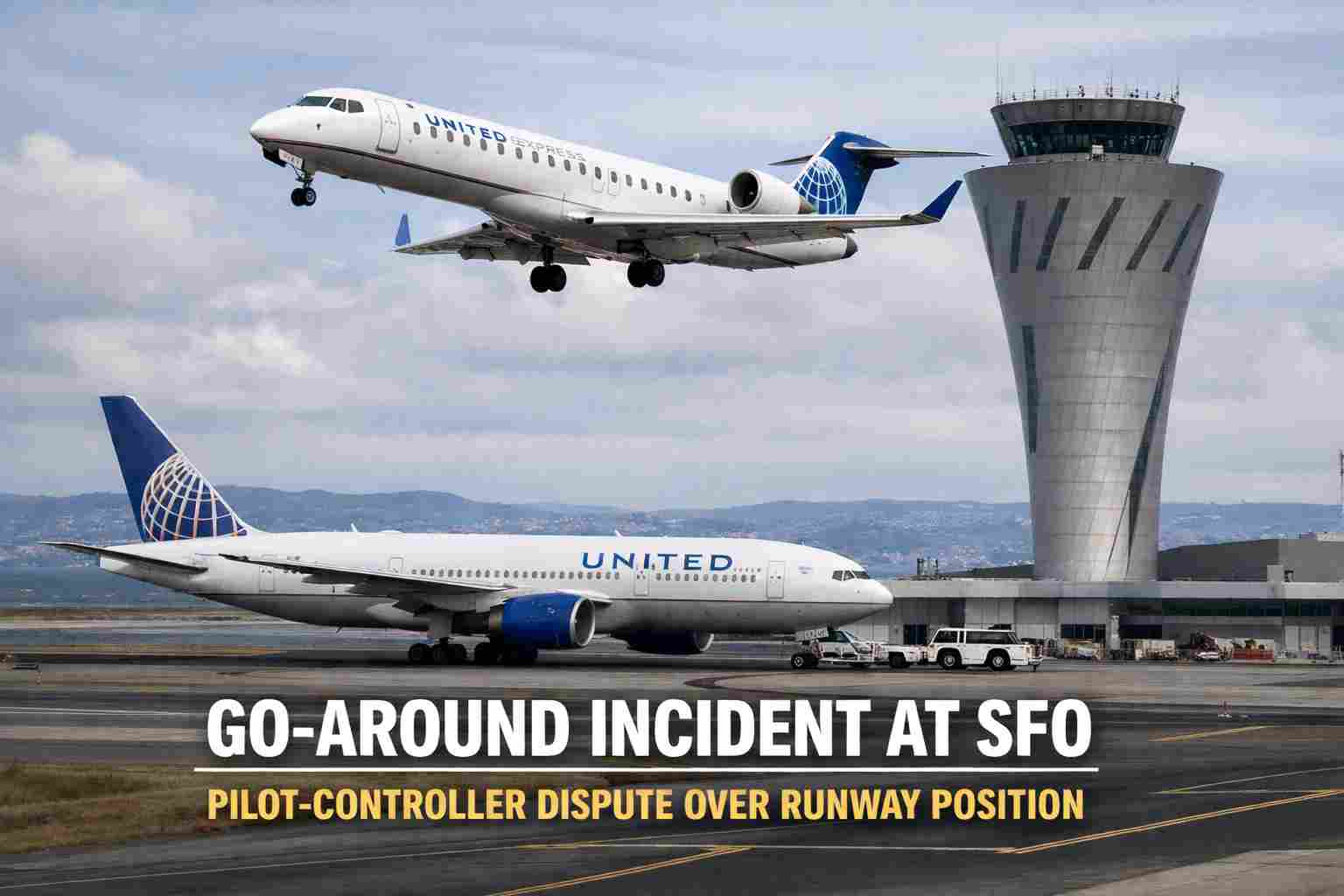
A routine landing at San Francisco International Airport turned into a closely watched aviation moment after a United Express flight executed a go-around, prompting a brief but pointed exchange between pilots and air traffic control. The January 29, 2026 incident underscores how differing perspectives between cockpit crews and controllers can surface during high-traffic operations—while still producing a safe outcome.
Incident Overview: A Conservative Call on Final Approach
Shortly after noon, United Express flight UA5899—operated by SkyWest Airlines—was arriving from Reno-Tahoe International Airport when the flight crew initiated a go-around during final approach at SFO. The aircraft, a Bombardier CRJ-700, was cleared to land but the pilots elected to discontinue the approach after questioning runway clearance.
Go-arounds are standard safety maneuvers and are encouraged when any uncertainty arises during landing. Following the maneuver, tower controllers asked the crew to explain the reason—routine procedure after a missed approach.
Disagreement Over Runway Positioning
According to the exchange, the pilot indicated concern that the tail of a Boeing 777-200ER—operated by United Airlines—waiting for departure on parallel runway 28R appeared to extend beyond the hold short line. Hold short markings are designed to keep aircraft clear of protected runway areas during landing and departure operations, particularly critical at airports with closely spaced parallel runways.
The tower controller responded immediately, stating the aircraft was properly positioned and not beyond the hold line, and then instructed the regional jet to contact departure control. The exchange drew attention online for its direct tone, though such brevity is typical in busy tower environments.
Safe Outcome and Timely Landing
After rejoining the arrival sequence, UA5899 landed safely at approximately 12:22 p.m., concluding a flight time of about 67 minutes. The aviation outlet OMAA T later reported on the timeline and operational details.
While the disagreement sparked discussion among aviation observers, there were no injuries, delays of consequence, or reported operational impacts beyond the brief go-around—an outcome consistent with the design of modern aviation safety systems.
Why Go-Arounds Are Encouraged
Industry guidance from airlines and regulators consistently reinforces conservative decision-making on approach. A go-around preserves safety margins whenever pilots perceive a potential conflict, unstable approach, or uncertainty—regardless of whether that concern is later confirmed.
Perspective plays a key role. Pilots assess conditions from a rapidly changing visual angle, while controllers rely on a combination of direct observation and surface radar. In complex environments like SFO, where parallel runway operations are routine, small differences in timing or aircraft movement can lead to divergent assessments.
Such judgment calls are uncommon but not unusual in high-density airspace.
Communication Under Pressure
Air traffic communications are designed to be concise and unambiguous. During peak traffic periods, that efficiency can sound abrupt to outside listeners. Pilots are trained to prioritize safety over schedule, and controllers are tasked with maintaining orderly, predictable runway operations. A disagreement in the moment does not necessarily indicate an error by either party.
Publicly available recordings from the event do not conclusively establish which assessment was correct. What they do show is that procedures functioned as intended, allowing the aircraft to safely reposition and land.
Operational Takeaways for Busy Hubs
The episode highlights several enduring principles of airline operations:
-
Pilots retain full authority to discontinue a landing when risk is perceived.
-
Controllers verify runway safety using both visual confirmation and radar tools.
-
Strict compliance with hold short requirements is essential during parallel runway use.
-
Clear, disciplined communication underpins safety during heavy traffic flows.
Despite the brief clash in viewpoints, the system delivered its intended result: a routine safety maneuver, followed by a normal landing. For major hubs like San Francisco, such layers of redundancy remain central to maintaining safety in one of the world’s busiest aviation environments.
