


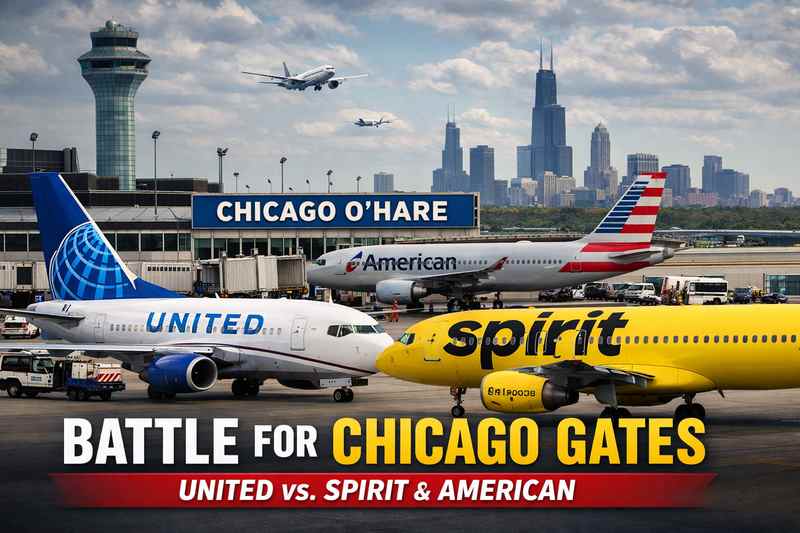
United Airlines is tightening its grip on Chicago’s busiest aviation hub, moving to acquire Spirit Airlines’ last two dedicated gates at O’Hare International Airport in a deal valued at roughly $30 million. The transaction underscores an escalating competitive battle among major U.S. carriers for dominance in one of the nation’s most lucrative airline markets, where loyalty revenue increasingly outweighs ticket sales.
The agreement positions United Airlines to further consolidate its presence at Chicago O’Hare, adding pressure on its largest rival at the airport, American Airlines. Chicago has become a focal point in a broader struggle for long-term revenue growth, customer loyalty, and strategic leverage among the country’s largest carriers.
Details of the Gate Acquisition
Under the terms of the deal, United will purchase gates G12 and G14 from Spirit Airlines for approximately $30.2 million. The transfer is subject to approval by a bankruptcy court, with a hearing scheduled for February 24, 2026.
Spirit, which has significantly scaled back its Chicago operations, plans to continue serving the market using common-use gates at O’Hare. That arrangement allows Spirit to exit its dedicated gate positions without immediately disrupting its reduced flight schedule at the airport.
The move follows earlier gate realignments at O’Hare that reshaped competitive positioning. In a previous transaction, American Airlines lost three gates but secured two former Spirit gates for $30 million. United’s latest purchase effectively gives it control over all of Spirit’s former dedicated infrastructure at the airport.
A Strategy of Matching and Pressure
United’s leadership has made clear that the airline intends to match any capacity expansion undertaken by American at O’Hare. The approach reflects a willingness to absorb short-term financial pressure in order to protect — and potentially expand — its long-term competitive position.
Industry observers describe this as strategic capacity deployment designed to weaken competitors’ positions while securing long-term dominance, View from the Wing flagged. By maintaining aggressive schedules and seat availability, United aims to make sustained competition costly for rivals that may already be under financial strain.
Chicago O’Hare, formally known as Chicago O’Hare International Airport, remains one of the busiest airports in the world, making gate access a critical constraint and a powerful competitive lever.
Why Loyalty Revenue Matters More Than Ever
The intensifying battle at O’Hare is driven less by ticket margins than by loyalty economics. Chicago is among the most valuable loyalty markets in the United States, where co-branded credit card spending and frequent-flyer enrollments generate billions of dollars in annual profits for airlines.
United previously adjusted its domestic capacity strategy to boost credit card spending volumes tied to its loyalty program. While the shift initially drew criticism from investors concerned about near-term margins, it helped United climb airline co-brand card rankings as American slipped.
American, for its part, has argued that Chicago remains indispensable. Company leadership has pointed to roughly 20 percent growth in loyalty enrollments and new credit card acquisitions in recent months, reinforcing the importance of maintaining a strong local presence. This is particularly significant as American has already reduced operations in other major business markets such as New York and Los Angeles.
Financial Stakes and Competitive Risks
United Chief Executive Scott Kirby has publicly suggested that American’s Chicago operations lose substantial money. However, external analysis indicates that once loyalty revenue is properly attributed to customer home markets, margins at O’Hare may be closer to systemwide averages than headline figures suggest.
Historically, airline profitability assessments have often understated hub performance by spreading loyalty revenue evenly across networks rather than tying it to where customers live and spend. That accounting nuance helps explain why American continues investing in Chicago despite intense competition and rising costs.
Abandoning the market would leave American with limited growth options, as gate and slot constraints in other major cities restrict expansion opportunities.
Implications for Travelers and the Industry
For travelers, capacity battles typically translate into lower fares and more flight options in the near term. Over time, however, if competition diminishes, dominant carriers may regain pricing power.
For airlines, the stakes are far higher. Control of gates at O’Hare is not just about flight schedules, but about securing long-term loyalty revenue and financial resilience in a core U.S. aviation market. United’s latest gate purchase signals that the fight for Chicago is far from over — and that the outcome could shape the competitive landscape of the U.S. airline industry for years to come.
