


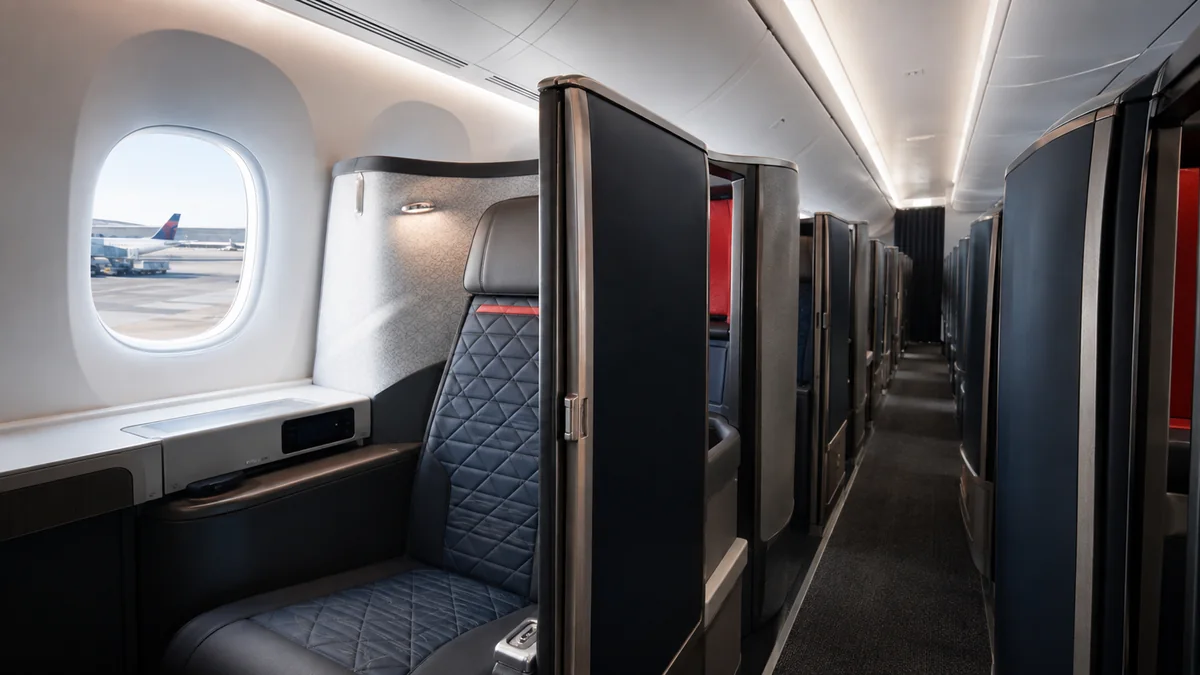
American Airlines is accelerating a major shift in its premium-cabin strategy, replacing its dedicated international and transcontinental First Class cabins with an expanded Flagship Suite Business Class product.
The transition affects the airline’s Airbus A321T and Boeing 777-300ER aircraft. Although American initially aimed to complete the change by late 2024, aircraft delivery schedules and the pace of cabin retrofits have pushed the broader phaseout toward 2027.
American Airlines Redefines Its Premium Cabin Strategy
The change applies specifically to Flagship First, a premium cabin positioned above Business Class. It does not affect the First Class product offered on American’s standard two-cabin domestic flights.
American began moving away from the three-cabin model after unveiling its Flagship Suite seats in September 2022. The airline’s strategy centers on offering a larger and more competitive Business Class cabin rather than maintaining a small First Class section.
Its older First Class product offered additional space but provided limited differentiation from Business Class. It also lacked the privacy features found in newer premium suites, while variations in onboard service made it difficult to justify a significantly higher fare.
As of August 2026, Flagship First remains available on some eligible flights. However, American has begun physically modifying aircraft to remove the cabin.
Physical Removal and Ticket Sales Are Separate Steps
American’s First Class retirement involves two different processes: removing the seats from aircraft and ending the sale of First Class tickets.
Aircraft entering major interior retrofits will return to service without a dedicated First Class cabin. American could nevertheless stop selling First Class before every affected aircraft receives its new interior.
On aircraft awaiting modification, existing First Class seats could potentially be managed as part of Business Class inventory. American has not yet disclosed its final policies for seat assignments or access during this transitional period.
Boeing 777-300ER Gains 70 Flagship Suites
American’s Boeing 777-300ER retrofit provides the clearest indication of its future premium offering.
The aircraft’s previous layout included eight First Class seats and 52 Business Class seats. Under the revised configuration, First Class is eliminated and Business Class expands to 70 Flagship Suite seats. Premium Economy also increases to 44 seats.
The first 777-300ER to receive the modification has returned to Dallas for final work, testing and certification. A second aircraft has been sent to Hong Kong as part of the retrofit program.
The Flagship Suite offers a sliding privacy door, direct aisle access and additional personal storage. These features are intended to create a more private and modern experience than American’s previous Business Class seats.
The project is therefore more than a straightforward removal of eight First Class seats. It increases the aircraft’s overall premium capacity and allows American to sell considerably more Business Class and Premium Economy tickets.
Airbus A321XLR Replaces the Specialized A321T
American is also retiring the specialized premium configuration of its Airbus A321T fleet.
The A321T currently features 10 Flagship First seats and 20 lie-flat Flagship Business seats. Developed for premium transcontinental routes, it is unusual among narrowbody aircraft because it offers separate lie-flat First Class and Business Class cabins.
American plans to convert these aircraft to a standard domestic configuration. The Airbus A321XLR is taking over their premium transcontinental role.
New Aircraft Eliminates Separate First Class
American’s A321XLR includes 20 Flagship Suite Business Class seats, 12 Premium Economy seats and 123 Main Cabin seats. It does not contain a separate First Class cabin.
The airline introduced the aircraft on premium routes from New York before expanding it to other markets. Its use on international services also demonstrates that American sees the A321XLR as an important part of its wider long-haul network.
Flagship Dining Expands Beyond First Class
One of the most distinctive elements of American’s First Class offering was Flagship First Dining, an elevated sit-down restaurant experience available inside selected Flagship Lounges.
American is preserving that premium ground service by making it available to more Business Class passengers.
Beginning September 15, 2026, eligible Flagship Business and Flagship Business Plus customers traveling on qualifying long-haul international, transcontinental and Hawaii routes will receive access to Flagship Dining at Dallas Fort Worth International Airport and Miami International Airport.
American also plans to reopen its Flagship Dining facility at Los Angeles International Airport later in 2026.
Final Phaseout Date Remains Unconfirmed
The transition means travelers will increasingly need to check aircraft types and seat maps when booking. American’s premium experience will vary while older and retrofitted aircraft operate simultaneously.
Passengers who value a separate First Class cabin will lose that option. However, travelers prioritizing privacy, lie-flat seating and direct aisle access may find the Flagship Suite more attractive.
American has not confirmed when it will stop selling premium First Class across its entire network. A wider phaseout during 2027 appears possible based on current fleet developments, but it remains an estimate rather than an official deadline.
The broader direction is clear: American Airlines is concentrating its premium investment on larger Business Class cabins, modern suites and expanded ground services instead of maintaining a small, separately branded First Class product.
