


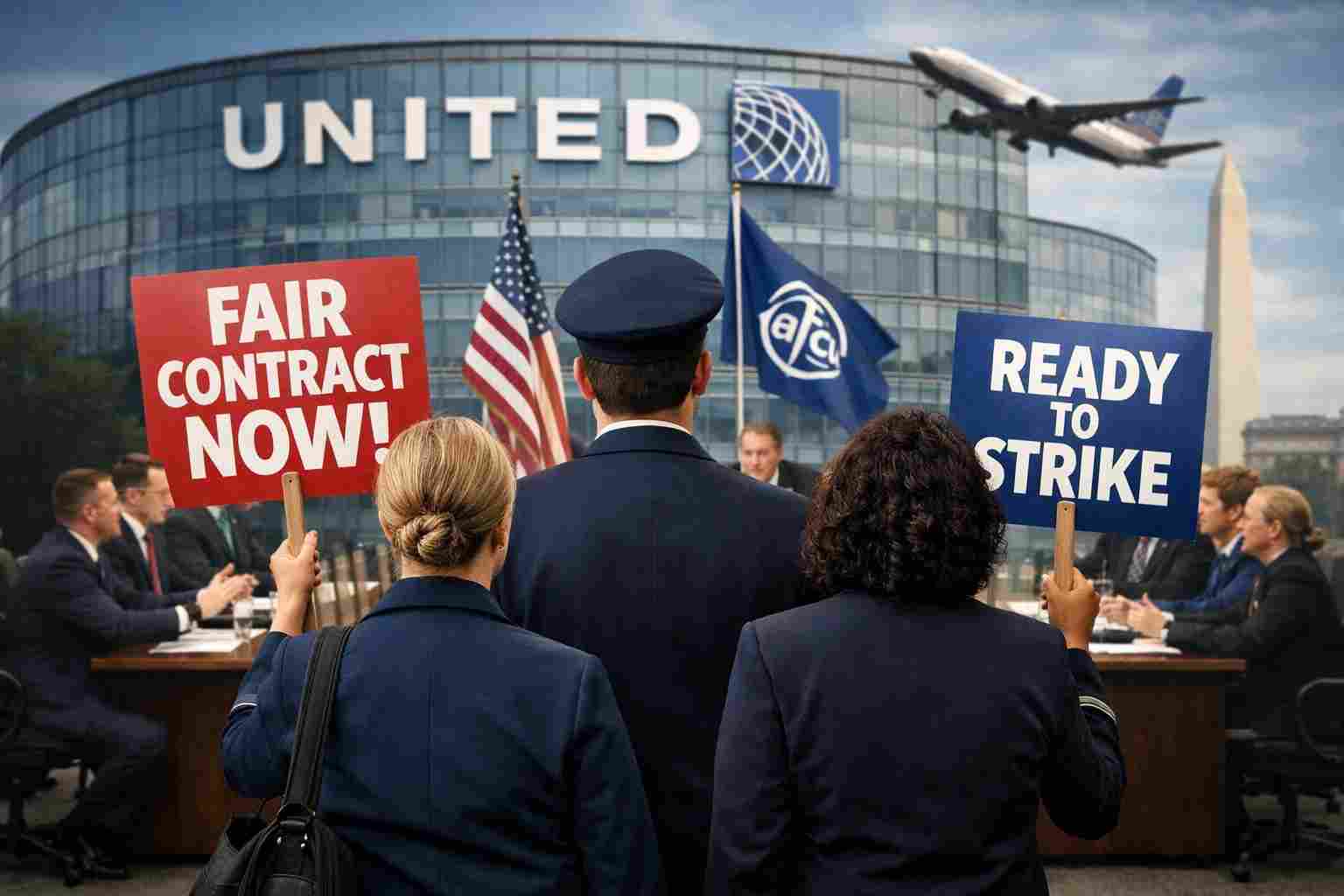
United Airlines and its flight attendants’ union have entered what could be the decisive phase of nearly six years of contract negotiations, with both sides convening this week in the nation’s capital for a final round of mediated talks.
The four-day bargaining session, which began Tuesday, brings together United Airlines and the Association of Flight Attendants-CWA (AFA-CWA) amid heightened expectations that a tentative agreement could be reached by Friday. The outcome is poised to have far-reaching implications for the airline’s workforce, cost structure, and operational strategy.
A Long-Running Dispute Nears Resolution
More than 30,000 United flight attendants have been working without a new contract since negotiations began nearly six years ago, making this one of the longest labor disputes in the airline’s recent history.
The current talks follow the rejection of a tentative agreement reached last summer. At the time, union leadership had warned members that the deal might represent the best achievable outcome under evolving political and economic conditions. However, flight attendants rejected the proposal by a wide margin, forcing negotiators back to the table.
According to PYOK, the environment surrounding the current negotiations closely resembles the one union leaders cautioned about previously, raising the stakes for both sides as they attempt to close remaining gaps.
Challenging External Pressures Build
United enters this critical negotiation period facing a series of external pressures that could influence its bargaining position.
Jet fuel prices have been rising, increasing operational costs across the airline industry. The carrier has already announced a 5% reduction in its summer schedule at Chicago O’Hare International Airport, signaling capacity adjustments in response to cost pressures and demand shifts.
Additionally, ongoing strain on the U.S. airspace system, linked in part to the partial federal shutdown, continues to disrupt operations. Broader geopolitical uncertainty in the Middle East adds another layer of unpredictability, particularly for international routes and fuel markets.
Together, these factors create a complex backdrop as United balances labor costs with broader financial and operational considerations.
United’s Proposal: Higher Pay with Conditions
United has positioned its latest offer as the most competitive compensation package in the U.S. aviation sector. The airline says the proposal would make its flight attendants the highest-paid in the industry, regardless of seniority.
However, the offer comes with significant conditions.
Under the proposal, flight attendants would be required to give up certain personal time-off provisions and accept the implementation of a Preferential Bidding System (PBS), a scheduling platform the airline says would improve efficiency.
The PBS would also introduce “sit rig” pay, compensating flight attendants for certain periods spent on the ground that are not currently paid. United argues that the efficiencies generated by the new system would help offset the increased labor costs tied to higher wages.
Union Pushback on Concessions
The AFA-CWA has consistently resisted any proposal that includes concessions, arguing that United’s financial performance does not justify trade-offs in working conditions.
Union leadership maintains that the airline has the financial capacity to provide higher compensation without requiring changes to scheduling flexibility or benefits. The union’s position reflects broader labor trends in the aviation sector, where workers are increasingly pushing for wage gains without concessions following the pandemic recovery.
In a recent communication to members, the union emphasized its goal of finalizing an agreement that supports the long-term interests of flight attendants, while acknowledging the challenges that remain in reaching a deal.
What Comes Next if a Deal Is Reached
If negotiators succeed in reaching a tentative agreement by the end of the week, the process will shift to internal union review.
The AFA-CWA’s master executive council must first evaluate and approve the agreement before it is presented to the full membership for a ratification vote. During last summer’s tentative agreement process, this review phase took several days, with only high-level details initially disclosed.
A ratified contract would mark a significant milestone for both United and its workforce, potentially stabilizing labor relations and providing greater predictability for the airline’s operations.
Industry Watching Closely
United Chief Executive Scott Kirby has previously indicated that the airline does not plan to scale back its broader investment strategy despite rising costs. Analysts will be closely monitoring whether that stance is reflected in the final terms of any agreement reached this week.
The outcome of these negotiations could also set a precedent for labor discussions across the airline industry, where unions and management teams continue to navigate post-pandemic economic realities.
With the deadline approaching, both sides face mounting pressure to deliver a deal that balances financial sustainability with workforce expectations—ending a prolonged dispute that has shaped United’s labor landscape for years.
