


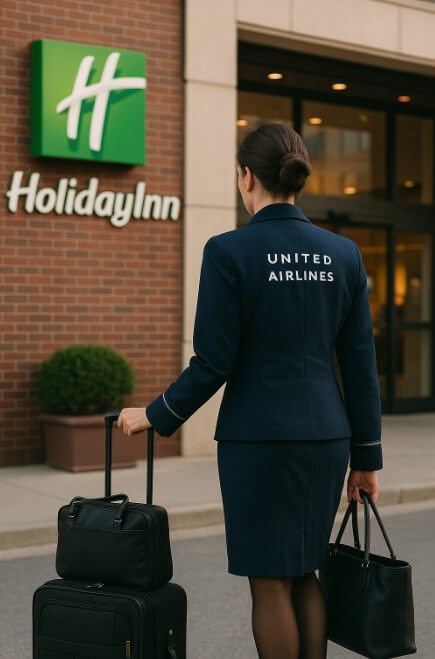
CHICAGO — United Airlines is facing growing pushback from hotels unwilling to accommodate its flight attendants during layovers, intensifying tensions between the carrier and its largest flight crew union amid ongoing contract negotiations.
The Association of Flight Attendants-CWA (AFA-CWA), which represents more than 25,000 United crew members, said the problem has become particularly visible across major international destinations, including London (LHR), Amsterdam (AMS), and New York (JFK). Hotels in these cities have reportedly become more reluctant to accept airline contracts, citing operational burdens and shifts in the post-pandemic travel economy.
The issue underscores a broader transformation in the hospitality industry, where hotels—once eager for airline business—are now prioritizing higher-paying leisure and business travelers. For United, headquartered at Chicago O’Hare International Airport (ORD), the shift complicates its ability to provide safe and contractually compliant accommodations for flight crews.
Changing Economics of Airline Lodging
For decades, flight attendants and pilots could expect stays in centrally located, premium hotels, often seen as a perk of the profession. That longstanding arrangement is eroding as the economics of hotel management evolve.
According to PYOK, many hotel operators now prefer guests who book directly, stay multiple nights, and spend more on amenities—offering higher overall revenue compared to short, unpredictable crew layovers. Airline contracts often include special conditions such as 24-hour check-ins, proximity to elevators or ice machines, and minimum quality standards, requirements that can restrict hotel operations and reduce flexibility.
“With strong post-pandemic demand,” one travel analyst noted, “many hotels have found they can maintain high occupancy rates at better margins without relying on airline business.”
The AFA-CWA has acknowledged that while guaranteed bookings once made airline partnerships appealing, hotels increasingly view them as logistical challenges that add strain to daily operations.
United, for its part, must walk a fine line—managing cost pressures while ensuring flight attendants have safe, comfortable, and contractually compliant lodging options. The carrier faces both reputational and operational risk if the issue worsens, particularly given strict rest-time regulations for flight crews.
Contract Disputes and Crew Dissatisfaction
The AFA-CWA has been vocal about the need for “better quality hotels located closer to central attractions and airports,” a priority it continues to press in ongoing labor talks. United management, however, points to escalating room rates and shrinking availability in key cities as factors forcing compromise.
The airline has recently invoked a clause in its existing agreement that allows for “downtown or downtown-like” accommodations—terminology that critics say has enabled the company to relocate crews to less desirable or more remote areas.
Examples include crew reassignments from central London districts to towns more than 20 miles away, along with similar displacements in Amsterdam, Rome, and New York. Flight attendants say these changes lengthen commute times, disrupt rest periods, and degrade overall layover quality.
Despite rising frustrations, progress at the bargaining table has been slow. A tentative agreement earlier this year proposed removing the controversial “downtown-like” clause and clarifying the definition of “business class” hotels. If adopted, those revisions could set stricter minimum standards for crew accommodations.
Still, formal bargaining sessions are scheduled to continue into Spring 2026, leaving many flight attendants doubtful about short-term improvements.
Industry Outlook: Hotels Hold the Leverage
The changing hotel landscape poses a strategic challenge not just for United but for the broader airline industry. As global travel normalizes, hotels are increasingly choosing flexibility and profitability over long-term corporate contracts—particularly those requiring specialized arrangements.
For airlines, that means higher costs and less control over where their crews stay, especially in high-demand markets. For unions, it means added pressure to ensure that flight attendants’ working conditions—including rest and recovery during layovers—remain protected.
If United and the AFA-CWA ultimately reach a new agreement, modest improvements in hotel selection may follow. But until then, many of the airline’s crew members will continue to navigate inconsistent lodging experiences and extended layover commutes.
As both sides prepare for another round of negotiations, the standoff reflects a broader reality in today’s travel economy: even longstanding industry relationships are being rewritten by shifting priorities and tighter margins.
Stay tuned with us. Further, follow us on social media for the latest updates.
