


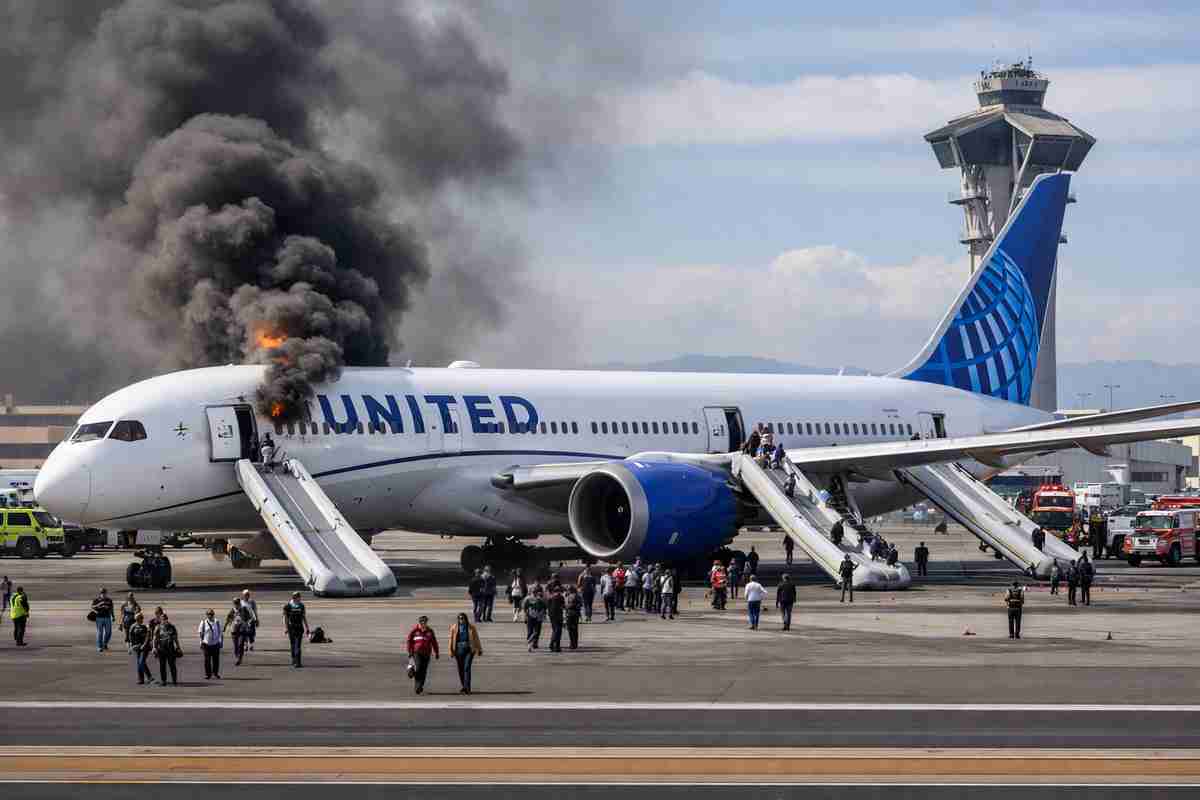
Passengers aboard a United Airlines transcontinental flight were evacuated onto the tarmac at Los Angeles International Airport on March 2 after an engine malfunction forced the aircraft to return shortly after departure, triggering a rapid emergency response and a federal investigation.
The Boeing 787-9 Dreamliner was operating as flight UA2127 from Los Angeles to Newark Liberty International Airport when the crew reported a problem with its left-hand engine. The aircraft landed safely, and all 256 passengers evacuated using slides and mobile airstairs. No injuries were reported.
Engine Trouble Minutes After Takeoff
United Airlines flight UA2127, operated by a Boeing 787-9 Dreamliner, departed Los Angeles International Airport (LAX) at approximately 11:20 am on March 2 for Newark Liberty International Airport (EWR). Minutes after takeoff, the aircraft experienced an issue with its left-hand GEnx turbofan engine.
The aircraft, registered N24972, climbed to 18,000 feet before the flight crew declared an emergency and requested an immediate return to LAX. Air traffic control prioritized the aircraft’s arrival, and emergency services were placed on standby.
Video footage captured from the ground showed black smoke coming from the left engine as the aircraft approached the airport.
The flight landed safely and came to a stop on the tarmac, where ground teams positioned mobile airstairs at the forward right-hand door for a controlled disembarkation.
Moments later, a full evacuation was ordered. Cabin crew deployed evacuation slides on the right-hand side of the aircraft, avoiding exits near the affected engine. Passengers exited quickly and without carry-on baggage, following standard emergency procedures.
Evacuation Completed in Under One Minute
The aircraft was carrying 256 passengers. The majority were evacuated in less than one minute, significantly below the Federal Aviation Administration’s (FAA) 90-second certification benchmark for full aircraft evacuation under test conditions.
Only half of the available emergency exits were used. The decision to block the left-side exits appears to have been based on smoke and a potential fire risk from the affected engine. Limiting exits to the safe side of the aircraft is consistent with standard safety protocols.
The orderly nature of the evacuation stands out. In several recent industry incidents, passengers delayed evacuations by retrieving personal belongings. In this case, no visible hand luggage was seen during the slide descent, allowing for a continuous and efficient flow.
According to PYOK, United Airlines confirmed that the aircraft returned to Los Angeles to address an issue with one of its engines. The airline stated that passengers deplaned via slides and airstairs and were transported to the terminal by bus. No injuries were reported.
FAA Investigation and Oversight Context
The Federal Aviation Administration is expected to investigate the incident to determine the precise cause of the engine malfunction. As of now, there has been no official confirmation regarding the technical fault.
The event comes weeks after a report by the U.S. Department of Transportation’s Office of Inspector General criticized the FAA’s Certificate Management Office, which oversees United Airlines.
The audit found staffing shortages, high turnover, insufficient inspectors, and reliance on virtual inspections rather than in-person oversight.
While there is no direct link between the recent audit and this engine incident, the broader oversight environment may attract regulatory scrutiny as part of the investigation process.
Operational Response and Passenger Rebooking
The coordinated evacuation reflects effective crew training and adherence to established safety procedures. Cabin crew activated slides in sequence and directed passengers away from the hazard area.
The FAA requires aircraft manufacturers to demonstrate that an aircraft can be fully evacuated within 90 seconds using half the available exits. Although certification tests differ from real-world emergencies, the rapid evacuation at LAX aligns with these safety principles.
United Airlines stated it is working to re-accommodate affected passengers and transport them to their final destinations. The aircraft was removed from service pending inspection and further evaluation.
The incident underscores the aviation industry’s layered safety systems — from cockpit decision-making and air traffic control coordination to cabin crew execution — that are designed to mitigate risk when mechanical failures occur.
