


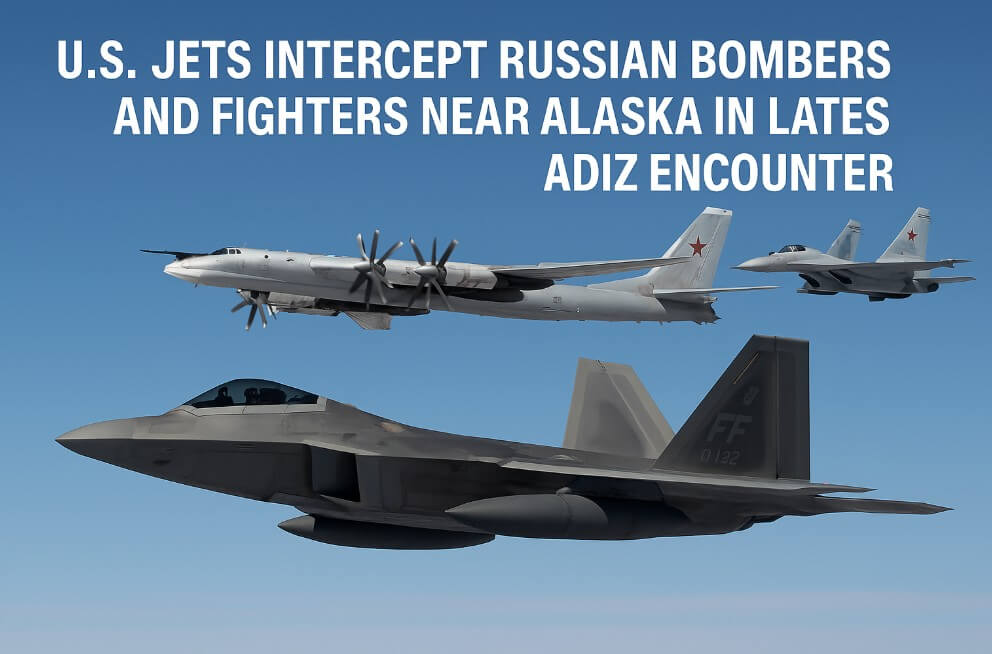
ANCHORAGE, Alaska — U.S. Air Force fighter jets intercepted a formation of Russian military aircraft operating near Alaska’s Air Defense Identification Zone (ADIZ) on Wednesday, marking the ninth such incident this year, the North American Aerospace Defense Command (NORAD) confirmed.
The encounter involved two Tu-95 strategic bombers and two Su-35 fighter jets flying near Anchorage, Alaska. NORAD said the aircraft were detected as they approached the ADIZ and tracked until U.S. forces visually confirmed their identity.
To respond, nine U.S. aircraft were scrambled, including one E-3 Sentry airborne warning and control plane, four F-16 Fighting Falcons, and four KC-135 Stratotankers. The response highlighted the resources required to shadow Russian flights that approach U.S. borders, even when they remain outside sovereign airspace.
“NORAD emphasized that the Russian planes did not enter U.S. or Canadian sovereign airspace,” the military said in a statement. According to Defense News, such flights are considered routine and do not represent an immediate threat. However, officials noted they serve as reminders of the geopolitical tensions between Moscow and Washington.
A Strategic Flashpoint Over Alaska
The Alaskan ADIZ, one of the world’s most closely monitored stretches of military airspace, extends thousands of miles into the North Pacific. Foreign aircraft entering the zone are required to identify themselves or risk being treated as potential threats.
Russia has regularly dispatched bombers and fighters along this corridor, a practice defense analysts say is designed to test U.S. detection systems and demonstrate long-range capabilities.
“This marks the third time in a month such Russian flights have approached Alaska,” officials confirmed, underscoring a steady pattern of activity.
While not unprecedented, these flights add pressure on U.S. defense forces tasked with monitoring a vast and strategically vital region that serves as a gateway between North America and the Pacific.
Rising Tensions Across NATO’s Periphery
The latest Alaska encounter comes amid heightened military frictions across Europe and the Arctic. Earlier in September, Polish forces reported shooting down Russian drones near their border, while Estonia accused Russian fighter jets of briefly crossing into its airspace.
In response, NATO issued a warning that the alliance would use “all available measures” to defend its territory against incursions.
The incident also drew political commentary in the United States. Former President Donald Trump said this week that NATO members should shoot down Russian aircraft if they cross into allied airspace. When asked if Washington would back such actions, he replied that U.S. support would “depend on the circumstance.”
Trump’s remarks came shortly after he suggested Ukraine could reclaim all territories lost to Russia, signaling a sharper tone compared with his earlier calls for Kyiv to consider concessions.
Link to the Ukraine Conflict
Military analysts note that the Alaska air intercepts cannot be viewed in isolation from the ongoing war in Ukraine, now entering its third year.
Russian President Vladimir Putin has intensified missile and drone attacks across Ukrainian cities while rejecting the possibility of direct talks with Ukrainian President Volodymyr Zelenskyy.
Although Trump once suggested hosting a summit in Alaska to broker negotiations, Moscow has shown little interest in dialogue. Instead, Russian forces continue to conduct both regional operations in Ukraine and global displays of strategic reach, such as the bomber patrols off the U.S. coast.
For the Pentagon, these flights serve as a reminder that Moscow retains the ability to project power even while bogged down in a grinding ground war.
Outlook
The Alaska intercept underscores the dual challenge facing U.S. defense planners: deterring Russia’s ongoing aggression in Eastern Europe while maintaining vigilance along America’s own northern approaches.
For NORAD, headquartered in Colorado Springs, the task requires a constant state of readiness. The latest incident, while not escalating into a direct confrontation, illustrates how routine patrols can tie up substantial U.S. resources and keep pressure on military forces stretched across multiple theaters.
As one defense analyst noted, such encounters are “part of the cat-and-mouse game of modern military competition.” With both sides unwilling to back down, the airspace over Alaska is likely to remain a flashpoint in the broader contest between Washington and Moscow.
