


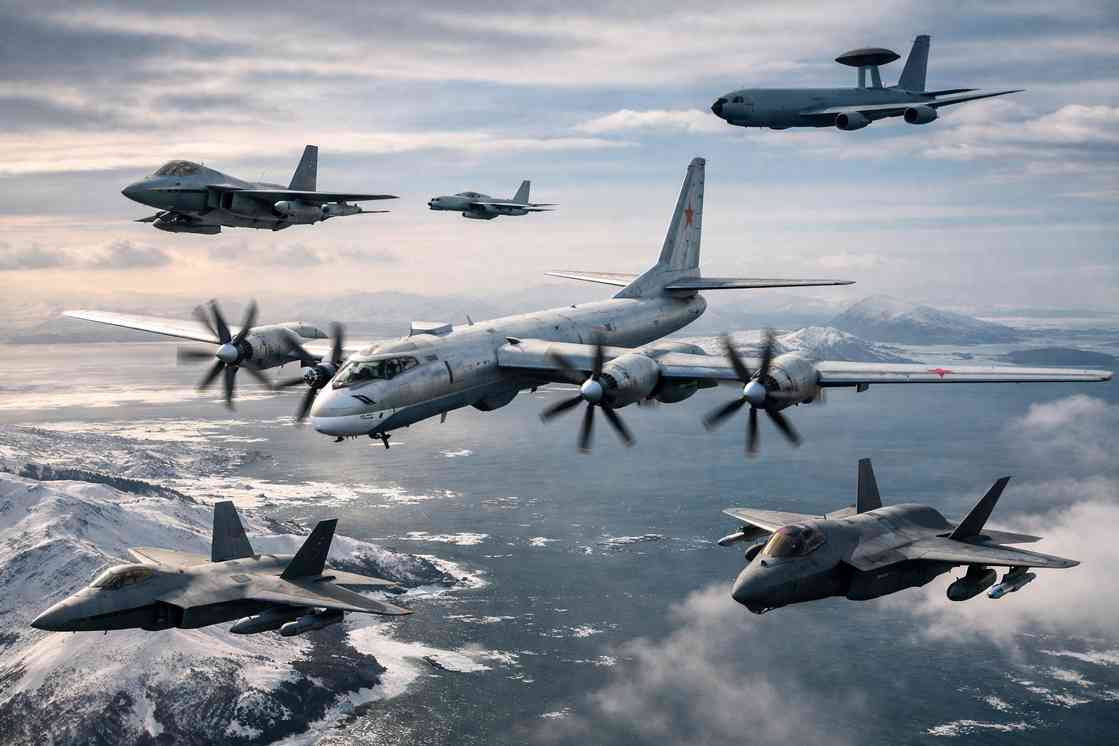
The North American Aerospace Defense Command (NORAD) launched a large interception mission after Russian military aircraft approached the Alaska Air Defense Identification Zone (ADIZ), triggering a coordinated response from U.S. and Canadian forces.
On March 4, 2026, NORAD scrambled a total of twelve aircraft after detecting two Russian military aircraft entering the Alaska and Canadian ADIZ near Anchorage, Alaska. The response included six fighter aircraft and six support aircraft, making it one of the largest interception missions conducted by NORAD in the past decade.
Despite the scale of the response, NORAD confirmed that the Russian aircraft remained in international airspace and did not enter U.S. or Canadian sovereign airspace.
Large Interception Mission Near Alaska
The interception mission involved a mix of advanced fighter aircraft and supporting platforms designed to identify, track, and monitor the approaching Russian aircraft.
The operation included Lockheed Martin F-35A Lightning II, Lockheed Martin F-22 Raptor, and McDonnell Douglas CF-18 Hornet fighters from the United States and Canada. Tanker aircraft and surveillance platforms were also deployed to provide aerial refueling and situational awareness throughout the operation.
The fighter aircraft were tasked with visually identifying and shadowing the Russian planes, while the supporting aircraft ensured sustained coverage of the mission area.
The incident occurred within the Alaska and Canadian Air Defense Identification Zone monitored by NORAD. Air Defense Identification Zones extend beyond national airspace and allow military authorities to identify and track aircraft approaching sovereign territory.
The mission also marked one of the rare occasions in recent years when F-22 and F-35 fifth-generation fighters were scrambled together for a NORAD interception.
Russian Tu-142 Maritime Patrol Aircraft
The aircraft detected by NORAD were Tupolev Tu-142 maritime patrol aircraft, a long-range platform used by Russia for reconnaissance and anti-submarine warfare missions.
The Tu-142 is derived from the Tu-95 strategic bomber platform and is designed for extended patrol operations over large ocean areas. The aircraft is commonly used to monitor naval activity and conduct maritime surveillance across the Arctic and Pacific regions.
Russian military aircraft frequently operate in international airspace near Alaska. NORAD routinely tracks and identifies these aircraft when they approach the Air Defense Identification Zone to ensure that North American airspace remains secure.
Strategic Context and Military Signaling
The interception took place during a period of heightened global military activity. At the time of the Russian patrol, the United States had hundreds of combat aircraft deployed in the Middle East for operations against Iran.
The Russian flight was also the first such activity near Alaska since the United States launched Operation Epic Fury.
Despite only two Russian aircraft being present, NORAD deployed twelve aircraft for the interception.
According to Air & Space Forces, the scale of the response suggests the mission may have been intended to demonstrate readiness and send a strategic message regarding Arctic air defense.
Comparison With Earlier Russian Patrols
The March 4 interception followed a previous Russian mission near Alaska on February 19.
Russian patrols near Alaska have been relatively frequent in recent years, reflecting increased strategic interest in Arctic airspace and surrounding maritime routes.
Arctic Edge 26 and Growing Arctic Security Focus
The Russian aircraft activity occurred during Arctic Edge 26, a large-scale annual military exercise conducted by the United States and Canada.
The exercise spans operational areas from Alaska to Greenland and focuses on improving joint military coordination, Arctic defense readiness, and rapid response capabilities in extreme environments.
The March interception was also the largest NORAD response since July 2024, when Russian and Chinese bombers conducted a joint patrol near Alaska.
That patrol marked the first time the two countries conducted a coordinated bomber mission in the region.
NORAD responded to that event using American F-16 and F-35 fighters alongside Canadian CF-18 aircraft.
The repeated interceptions highlight the increasing strategic importance of Arctic airspace for both surveillance and defense operations.
