


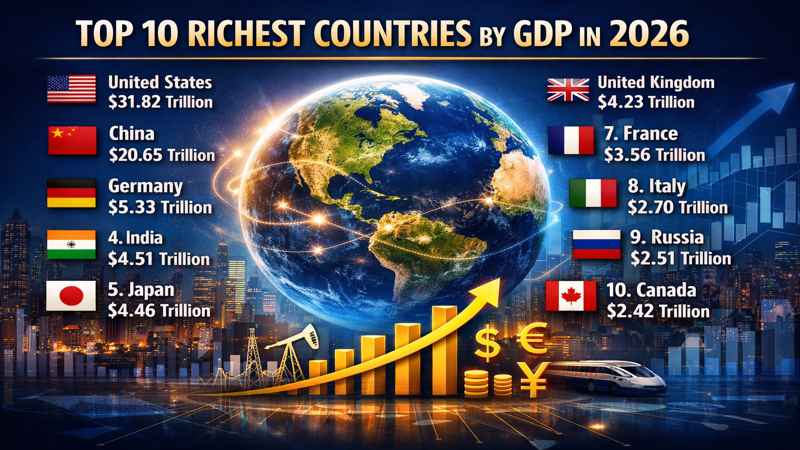
The global economy in 2026 presents a compelling picture of continuity and transformation. While traditional economic leaders continue to dominate, emerging economies are rapidly climbing the ranks, reshaping global financial dynamics. Projections for nominal Gross Domestic Product (GDP) highlight how innovation, demographics, and strategic investments are driving growth across nations.
GDP remains one of the most widely used indicators of economic performance, measuring the total value of goods and services produced within a country. The 2026 rankings reveal a blend of established powerhouses and rising markets influencing the global economy.
United States Leads by a Wide Margin
The United States retains its position as the world’s largest economy, with a projected GDP of $31.82 trillion. Its economic strength is rooted in a diverse structure that spans technology, finance, healthcare, and consumer markets.
Innovation remains a key growth driver, supported by leading technology hubs and financial centers. Strong domestic consumption and the ability to attract global talent and investment continue to reinforce its dominance.
China Secures Second Position
China holds the second spot with a projected GDP of $20.65 trillion. Its rise as a global manufacturing hub and trade leader has been central to its economic success.
Significant investments in infrastructure and a strategic shift toward advanced technologies such as artificial intelligence and renewable energy are shaping its future growth. A growing middle class continues to support domestic demand.
Germany Anchors Europe’s Economy
Germany ranks third globally with a GDP of $5.33 trillion, maintaining its position as Europe’s largest economy. Its strength lies in high-quality manufacturing, engineering, and exports.
A skilled workforce, efficient infrastructure, and strong global demand for German products contribute to its continued economic stability.
India Emerges as a Rising Power
India climbs to fourth place with a projected GDP of $4.51 trillion, marking a major milestone as it surpasses Japan. Its rapid growth is driven by a young population, expanding digital economy, and increasing urbanization.
Government-led infrastructure development and economic reforms have further accelerated growth, particularly in technology, manufacturing, and services.
Japan Faces Economic Headwinds
Japan ranks fifth with a GDP of $4.46 trillion. Despite being a global leader in technology, robotics, and automotive production, it faces challenges from an aging population and slower domestic growth.
These structural issues have slightly impacted its global standing.
United Kingdom Driven by Services
The United Kingdom holds sixth place with a GDP of $4.23 trillion. Its economy is heavily driven by the services sector, especially finance, banking, and professional services.
London continues to function as a major global financial hub, while innovation in fintech and digital services supports future growth.
France Maintains Diverse Economy
France ranks seventh with a projected GDP of $3.56 trillion. Its economy benefits from a mix of manufacturing, agriculture, and tourism.
Strong infrastructure, global brands, and its influence within the European Union contribute to its stable economic position.
Italy Relies on Industry and Tourism
Italy stands eighth with a GDP of $2.70 trillion. Its economy is supported by manufacturing, fashion, tourism, and small businesses.
Known for craftsmanship and luxury goods, Italy continues to attract global demand, although growth remains moderate.
Russia Powered by Natural Resources
Russia ranks ninth with a projected GDP of $2.51 trillion. Its economy is largely driven by oil and gas exports, which provide significant revenue and global influence.
However, reliance on natural resources and limited diversification remain key challenges.
Canada Rounds Out the Top 10
Canada completes the list with a GDP of $2.42 trillion. Its stable economy is supported by natural resources, services, and strong trade ties, particularly with the United States.
A steady influx of skilled immigrants and a high quality of life make Canada an attractive destination for investment and business.
Outlook: A Changing Global Landscape
The 2026 GDP rankings highlight both stability and evolution in the global economy. While the United States and China continue to lead, the rise of emerging economies like India signals a shift in global economic power.
As nations continue to invest in innovation, infrastructure, and human capital, the global balance of economic influence is expected to keep evolving in the years ahead.
