


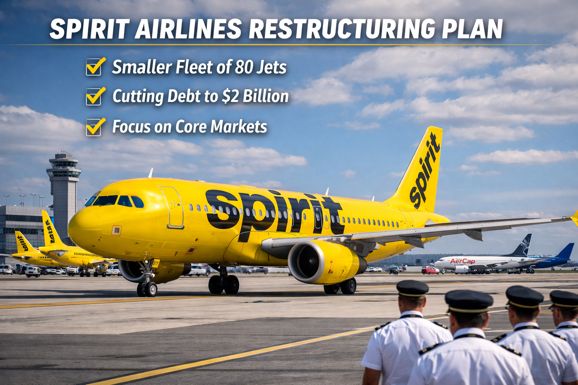
Spirit Airlines is preparing to emerge from bankruptcy as a smaller, more financially stable airline, outlining plans to operate roughly 80 aircraft and adopt a more flexible scheduling model as part of its Chapter 11 restructuring.
The Miramar, Florida–based ultra-low-cost carrier said its restructuring strategy focuses on reducing debt, shrinking its fleet and concentrating operations in its strongest markets. The airline expects the overhaul to position it as a leaner standalone carrier capable of responding more quickly to shifts in travel demand.
Spirit filed a restructuring support agreement and plan of reorganization with the U.S. Bankruptcy Court for the Southern District of New York on March 13. The filing details the company’s roadmap for exiting Chapter 11 while maintaining its core identity as a low-fare airline.
The restructuring plan has the backing of debtors in possession and secured noteholders, a step the company views as essential to completing the bankruptcy process. Chief executive Dave Davis said the agreements mark significant progress toward a turnaround, although discussions with additional stakeholders are still underway.
Smaller Fleet Central to Turnaround
A key element of the restructuring involves sharply reducing the airline’s fleet.
Spirit once operated more than 230 aircraft from the Airbus A320 family at its peak. During the restructuring process, however, the airline has already begun scaling back its operations.
According to aviation analytics firm Cirium, the airline currently has 113 aircraft listed as active. Under the new plan, that number will fall to between 76 and 80 aircraft by the third quarter of this year.
The remaining fleet will primarily consist of older variants of the Airbus A320 and Airbus A321 aircraft.
Spirit has been gradually reducing reliance on newer A320neo-family jets because of ongoing reliability issues related to geared turbofan engines produced by Pratt & Whitney. The industry-wide engine recall has forced multiple airlines to ground aircraft for inspections and repairs.
By shrinking the fleet, Spirit expects to reduce aircraft ownership costs, lease obligations and overall debt — a critical step for stabilizing its finances after months of operational pressure.
Expansion Possible Later in the Decade
Despite the near-term downsizing, Spirit has left the door open for future fleet growth.
The airline previously reached an agreement with aircraft leasing giant AerCap that could allow it to lease up to 30 Airbus A320-family aircraft in the future.
Those aircraft could begin entering service between 2027 and 2030 if market conditions support expansion. Spirit has indicated that any growth will be tied to profitable opportunities rather than rapid network expansion.
Focus on Core Markets
Spirit is also reshaping its route network to emphasize markets where the airline historically performs well.
The carrier plans to concentrate operations at major bases including Fort Lauderdale, Orlando, Detroit and the New York metropolitan area through Newark Liberty International Airport.
By strengthening its presence in these core markets, the airline hopes to improve route profitability and compete more effectively with larger carriers.
More Flexible Scheduling
Another major change involves how Spirit schedules flights.
The airline is introducing a demand-driven scheduling model similar to the approach used by Allegiant Air. Under this system, aircraft utilization increases during peak travel periods while off-peak flying is reduced.
This approach allows the airline to shift capacity more quickly based on seasonal travel demand, helping control costs and improve efficiency.
Adding Premium Options
Spirit is also adjusting its product strategy as part of the restructuring.
Like several U.S. low-cost airlines, the carrier has begun introducing premium economy seating options designed to appeal to travelers seeking more comfort while still paying lower fares. The move reflects broader changes in consumer expectations, as budget airlines increasingly compete with full-service carriers on certain routes.
Debt Reduction a Key Outcome
One of the most significant elements of the restructuring plan is a dramatic reduction in financial obligations.
Spirit expects its combined debt and lease liabilities to fall from about $7.4 billion before filing for bankruptcy to roughly $2 billion once it exits Chapter 11.
A lighter balance sheet would give the airline more flexibility to invest in operations and withstand industry volatility.
Pilot Recalls Signal Recovery
The company has also begun recalling employees furloughed during the restructuring.
Earlier this week, Spirit issued recall notices to hundreds of pilots who had been furloughed between Sept. 1, 2024, and Nov. 1, 2025 — a period marked by financial strain and shifting market conditions.
The pilot recalls suggest the airline is preparing for a more stable operating phase as it moves closer to emerging from bankruptcy.
Together, the fleet reductions, financial restructuring and operational changes represent a significant reset for Spirit as it attempts to rebuild its business and restore profitability in the competitive U.S. airline industry.
