


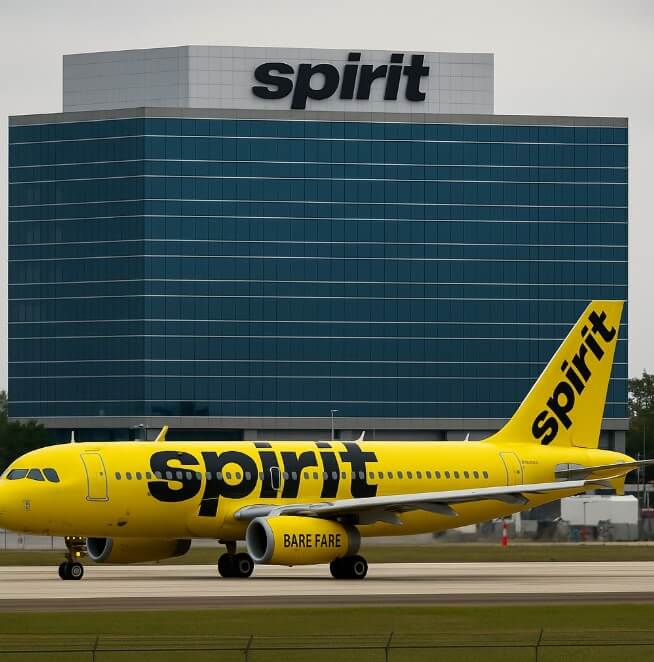
MIRAMAR, Fla. — Spirit Airlines’ second bankruptcy filing in less than a year underscores a growing problem for the ultra-low-cost carrier that extends far beyond rising labor costs or competition from larger rivals. Beneath the headlines about debt and restructuring lies a simpler but more damaging truth: Spirit has become too difficult for customers to do business with.
From Budget Success to Brand Breakdown
For years, Spirit Airlines (NK) thrived by offering travelers no-frills, rock-bottom fares that made it a favorite among budget-conscious fliers. Its business model — charging separately for every add-on while keeping base fares low — allowed the airline to carve out a profitable niche in a crowded market. As View from the Wing reported, “minimal frills, tight operations, and fares others refused to match” once defined the airline’s success.
But the environment that supported that model has shifted dramatically. The pandemic brought a wave of wage hikes across the aviation industry, inflating operational costs that Spirit can no longer offset through ancillary fees alone. Meanwhile, the carrier’s recent investments, including a sprawling new headquarters in Miramar, Florida, have further eroded the lean cost structure that once made it competitive.
“Spirit Airlines (NK) has filed for bankruptcy for the second time in less than a year,” the company confirmed. The filing, while expected by analysts, has reignited concerns about whether the carrier can survive in a marketplace that now demands more than just low prices.
The Market Has Moved On
Today’s travelers — even those once loyal to discount airlines — are showing a greater willingness to pay for comfort, reliability, and digital convenience. Spirit’s “Big Front Seat” product was designed to offer a taste of premium travel, but industry observers say it falls short of what business or leisure travelers now expect.
The carrier’s limited route network has also left it at a disadvantage. Spirit remains largely absent from lucrative long-haul markets such as transatlantic travel, where larger competitors like Delta Air Lines (DL), United Airlines (UA), and American Airlines (AA) have expanded aggressively.
Those same legacy carriers have also adopted “basic economy” fares that directly target Spirit’s price-sensitive customers. By offering similarly low prices without stripping away reliability or service consistency, the big three have undercut Spirit’s once-exclusive claim to affordability — without cannibalizing their higher-paying customers.
A Simpler, More Damaging Problem
While cost pressures are part of Spirit’s troubles, the more immediate threat may come from within. The airline’s digital infrastructure — particularly its website — has become a growing source of frustration for customers trying to book flights.
Reports of login failures, booking errors, and broken payment links have become increasingly common. Passengers say the site frequently rejects transactions or forces users to restart searches after system crashes. In some cases, families traveling with infants or children encounter mismatched passenger data that prevents them from completing purchases altogether.
Even Spirit’s effort to upsell travelers to its premium “Big Front Seat” has hit snags. Customers attempting to book the upgrade while traveling with a lap infant are sometimes blocked from completing the transaction because the system cannot determine which seats are certified for that passenger type.
These failures, experts say, represent more than technical glitches — they signal a deeper operational weakness. Spirit’s systems, many of which date back years, appear unable to meet modern e-commerce expectations. For an airline built on volume and efficiency, the inability to complete transactions quickly and reliably poses an existential problem.
Losing Revenue Before Takeoff
Every extra click between a customer and a completed booking represents potential lost revenue. For Spirit, those clicks have multiplied. Travelers abandoning their purchases due to system errors cost the airline not only immediate sales but also long-term trust and loyalty.
Industry analysts say that while Spirit’s restructuring will likely focus on cutting debt and renegotiating leases, the company’s survival may depend just as much on fixing its digital foundation. “Low fares can only attract passengers if they can actually buy the ticket,” one analyst noted.
As the airline works through its second bankruptcy in less than a year, customers and investors alike are watching to see whether Spirit can rebuild its reliability — both in the air and online. Its future may depend on whether it can restore the ease and confidence that once made its low-cost promise appealing in the first place.
