


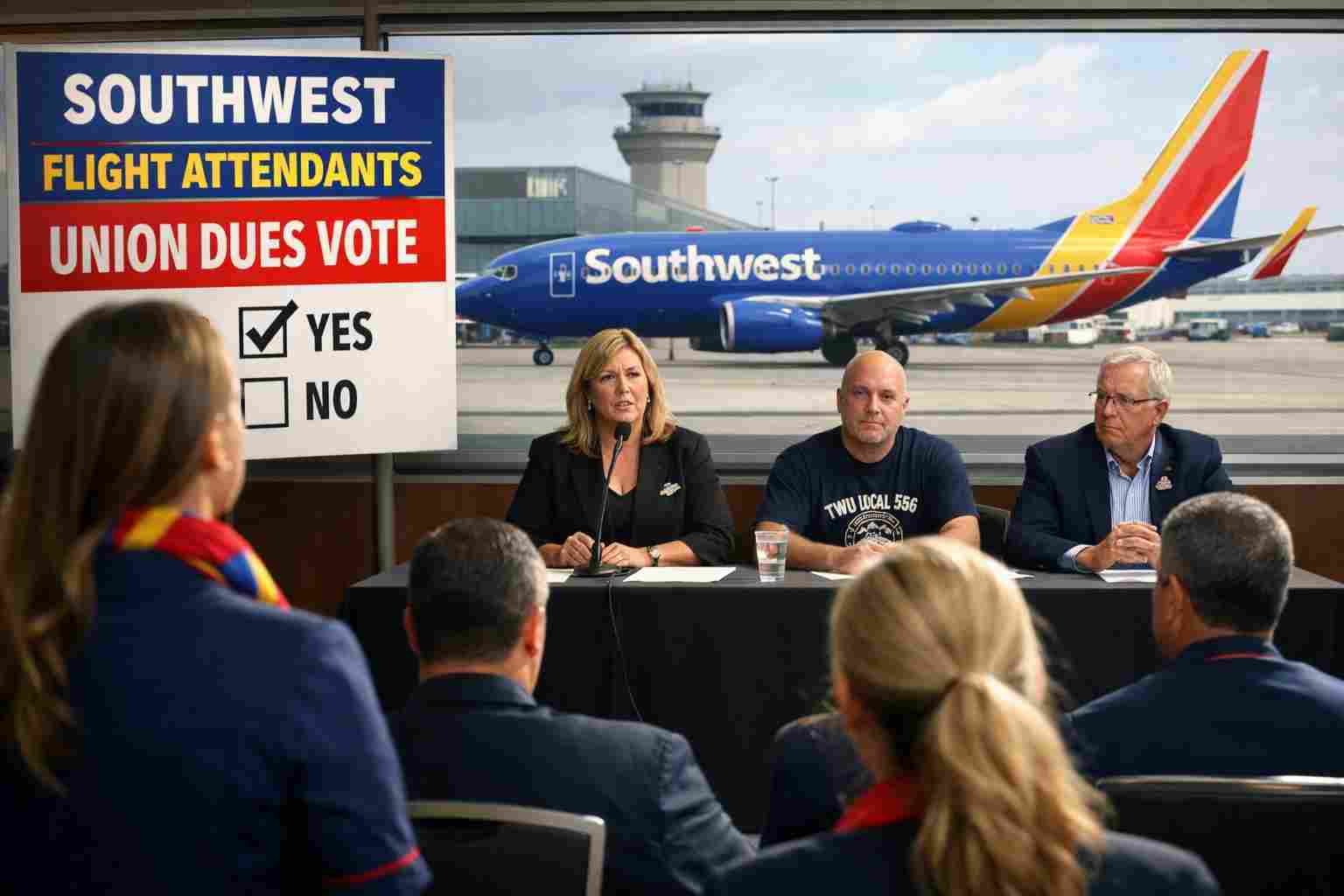
DALLAS — Flight attendants at Southwest Airlines will vote for a fourth time on whether to approve a special union assessment, reopening debate over bargaining resources, governance, and member representation after three previous rejections.
The vote, organized by TWU Local 556, comes as the Dallas-based carrier’s cabin crews prepare for future contract negotiations. Union leadership argues additional funding is necessary to secure stronger pay and protections, while critics question both the repeated votes and new in-person voting requirements.
Fourth Attempt Follows Three Rejections
TWU Local 556, which represents Southwest’s flight attendants, has scheduled membership meetings between Feb. 16 and March 25, 2026, where members will decide whether to approve a $5 per member, per month special assessment.
According to union documents, the funds would be used exclusively for collective bargaining and automatically end 90 days after ratification of the next contract.
This marks the fourth time the union has proposed a special assessment. Earlier proposals in 2025 sought monthly increases of $11, $8, and $7, but members rejected each one.
The current ballot reads:
“I approve that the union establishes a special assessment fee of $5 per member, per month, to be earmarked exclusively for negotiations, and that this assessment shall automatically terminate 90 days after ratification of the next Collective Bargaining Agreement.”
Members must vote either “Yay” or “Nay.”
Supporters say the lower amount reflects leadership’s attempt to address prior concerns while still funding negotiations.
In-Person Voting Requirement Raises Access Questions
Unlike earlier votes, the new ballot requires members to attend meetings in person to participate. Voting will take place at 13 airports, including Phoenix Sky Harbor International Airport and Los Angeles International Airport, as well as locations such as Denver, Chicago Midway, and Orlando.
Meetings begin at 10:00 a.m. local time, and identification checks will be conducted. Probationary flight attendants may attend but cannot vote.
Critics argue the weekday mid-morning schedule may limit participation, particularly for flight attendants assigned to trips or reserve duty. Most members are not paid to attend.
Union officers on official business, however, receive compensation for lost work time and travel expenses, consistent with standard labor practices. Opponents say this could create an imbalance in turnout.
The shift to in-person voting has intensified debate beyond the dollar amount itself, raising broader questions about union governance and member access.
Governance and Leadership Scrutiny
Some flight attendants have voiced concerns about the repeated votes, questioning whether bringing back similar proposals reflects leadership’s willingness to accept earlier outcomes.
Opponents have characterized the effort as an attempt to secure approval after multiple failures rather than introducing a fundamentally new proposal.
The union has also faced internal tensions in recent years, including criticism related to disciplinary actions against members who publicly challenged leadership or explored alternative representation.
These controversies continue to shape how some members view the current assessment vote.
Union leadership, meanwhile, maintains that additional funding is essential to effectively negotiate on behalf of flight attendants in upcoming talks.
Broader Implications for Airline Labor
The dispute highlights ongoing tensions across the airline industry as labor groups push for improved contracts amid strong travel demand and airline profitability.
Some observers have compared the situation to Delta Air Lines, where flight attendants remain non-union despite organizing efforts by the Association of Flight Attendants-CWA. AFA-CWA President Sara Nelson had previously predicted Delta’s flight attendants would unionize within months, a timeline that has yet to materialize.
At Southwest, supporters of the assessment argue adequate funding is necessary to remain competitive with peers and secure stronger contracts.
Opponents counter that repeated dues proposals and voting access restrictions risk undermining member trust.
Outcome Could Shape Future Negotiations
Southwest, headquartered at Dallas Love Field, has long prided itself on strong labor relations, but the outcome of this vote could influence both internal union dynamics and future contract negotiations.
If approved, the $5 monthly assessment would provide new bargaining funds. If rejected again, union leadership may face pressure to reconsider its strategy.
The results could also signal broader sentiment among flight attendants about union leadership and priorities at a critical moment for airline labor relations.
The vote outcome is expected following the conclusion of the nationwide meeting schedule in late March.
