


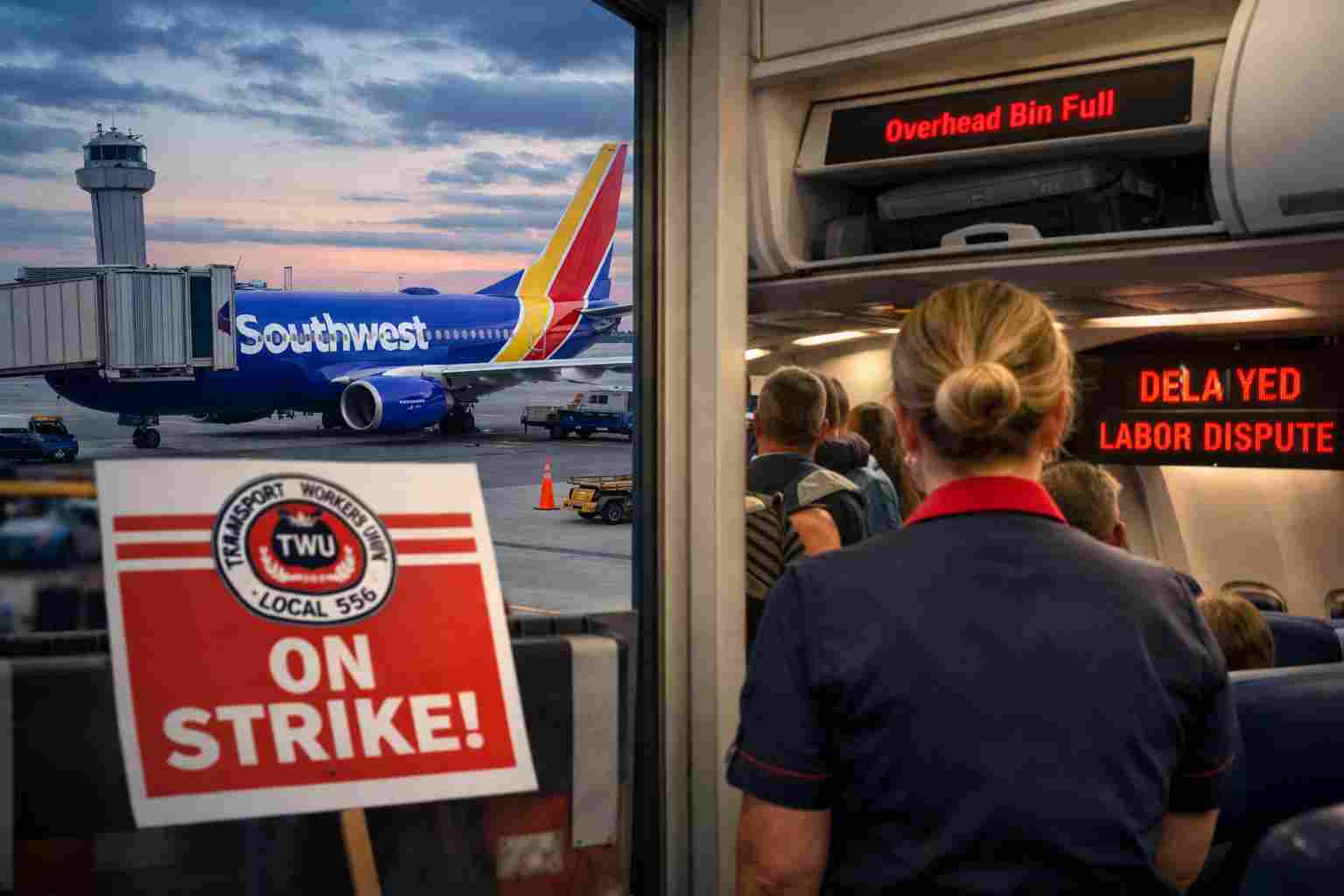
DALLAS — Southwest Airlines is confronting a fresh labor dispute with its flight attendants union after recent operational changes tied to assigned seating slowed boarding and complicated the airline’s tightly managed turnaround schedule, raising concerns about costs, reliability, and employee relations.
The conflict centers on how the airline adapts its operations following the January transition away from its long-standing open seating model, a defining feature that had supported its industry-leading aircraft utilization and fast gate turns. Now, with boarding times increasing and cabin congestion worsening, tensions are rising between management and frontline crews over how to respond.
The Transport Workers Union Local 556, which represents Southwest flight attendants, has sharply criticized leadership, describing executives as “out of touch” and accusing management of ignoring contractual protections in its efforts to maintain on-time performance.
Assigned Seating Creates New Boarding Bottlenecks
Southwest’s shift to assigned seating fundamentally altered how passengers move through the cabin. Under the previous open seating system, passengers naturally spread out, allowing overhead bin space to fill more evenly and reducing aisle congestion.
With assigned seating, however, priority passengers—many seated near the front—fill forward overhead bins quickly. Other passengers must walk farther back to find available space, then attempt to move forward again to reach their assigned seats. This counterflow disrupts the boarding stream and slows the process.
The problem has been exacerbated by Southwest’s decision to eliminate its signature “two bags fly free” policy. That change has led more travelers to carry luggage onboard instead of checking it, increasing competition for limited overhead space and intensifying congestion.
Management has introduced procedural adjustments to reduce bottlenecks on jetbridges and in aisles, but union communications indicate these challenges were foreseeable during planning. The airline’s leadership continues to emphasize fast turn times, which are essential to maintaining schedule reliability and controlling costs.
Union Pushback Over Early Boarding Proposal
The labor dispute escalated after management suggested that flight attendants begin boarding earlier than scheduled to help protect on-time departures.
In a memo to members, the union responded forcefully, saying management “needs to read the room and read and respect our Contract.” The union argued that leadership failed to account for the real-world impact of operational changes on frontline workers.
Under the current labor agreement, Southwest flight attendants do not receive boarding pay. Instead, the union previously prioritized higher pay rates for time spent flying rather than compensation for ground duties such as boarding.
Traditionally, boarding begins 30 minutes before departure, which had been sufficient under the open seating system. Extending boarding without additional pay, the union argues, undermines the spirit of the agreement and increases workloads without compensation.
The union also warned that recent decisions have reduced operational flexibility, made jobs more difficult, and placed flight attendants in the middle of customer frustration when delays occur.
Overhead Bin Dispute Adds to Tensions
Another point of contention involves management’s proposal to relocate a dedicated crew-only overhead bin from the front of the aircraft to the rear.
Flight attendants have historically used forward bins to store personal items while maintaining visual oversight. On newer aircraft, these compartments include locks to prevent passenger access.
The union contends that moving the bin would reduce security and add unnecessary complications during already stressful boarding situations. The issue gained urgency as overhead space became more limited following the seating and baggage policy changes.
Union leaders have accused management of being unprepared for operational consequences stemming from its policy overhaul.
Broader Operational and Strategic Stakes
Boarding efficiency is a key performance metric across the airline industry. Even modest increases in boarding time can ripple through flight schedules, affecting aircraft utilization, crew scheduling, and operating costs.
Other carriers have already adjusted. American Airlines, for example, extended domestic narrowbody boarding times last year to improve reliability.
For Southwest, the stakes are especially high. The airline’s business model has long depended on rapid aircraft turns to maximize efficiency and profitability. Any sustained slowdown threatens that advantage.
The union maintains that it wants the airline to succeed but insists contractual protections must be honored.
Management now faces a delicate balancing act—preserving operational discipline while maintaining labor support during a significant transition in how its planes are boarded.
The outcome could shape Southwest’s operational performance, labor relations, and financial results in the months ahead, as the airline works to adapt its signature efficiency model to a new era of assigned seating.
