


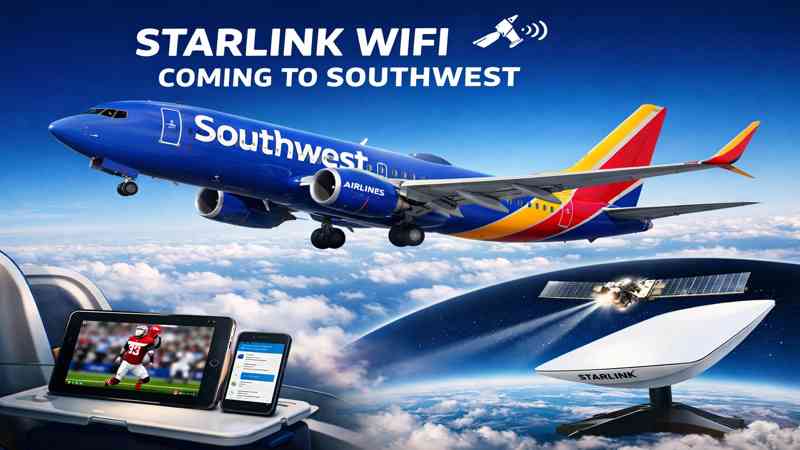
Southwest Airlines is preparing for a major upgrade to its onboard technology, announcing plans to install Starlink satellite internet across more than 300 aircraft by the end of 2026. The rollout, which begins this summer with the first passenger flights equipped with the new system, represents one of the most significant connectivity investments in the carrier’s history and underscores a broader effort to modernize its product while remaining competitive in the U.S. airline market.
The Dallas-based airline said the Starlink installation will move quickly once initial service begins, reflecting confidence in the technology and its ability to meet rising passenger expectations for reliable, high-speed internet in the air.
Faster, More Reliable Inflight Connectivity
Starlink’s system is powered by a constellation of more than 9,000 low-Earth orbit satellites that operate significantly closer to Earth than traditional geostationary satellite networks. That proximity allows for faster data speeds and lower latency, enabling an onboard internet experience closer to what travelers expect from home broadband.
Southwest said passengers will be able to stream video, watch live sports, send messages, browse the web, download files, and work using cloud-based applications from shortly after takeoff through landing. The airline expects the service to support business travelers who need consistent connectivity as well as leisure passengers who increasingly view streaming and real-time communication as standard parts of the travel experience.
Southwest executive Tony Roach framed the decision as part of a wider transformation underway at the airline, saying the goal is to raise customer expectations and demonstrate that the company is evolving beyond its traditional product offering.
Joining a Growing Group of Starlink Users
With this move, Southwest becomes the fourth major U.S. airline to commit to Starlink for inflight connectivity. United Airlines is already in the process of installing the system across its fleet, and by early 2026 nearly all of its dual-cabin regional jets are expected to operate with Starlink service.
Hawaiian Airlines currently offers Starlink internet on its Airbus aircraft, while Alaska Airlines has begun installing the technology as well. Both Hawaiian and Alaska operate under Alaska Air Group following their 2024 merger.
Industry analysts view the rapid adoption of Starlink by multiple carriers as a clear signal that airlines are shifting away from slower, legacy satellite systems in favor of low-Earth orbit technology that can better support modern digital demands.
Passenger Benefits and Free WiFi Access
Starlink connectivity is designed to support a wide range of onboard digital needs, including high-definition streaming, live entertainment, real-time messaging, faster browsing, reliable remote work, cloud applications, and even online gaming.
Southwest already provides free inflight WiFi to Rapid Rewards members on aircraft equipped through its partnership with T-Mobile. The airline expects Starlink to significantly improve both speed and reliability, delivering a more consistent experience across routes and flight durations.
Cabin Modernization Beyond Connectivity
The Starlink rollout is arriving alongside sweeping changes to Southwest’s cabin and service model. The airline is transitioning to assigned seating and introducing premium seating and extra legroom options, marking a departure from its long-standing open seating approach.
Additional upgrades planned across the fleet include new RECARO aircraft seats, in-seat power outlets, larger overhead bins, integrated device holders in seatbacks, and enhanced snack and beverage offerings on select routes. Premium seat customers and loyalty members will also see improved boarding priority.
Industry observers say these changes represent one of the largest operational shifts in Southwest’s history and suggest the airline is laying the groundwork for potential future enhancements, such as airport lounges or additional premium products, though no formal announcements have been made.
Loyalty, Network, and Competitive Position
Rapid Rewards members will continue to receive core benefits, including free inflight WiFi on equipped aircraft, loyalty points earning, and flexible redemption options across Southwest’s network.
The airline serves 118 airports across 11 countries and remains one of the largest domestic carriers in the United States. In 2025, Southwest carried more than 134 million passengers and employed over 72,000 people.
Taken together, the Starlink deployment, cabin upgrades, and loyalty enhancements highlight Southwest’s strategy to modernize the customer experience while preserving its low-cost operating model in an increasingly competitive airline industry.
