


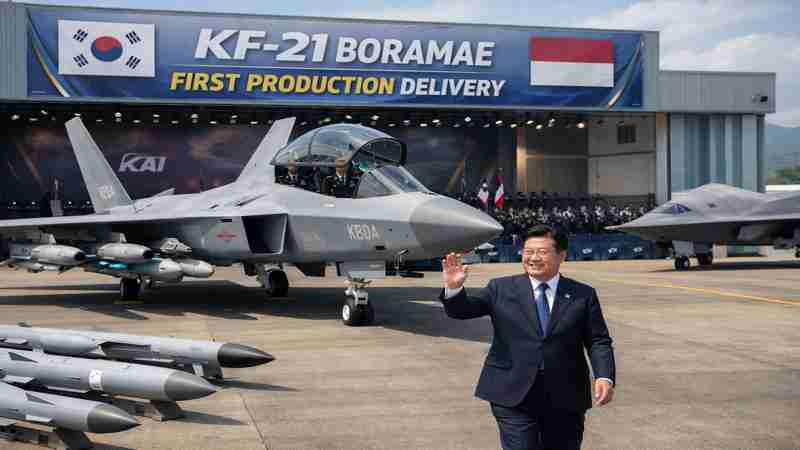
South Korea has taken delivery of its first series-produced KF-21 Boramae fighter jet, marking a significant step in the country’s drive to strengthen domestic defense capabilities and expand its role in the global arms market.
The aircraft was unveiled at the headquarters of Korea Aerospace Industries in Sacheon, just over five years after the fighter’s prototype debut in April 2021. The ceremony was attended by Lee Jae Myung, who underscored the broader strategic importance of the program.
Lee reaffirmed South Korea’s ambition to become one of the world’s top four defense powers, emphasizing that the KF-21 demonstrates the country’s ability to defend its skies with homegrown technology.
Rapid Development Reaches Production Milestone
The KF-21 program, formally launched in 2016, has progressed بسرعة compared to similar next-generation fighter efforts. The first prototype was rolled out in April 2021, followed by its maiden flight in July 2022.
By May 2023, the aircraft had been provisionally declared fit for combat. In total, six prototypes have been built and tested, including two two-seat variants that are expected to play a larger role in future operations.
The first production model is also a two-seater, reflecting growing emphasis on flexibility and multi-role capability. The Republic of Korea Air Force plans to induct 40 KF-21 jets by 2028, expanding to a total fleet of 120 aircraft by 2032.
A Deliberate “4.5-Generation” Strategy
South Korea has intentionally positioned the KF-21 as a “4.5-generation” fighter, striking a balance between advanced capability and cost efficiency.
Unlike fully stealth-focused fifth-generation aircraft such as the F-35 Lightning II or Russia’s Sukhoi Su-57, the KF-21 does not rely primarily on low-observable shaping or the most advanced sensor fusion technologies.
This approach allows for faster development and reduced costs, while still delivering a capable multirole platform. South Korea already operates the F-35A for high-end stealth missions, making the KF-21 a complementary system rather than a direct replacement.
Advanced Sensors and Future Upgrades
Despite its classification, the KF-21 is equipped with modern systems, including an active electronically scanned array (AESA) radar and an infrared search and track (IRST) system.
The fighter is expected to carry advanced weaponry such as the MBDA Meteor beyond-visual-range air-to-air missile, along with domestically developed long-range cruise missiles.
Currently, weapons are mounted externally or semi-conformally, but future upgrades are planned. The Block 3 version is expected to introduce internal weapons bays, bringing the aircraft closer to fifth-generation standards. Officials also revealed plans for a specialized escort jamming variant during the rollout.
Focus on Crewed-Uncrewed Teaming
A key feature of the KF-21 program is its integration into a broader concept of crewed-uncrewed teaming.
The two-seat configuration is designed to support operations alongside domestically developed stealth drones, with the second crew member acting as a drone controller. This concept is intended to extend operational reach and increase combat effectiveness without the need for additional piloted aircraft.
Faster Timeline Than Global Peers
The KF-21’s development timeline stands out in comparison to other advanced fighter programs. Only about five years elapsed between the prototype rollout and the first series-produced aircraft.
By contrast, the F-35 program took roughly 11 years from the first flight of the X-35 prototype to the delivery of the first production aircraft. Russia’s Su-57 required about a decade to reach a similar milestone.
This accelerated timeline reflects South Korea’s focused investment and streamlined development approach.
Export Ambitions and Defense Growth
South Korea is already exploring export opportunities for the KF-21. Discussions are underway to supply 16 aircraft to Indonesia, which was previously a junior partner in the program despite earlier disputes over costs and workshare.
Officials have also indicated plans to expand partnerships with additional countries to strengthen the competitiveness of South Korea’s defense sector.
The KF-21 joins a growing portfolio of Korean defense exports, including the K9 self-propelled howitzer, the Cheongung surface-to-air missile system, and the KAI T-50 Golden Eagle / FA-50 light combat aircraft family.
At the same time, South Korea is expanding its domestically developed air-launched weapons, reducing reliance on foreign suppliers and sidestepping restrictions such as the U.S. International Traffic in Arms Regulations (ITAR).
A Strategic Step Forward
The rollout of the first production KF-21 highlights South Korea’s emergence as a serious player in advanced military aviation. By balancing capability, cost, and speed of development, the country is positioning itself not only to strengthen national defense but also to compete more aggressively in the global arms market.
