


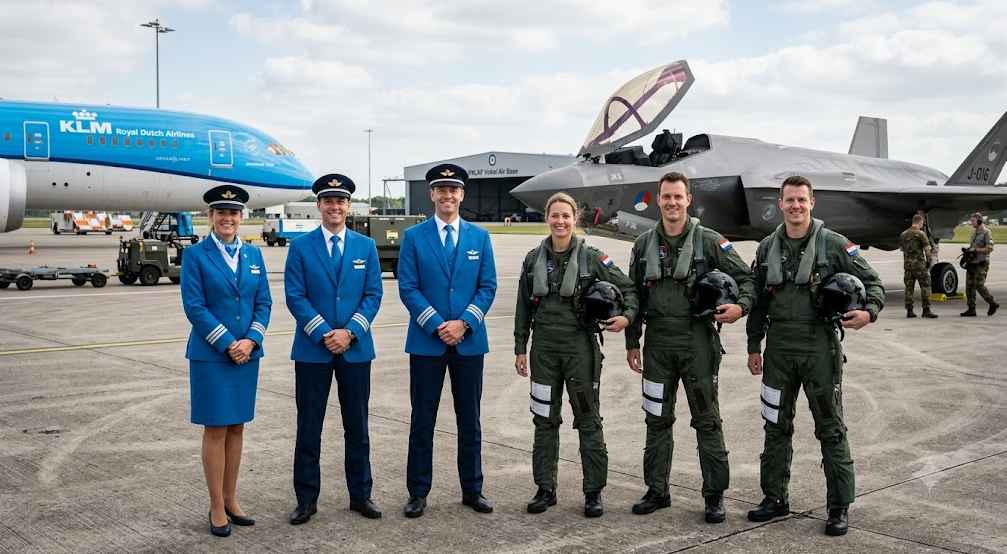
KLM and Netherlands Ministry of Defence Expand Cooperation on Aviation, Sustainability and Maintenance
AMSTELVEEN, Netherlands — KLM Royal Dutch Airlines and the Netherlands Ministry of Defence are expanding a strategic partnership that will see six commercial airline pilots fly one of the world’s most advanced fighter aircraft while both organizations pursue new initiatives in sustainable aviation fuel, maintenance innovation and workforce development.
The expanded cooperation was announced during a working visit at Schiphol-East, part of Amsterdam Airport Schiphol, roughly one year after the two sides signed a cooperation agreement aimed at strengthening the resilience of the Netherlands through closer collaboration between the civil and military aviation sectors.
At the center of the latest developments is a plan that will allow six KLM pilots to serve as reservists with the Royal Netherlands Air Force, flying the F-35 fighter jet while continuing their careers as commercial airline pilots.
The move builds on a memorandum of understanding signed in 2025, which sought to combine expertise, resources and operational capacity between the airline and the Dutch military.
Six Commercial Pilots to Fly F-35s for the Royal Netherlands Air Force
The deployment of six KLM pilots as reservists marks a significant milestone in the partnership. The initiative creates a direct pathway for experienced commercial aviators to contribute to national defense while remaining active in the airline industry.
Officials say the arrangement will help preserve critical aviation expertise in the Netherlands and strengthen connections between military and civilian flight operations.
In addition to the reservist program, one KLM pilot will relocate to Texas in September for a four-year assignment as an instructor. In that role, the pilot will help train future fighter pilots, further expanding the collaboration between the airline and the Dutch military.
Executive Remarks
KLM Chief Executive Officer Marjan Rintel highlighted the progress made since the partnership was launched.
“KLM CEO Marjan Rintel said the airline set out a year ago to add to the resilience of the Netherlands and has since taken concrete steps toward that goal, including the deployment of six pilots as reservists.”
“She added that the cooperation lets KLM staff apply their knowledge more broadly and that the airline is studying further ways to support Defence.”
State Secretary for Defence Derk Boswijk emphasized the broader value of public-private cooperation.
“State Secretary Derk Boswijk said cooperation between Defence and civilian partners is essential for the country. He noted that placing KLM pilots as reservists strengthens military capability while keeping skilled pilots in commercial aviation.”
Joint Focus on Sustainable Aviation Fuel
Beyond pilot training and defense readiness, KLM and the Ministry of Defence are examining opportunities to collaborate on alternative aviation fuels, particularly Sustainable Aviation Fuel (SAF).
A key area of interest is e-SAF, a synthetic aviation fuel that many industry experts view as an important component of aviation’s long-term decarbonization strategy.
Both organizations believe broader adoption of e-SAF could help reduce aviation-related emissions while also supporting greater energy independence for the Netherlands and Europe. The partners plan to combine technical expertise, industry networks and operational knowledge to accelerate development and deployment efforts.
HYPERION Project Advances Digital Aircraft Maintenance
Another major component of the partnership involves aircraft maintenance modernization through the HYPERION project.
Under the initiative, the Ministry of Defence and KLM Engineering & Maintenance are working together to improve maintenance efficiency and sustainability through greater digitalization and data-driven processes.
Officials said enhanced information sharing can improve component availability, reduce turnaround times and strengthen operational readiness. The project is also intended to reinforce the Netherlands’ position as a leader in advanced aviation maintenance practices.
Mechanics to Receive Military Training
The partnership is also expanding into technical workforce development.
Beginning in September, seven KLM mechanics will start training with the Dutch Royal Air Force under a pilot program designed to evaluate how civilian technical personnel can support maintenance work on military helicopters.
Mathieu Essenberg, Executive Vice President of KLM Engineering & Maintenance, welcomed the initiative.
“Mathieu Essenberg, EVP KLM Engineering & Maintenance, said KLM technicians work daily to keep the fleet safe and that the training lets them apply their skills in a new setting while gaining fresh knowledge. He added that the programme strengthens both the airline and the resilience of the Netherlands.”
Commodore Ellen Meeuwsen-Scholten, Director of Personnel at the Dutch Royal Air Force, also underscored the strategic value of the effort.
“Commodore Ellen Meeuwsen-Scholten, Director of Personnel at the Dutch Royal Air Force, said the cooperation shows how government and industry can work together for national resilience. She explained that giving technical staff experience within Defence builds scalable capacity for use when needed, while familiarising them with Defence processes and culture.”
Shared Infrastructure and Future Collaboration
Looking ahead, KLM and the Ministry of Defence are evaluating additional opportunities to share expertise, personnel and facilities.
The organizations are exploring expanded cooperation in engine and component maintenance while assessing how existing infrastructure at Schiphol-East and Schiphol-Rijk, including the Regional Jet Center and EPCOR facilities, could be utilized more effectively.
They are also studying the possibility of establishing a dedicated military maintenance site in the future.
The latest initiatives signal a growing alignment between the Dutch aviation sector and national defense, with both parties seeking to improve operational resilience, strengthen workforce capabilities and support long-term sustainability goals through closer collaboration.
