


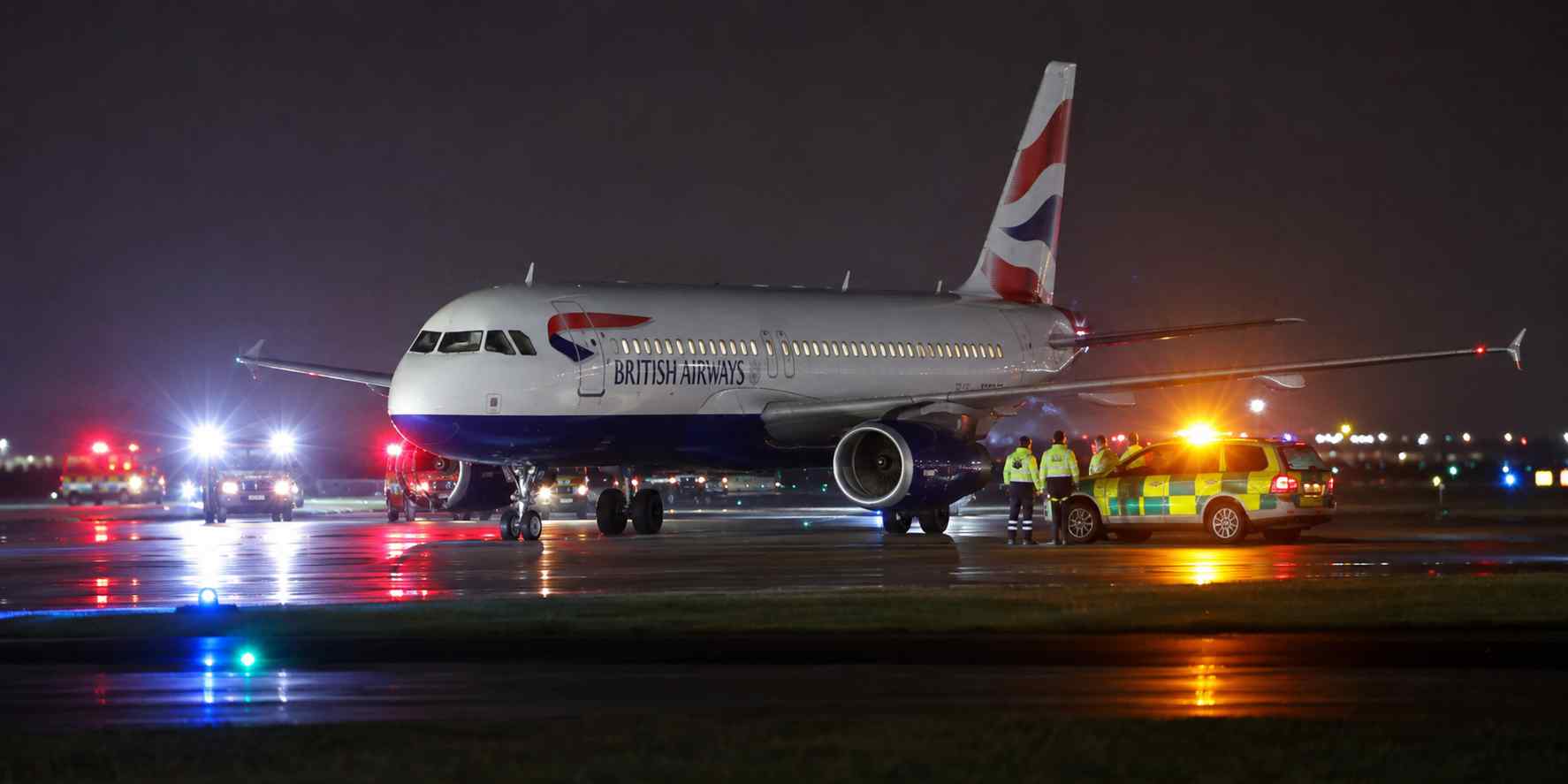
LONDON — A technical issue involving a British Airways Airbus A320 temporarily shut down London Gatwick Airport’s only active runway overnight, causing widespread disruption to inbound flights and prompting nine aircraft to declare emergencies as they faced extended holding times and declining fuel reserves.
The incident occurred during the early hours of July 15 when British Airways flight BA2673 from Palma de Mallorca arrived at Gatwick but was unable to clear the runway immediately after landing. The aircraft’s position on the runway effectively halted arrivals at one of the United Kingdom’s busiest airports, forcing multiple diversions and creating a backlog of inbound traffic.
Airport operations returned to normal after emergency crews inspected the aircraft and the runway was reopened. However, the temporary closure had already affected dozens of flights and passengers traveling into London.
Aircraft Experienced Reported Nose Wheel Issue
British Airways flight BA2673 had been scheduled to arrive at approximately 11:50 p.m. but landed in the early hours of the morning following its journey from the Spanish holiday destination of Palma de Mallorca.
The aircraft involved was a 25-year-old Airbus A320 registered as G-GATS. According to reports, the flight crew notified air traffic control of a potential issue involving the aircraft’s nose wheel. Before landing, the aircraft reportedly entered a holding pattern over southeast England while pilots worked through troubleshooting procedures.
Emergency services were positioned on the runway as a precaution when the aircraft landed. Despite the technical concern, no Mayday or PAN distress call was issued by the crew.
After touchdown, the aircraft was unable to vacate the runway immediately, resulting in the closure of Gatwick’s only active runway. Airport personnel conducted inspections before the aircraft was cleared and operations resumed.
British Airways subsequently removed the aircraft from service and canceled a scheduled round-trip service to Alicante, Spain, planned for Wednesday.
Nine Flights Declared Squawk 7700 During Extended Holding
The runway closure created significant challenges for inbound aircraft approaching Gatwick. With arrivals unable to land, several flights entered holding patterns over southeast England while awaiting further instructions.
As fuel reserves decreased, nine flights transmitted the Squawk 7700 code, an internationally recognized emergency signal used by pilots to indicate a general emergency requiring priority handling from air traffic controllers.
According to flight tracking service Flightradar24, the aircraft declaring emergencies included British Airways flights BA2607 from Bari and BA2703 from Tenerife, along with easyJet services from Agadir, Valencia, Fuerteventura, Athens and Rome. Jet2 flight LS3104 from Lanzarote and TUI Airways flight BY4249 from Rhodes also transmitted the emergency code.
While a Squawk 7700 declaration is not unusual when viewed individually, aviation experts note that multiple aircraft simultaneously broadcasting the code at the same airport is a rare occurrence.
The concentration of emergency declarations quickly attracted attention among aviation observers and flight-tracking communities, with many describing the situation as highly unusual given the number of affected flights.
Fourteen Flights Diverted to Alternative Airports
As Gatwick’s runway remained unavailable, air traffic controllers coordinated the diversion of 14 inbound flights to alternative airports across England.
Five flights were redirected to London Luton Airport, while four landed at London Stansted Airport. Birmingham Airport accepted three diverted flights, while Bristol Airport and London Heathrow Airport each received one aircraft.
Heathrow’s acceptance of a diverted flight was notable because the airport was permitted to temporarily break its overnight curfew to accommodate the arrival.
The nine aircraft that declared Squawk 7700 were among those diverted to Luton and Stansted. According to Gatwick officials, 11 of the 14 diverted flights later returned to Gatwick with passengers remaining onboard.
For travelers, the disruption resulted in lengthy delays and extended travel times before reaching their intended destinations.
Airport and Airline Respond
Airport and airline representatives emphasized that safety procedures worked as intended during the incident.
A London Gatwick spokesperson addressed the disruption, stating:
“Earlier this morning, the runway was closed for a short period due to a technical issue with an aircraft,” the spokesperson said.”
“As a result, a small number of flights were diverted, with the majority later returning to London Gatwick. As always, safety and security is our number one priority.”
British Airways also confirmed that the aircraft landed safely and that passengers were able to leave the aircraft normally.
“Our flight landed safely and customers disembarked normally following reports of a technical fault with the aircraft,” a British Airways spokesperson said.
Operations Restored After Overnight Disruption
The incident highlights the operational challenges faced by airports that rely on a single active runway. Even a short-lived blockage can quickly affect inbound traffic, force diversions, and place additional pressure on airlines and air traffic controllers.
Although the runway closure lasted only a limited period, the disruption rippled across multiple airports and affected numerous overnight arrivals. By morning, Gatwick had restored normal operations, but the event will likely be remembered as one of the more unusual overnight disruptions at the airport in recent years.
