


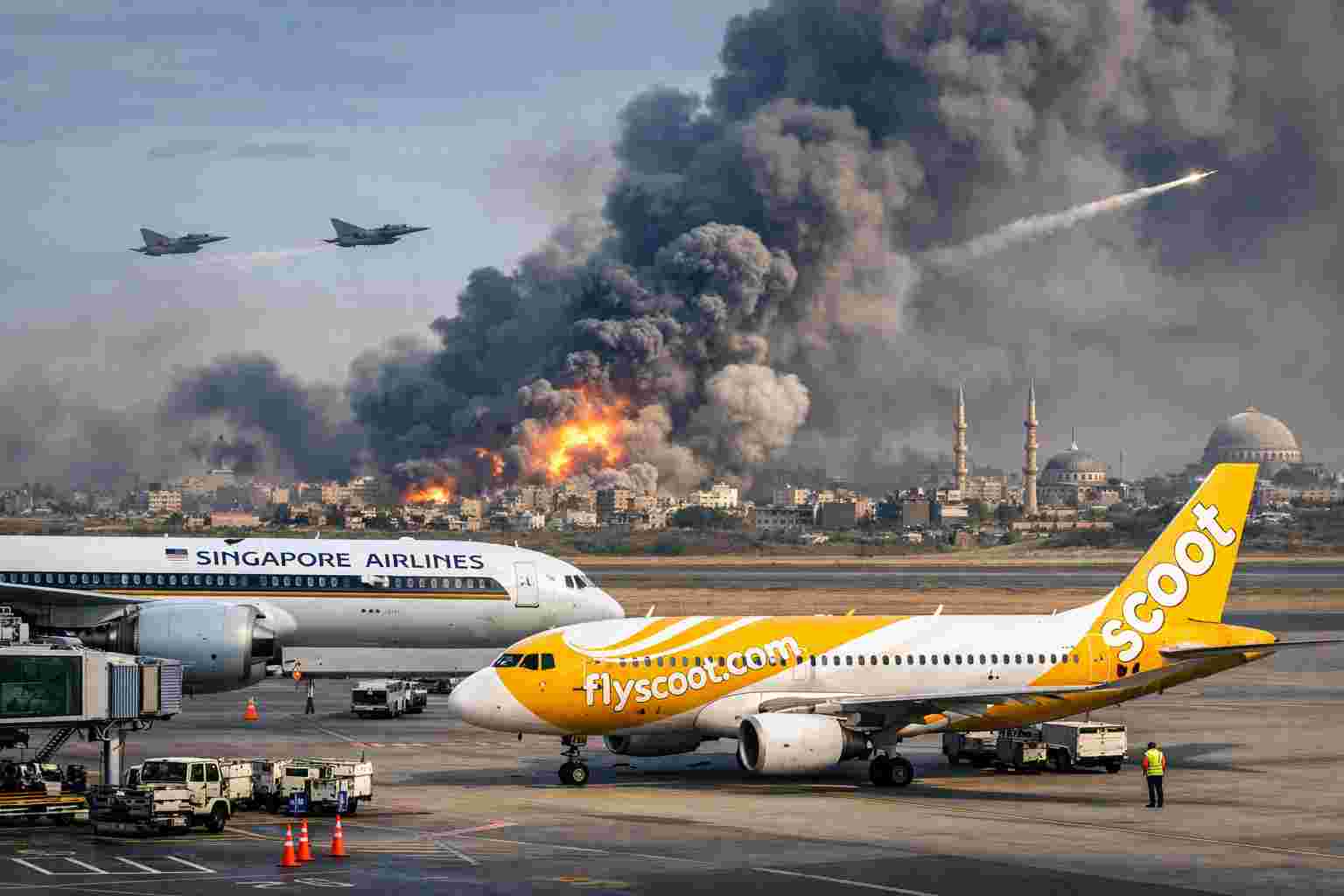
SINGAPORE — Singapore Airlines and its low-cost subsidiary Scoot have extended the suspension of several Middle East routes as escalating regional tensions linked to Iran continue to disrupt aviation operations across the region.
The decision affects flights connecting Singapore Changi Airport with key Middle Eastern hubs including Dubai International Airport and King Abdulaziz International Airport in Jeddah. The airlines said the schedule changes were necessary due to an evolving security situation that has created uncertainty for commercial flights operating in and around affected airspace.
The latest suspensions highlight how geopolitical instability in the Middle East can quickly ripple through global airline networks, forcing carriers to cancel or reroute flights to ensure safety.
Middle East Flight Cancellations
Singapore Airlines confirmed that its Singapore–Dubai route will remain suspended until at least March 15. The affected services include flight SQ494 from Singapore to Dubai and SQ495 on the return leg.
The airline cited ongoing instability in the region as the main reason for extending the suspension. Flights on the route had already been halted beginning February 28 as tensions escalated and airlines reassessed the safety of operating through certain Middle Eastern air corridors.
Dubai is one of the most important transit hubs linking Asia, Europe and Africa, and the route is typically popular among both business and leisure travelers connecting through the United Arab Emirates.
Scoot has also adjusted its Middle East schedule in response to the disruptions. Flights TR596 from Singapore to Jeddah and TR597 from Jeddah to Singapore scheduled for March 9 and March 10 will not operate.
The Jeddah route normally operates four times per week and serves both religious travelers heading to Saudi Arabia and passengers connecting between Southeast Asia and the Gulf region. The temporary cancellations will reduce travel options between Singapore and Saudi Arabia in the short term.
Both airlines emphasized that the operational outlook remains fluid and further adjustments could be made depending on how the regional security situation evolves.
Passenger Assistance Measures
To support affected travelers, Singapore Airlines and Scoot have implemented several passenger assistance measures.
Passengers booked on impacted flights can request alternative travel arrangements on other available services when possible. Travelers may also opt for a full refund for the unused portion of their tickets.
The airlines encouraged customers to ensure their contact details are up to date in their bookings so they can receive timely notifications about schedule changes. Maintaining accurate contact information allows airlines to provide direct updates when disruptions occur.
Passengers can also subscribe to mobile alerts through the airlines’ digital platforms to receive operational notifications quickly.
Such measures are commonly implemented during large-scale operational disruptions, helping airlines maintain communication with passengers while minimizing uncertainty during rapidly changing travel conditions.
Wider Impact on Regional Aviation
The suspensions come as aviation activity across the Middle East remains uneven due to the ongoing conflict.
Several governments have begun organizing evacuation and repatriation flights for citizens stranded across the region. According to reports, limited commercial flight operations have gradually resumed in parts of the United Arab Emirates.
Major Gulf carriers including Emirates and Etihad Airways have restarted selected services from Dubai and Abu Dhabi, though airlines continue to monitor airspace restrictions closely.
Authorities in Singapore have also taken steps to assist citizens affected by the disruption. Earlier this week, the first aircraft carrying Singapore residents stranded by the conflict arrived back in the country.
Officials said additional repatriation flights are scheduled to operate from Muscat International Airport in Oman over the weekend.
Government representatives noted that roughly one quarter of Singaporeans who registered with the Ministry of Foreign Affairs for assistance have requested help returning home since the conflict intensified.
Officials have also contacted Singaporean students studying in countries including Jordan, Egypt, Saudi Arabia and Kuwait to confirm their safety.
For now, airlines and government agencies continue to monitor developments closely, with travel schedules likely to remain subject to rapid change as the regional security situation unfolds.
