


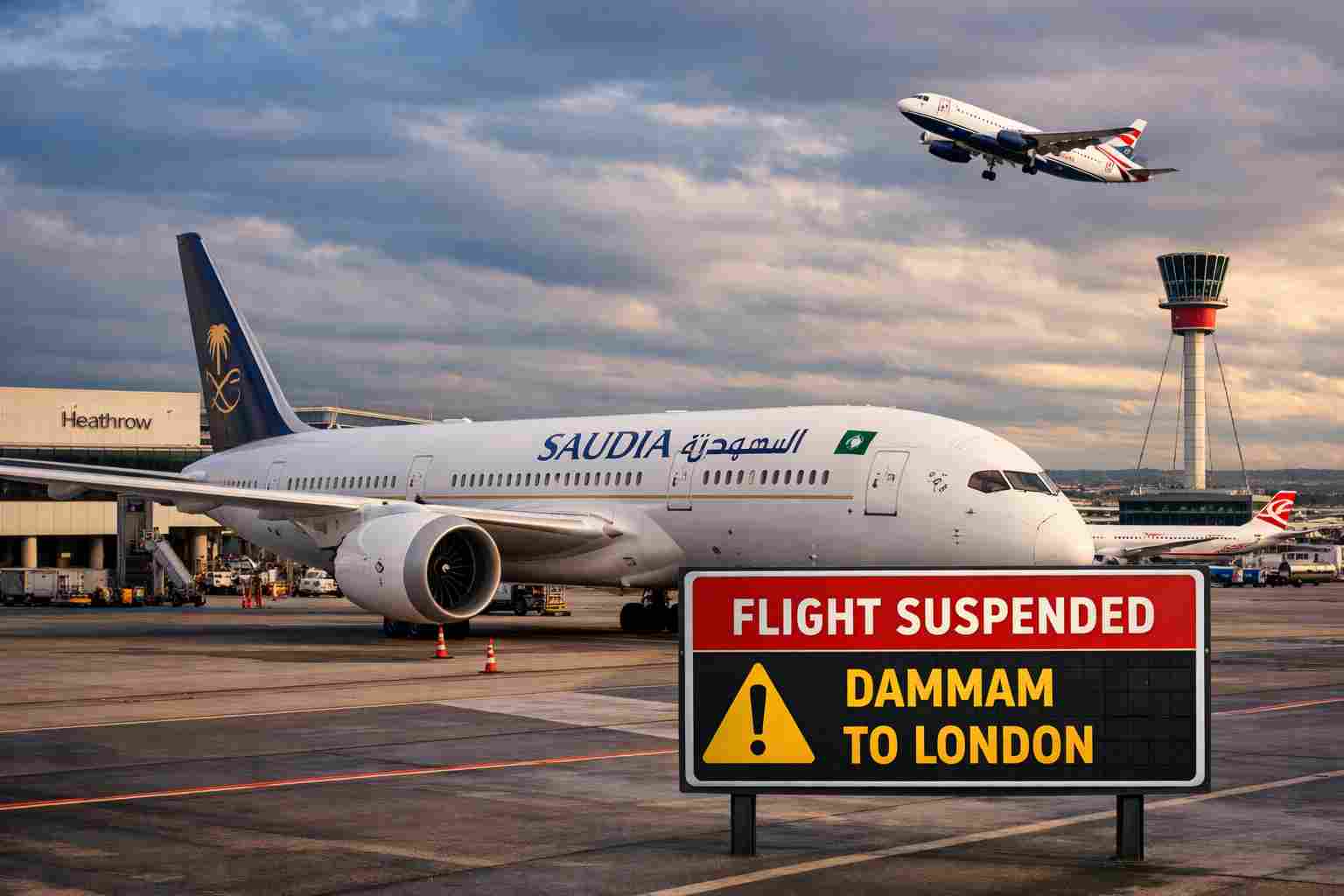
Saudia will suspend its Dammam (DMM) to London Heathrow (LHR) service beginning in mid-April 2026, withdrawing the route less than six months after its relaunch as part of a broader network expansion strategy.
The Saudi Arabian flag carrier has removed the service from its booking systems, with the final flight scheduled to depart London on April 17, 2026. Although the airline has not issued a formal statement, schedule filings confirm that all three weekly frequencies have been pulled from both the summer and upcoming winter timetables.
The decision underscores the challenges airlines face in sustaining long-haul routes from secondary hubs, particularly when demand fails to materialize as expected.
Short-Lived Expansion at Heathrow
The Dammam–London route was reintroduced in November 2025 as Saudia’s third connection to Heathrow, complementing its double-daily services from Jeddah and Riyadh. The move was intended to strengthen the airline’s presence at one of the world’s most competitive international gateways.
However, the suspension signals a rapid reversal of that expansion. Notably, Saudia has not announced any increase in frequencies on its remaining UK routes, leaving its broader Heathrow strategy unclear.
Slot utilization remains a critical factor. Airlines operating at Heathrow must use their allocated slots consistently to retain historic rights. Saudia had secured three weekly slot pairs for the Dammam service, and the lack of a replacement route raises questions about how the airline plans to manage these valuable assets.
Weak Load Factors Undermine Viability
Traffic data suggests the route struggled to gain traction from the outset. According to UK Civil Aviation Authority figures, Saudia carried approximately 4,400 passengers out of 9,000 available seats during the final two months of 2025, reflecting a load factor of roughly 50%.
Performance deteriorated further in January 2026. The airline offered nearly 5,400 seats but transported only around 2,000 passengers, indicating a sharp decline in demand.
While new routes often require time to mature, these figures point to sustained underperformance. Yield data has not been disclosed, leaving uncertainty over whether premium cabin demand may have offset lower seat occupancy. However, in the absence of strong revenue indicators, the route appears unlikely to have met profitability thresholds.
Strategic Role of Dammam in Question
Dammam is not a primary long-haul hub for Saudia, limiting the strategic importance of maintaining marginal intercontinental routes from the city. The airline currently operates only one other long-haul service from Dammam, a twice-weekly flight to Beijing Capital (PEK) using Boeing 787 aircraft.
This limited network presence reduces connectivity options for passengers and weakens the case for sustaining additional long-haul services. By contrast, Saudia’s core hubs in Riyadh and Jeddah offer broader networks, stronger demand bases, and greater operational efficiency.
The decision to suspend the London route may reflect a broader shift toward consolidating long-haul operations at these primary hubs.
Operational and Market Considerations
Airspace restrictions do not appear to have directly impacted the route. Flight tracking data shows that Saudia’s Dammam–London services consistently operated over Egyptian airspace without disruption.
However, broader geopolitical tensions in the Gulf region may have influenced travel demand. Airlines often adjust schedules in response to shifting market conditions, and short-notice route withdrawals can signal underlying uncertainty.
At the same time, Dammam has recently taken on a more prominent role as a temporary operational hub for Gulf Air. The Bahraini carrier has been routing passengers through Dammam due to airspace constraints, using ground transfers to connect Bahrain with the Saudi airport.
Gulf Air has expanded its interim network from Dammam to include destinations such as Cairo, Casablanca, and Chennai, as well as major global cities including London Heathrow, Bangkok, and Paris. This temporary arrangement is expected to remain in place until at least late March 2026.
Fleet deployment across these routes has included a mix of Boeing 787-9 and Airbus A321neo aircraft, highlighting the flexibility airlines are employing to manage capacity during ongoing operational disruptions.
Uncertain Path Forward
Saudia’s withdrawal from the Dammam–London route highlights the delicate balance between network expansion and market realities. While Heathrow remains a key strategic destination, sustaining service from secondary cities requires consistent demand and strong financial performance.
With no immediate replacement announced, attention will turn to how the airline manages its Heathrow slots and whether capacity will be redeployed to higher-performing routes.
The suspension also reinforces a broader industry trend: airlines are increasingly prioritizing efficiency and consolidating operations at major hubs, particularly in an environment marked by fluctuating demand and geopolitical uncertainty.
