


More Than 12,000 Flights Cut as Network Shrinks Sharply
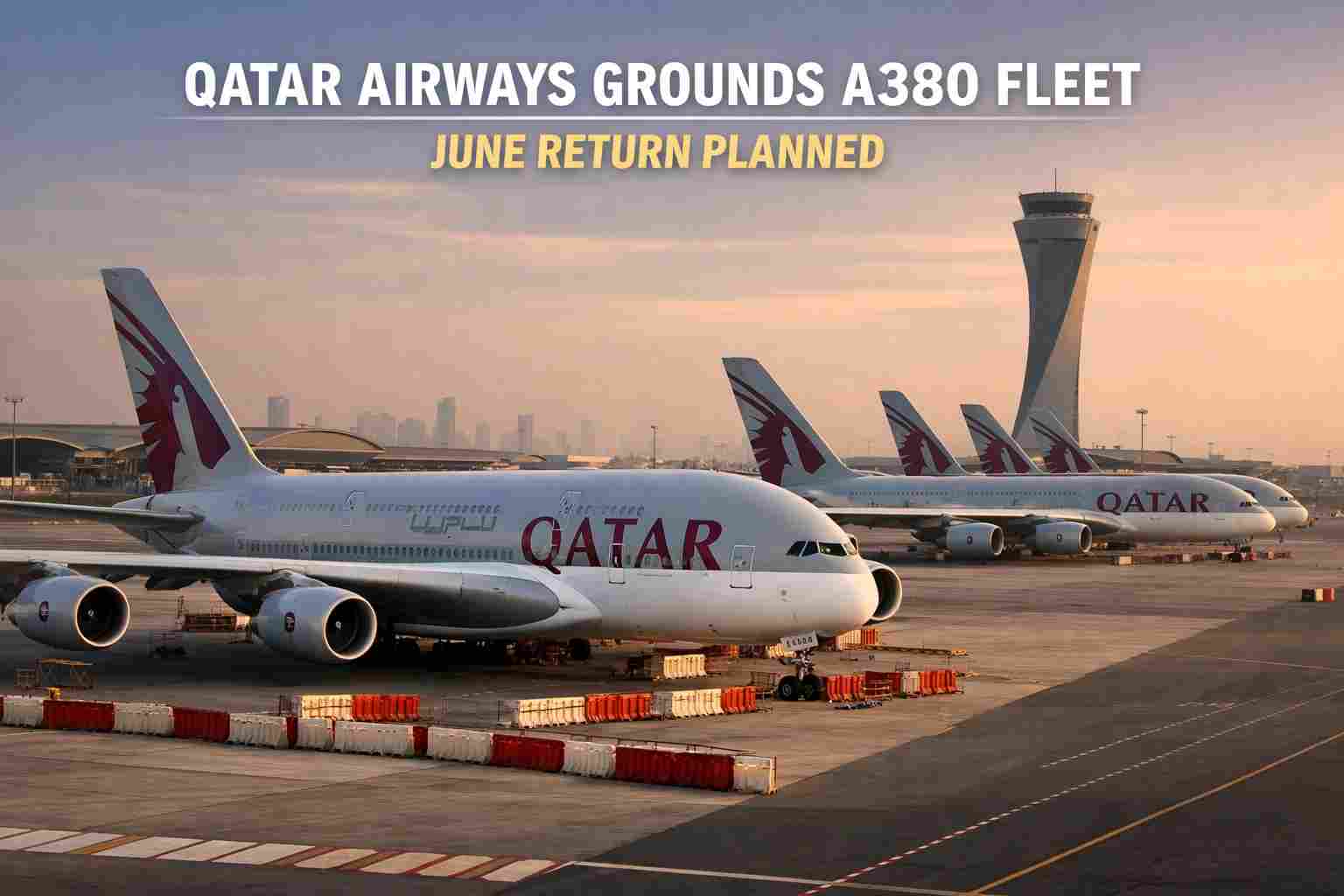
DOHA — Qatar Airways has grounded its entire active fleet of Airbus A380 aircraft and slashed more than 12,000 scheduled flights for April and May 2026, as ongoing regional disruptions force the Gulf carrier to significantly scale back operations.
The airline has suspended service to over 60 destinations during the two-month period, marking one of the most substantial capacity reductions in its recent history. All eight operational Airbus A380s are now parked at Hamad International Airport in Doha, according to current fleet tracking data.
Despite the widespread disruption, the airline is signaling a potential return for the superjumbo fleet, with a tentative restart date set for June 1, 2026, though that timeline remains subject to change.
Entire Active A380 Fleet Parked in Doha
Long-Haul Flagship Aircraft Temporarily Withdrawn
Qatar Airways operates a total of 10 Airbus A380 aircraft, though only eight have been in active service in recent years. Two aircraft, including A7-APA, have remained in long-term storage since 2020 and are not expected to re-enter commercial operations.
The remaining eight aircraft were in active rotation as recently as March 2026 but have since been progressively withdrawn and returned to Doha as the airline adjusted its schedule.
The A380, known for its 517-seat configuration and premium-heavy layout including first-class cabins, has been a cornerstone of the airline’s long-haul strategy, particularly on high-demand leisure and business routes.
Planned Comeback Begins June 1
Limited Initial Deployment Across Five Routes
According to schedule data from aviation analytics firm Cirium, Qatar Airways is planning a phased return of A380 operations beginning June 1, 2026. The current plan includes five departures from Doha on that date, targeting key long-haul markets.
However, the airline’s decision to extend refund offers through July has raised questions about whether disruptions could persist longer than currently anticipated.
The June restart, while significant, represents only a partial restoration of A380 operations and suggests a cautious approach as the airline evaluates market conditions.
Winter Schedule संकेत Partial Recovery
Capacity Still Trails 2025 Levels
Looking further ahead, Cirium data shows that Qatar Airways is planning 305 A380 departures from Doha across November and December 2026. While this marks a recovery compared to the reduced summer schedule, it still reflects a 22% decline compared to the same period in 2025.
Routes such as Bangkok — historically one of the airline’s busiest A380 destinations — previously saw three to four daily A380 flights during peak winter months. A return to similar frequencies is viewed as the most likely path for closing the capacity gap.
Even with the anticipated ramp-up, the airline appears to be taking a more conservative stance on deploying its largest aircraft.
Global A380 Operations Also Decline
Industry-Wide Contraction Reflects Broader Pressures
The pullback is not limited to Qatar Airways. Across all operators, global A380 activity has declined notably in recent weeks.
Scheduled two-way A380 flights for April and May 2026 total 12,449, representing a 7% week-over-week decrease. Much of that decline is driven by Emirates, the world’s largest A380 operator, whose services have dropped 14% compared to the previous week.
Etihad Airways has recorded a smaller weekly reduction of 2%, though its overall A380 schedule for April and May remains 16% below 2025 levels.
Meanwhile, Singapore Airlines is the only non-Gulf carrier to scale back A380 usage during this period, cutting 6% week-over-week after removing the aircraft from its Dubai route. The airline has not yet confirmed how it will redeploy those aircraft.
Outlook Remains Uncertain
While Qatar Airways’ planned June 1 restart offers a signal of recovery, the scale of recent cuts and ongoing regional instability suggest that a full return to normal operations could take longer.
The airline’s A380 fleet, once a symbol of capacity and luxury on major global routes, now reflects a broader recalibration underway across the aviation industry as carriers respond to shifting demand patterns and operational constraints.
For now, all eyes remain on early June, when Qatar Airways will attempt to bring its flagship aircraft back into service—marking a key test of both market recovery and operational resilience.
